Tag: Humor

  • Chase Two Rabbits, Catch None by Anton Chekhov: Summary and Analysis

    Chase Two Rabbits, Catch None by Anton Chekhov: Summary and Analysis

    No, this is not a treatise on efficient goal-setting. Or is it?

    Chase Two Rabbits, Catch None is a short story by Anton Chekhov that was first published in May 1880 in a magazine called Dragonfly. It is available as part of a short story collection published by New York Review books translated by Maria Bloshteyn.

    Chase Two Rabbits, Catch None: Summary and Plot Analysis

    Major Shchelkobokov is a proud owner of thousands of acres of land and a young wife Karolina. He overhears his wife’s more-than-friendly conversation with her cousin and comes to know that his wife has no love or respect for him. 

    Not only that, she considers him a mentally deranged, chronically drunk man who is no better than a peasant. 

    Naturally, the major is offended, and this newfound discovery keeps him up at night while he is frantic about finding ways to seek vengeance.

    He happens to have a conversation with his valet Panteley. He seems to be looking for information on whether beating someone’s wife was the right thing to do or if only people of the peasant class engaged in such behavior. 

    Panteley happily answers the question, adding that he regularly beats his own wife and that this practice had nothing to do with class. 

    A former Judge, where Panteley was employed earlier, used to clobber his missus and pound him too for good measure.

    He is convinced that this was the right thing to do. Choosing that as his plan to avenge his pride that had been hurt by his wife’s insult, he proposes a boat ride to his wife. The wife agrees, unaware of the husband’s intention. 

    As they get to the middle of the lake, the Major, seething with anger, takes the whip out to lash at her. Contrary to what he expects, though, the wife catches the whip and starts using that on her husband. 

    Being bald and unable to shield his head, he loses balance and the boat topples over.

    A man called Ivan, the Major’s former housekeeper, watching that incident unfold from far off, jumps into the river to save them. He soon realizes that it won’t be possible for him to save them both. Both Major and his wife try to persuade him to save one and leave the other to die. 

    Major offers to marry Ivan’s sister as a return to his favor of saving his life, while Major’s wife promises to marry Ivan, if he saves her instead. 

    Ivan, unable to choose from the two equally attractive offers, makes up his mind to save them both and reap the rewards.

    As soon as they get to the shore, the husband and wife resume their beating of each other, while the peasant girls crowd around them to watch. 

    Ivan later comes to know that he has been fired from his current job after the major pulled some strings while Ivan’s sister has been banished from Karolina’s apartment. 

    Ivan’s dreams of having Karolina as a wife and the major for his brother-in-law are shattered. Exasperated, he cries on the ghastly return gift for his kind deeds.

    “Oh, humankind”, Ivan Pavlovich kept repeating, as he strolled along the shore of the fateful lake, “Is this what you call gratitude?”

    Chase Two Rabbits, Catch None: Review and My Thoughts

    The story is hilarious. The Major is seething with anger on overhearing the conversation but seeks validation from his valet. His valet seems to him a good candidate, as he represents the peasant class. The conversation is sure to tickle your funny bones.

    Answer me straight, and don’t stammer! Do you beat your wife?

    Every single Tuesday, Sir.

    Very good. Why are you laughing? This is no joking matter.

    On being asked if this was something only peasants did to their wives, Panteley happily provides him an account of the same treatment doled out to a judge’s wife.

    He’d clobber his missus. He’d pound me too. Just for good measure.

    Just beat them, sir! There’s no two ways around it. Take my wife, for example. There’s nothing to do except beat her.

    The one below was an absolute show-stealer for me. What’s a climax without a twist?

    The major’s wife snatched the whip out of his hand and was just beginning to apply it. The major was just reminded of the fact that he had no hair to cushion this scalp. And then the boat overturned.

    I don’t know why, but just reading the title of the story somehow magically takes me to a mental image where I am jotting down my new year goals furiously.

    Someone in their right mind would learn from their mistake. Not me. I have managed to repeat the same mistakes every new year’s eve for the last twenty years. I loved seeing the characters in the story make the same mistake as me, although to a much-diluted degree.

    Misery loves company, doesn’t it?

    Being a doctor and a writer, Chekhov might have got something to do with his choice of such a topic to write on. This story is one of his early creations when he was training to be a doctor AND writing at the same time.

    He is known to have been a very compassionate medic and considered giving up the practice a great loss. The world knows and acknowledges his writing prowess. He is one of the most popular and prolific Russian writers ever.

    Contrary to Ivan’s experience in the story, Chekhov chased AND caught both the rabbits.

  • The Model Millionaire by Oscar Wilde: Summary and Review

    The Model Millionaire by Oscar Wilde: Summary and Review

    Has it ever happened to you that you tipped someone you shouldn’t have tipped in the first place, or that you asked a saleswoman for help who you thought was one, but was actually a shopper like you?

    Do you remember the look on their faces when you did that? It’s likely that they stared at you for a whole minute before they went their way, or were they one of those rare quiet angels who just shot you a broad smile and apologized for confusing you.

    I am sorry to I made you go down the memory lane, but I promise that you’ll soon know why.

    Without further ado Ado, Here is the model millionaire of Oscar Wilde for you.

    The Model Millionaire: Summary and Plot Analysis

    The story begins with an introduction to Hugh Erskine, affectionately known as Hughes. This guy is so charming that he could pull your socks off, but otherwise he is not very remarkable – neither intellectually nor financially.

    He lives on an annual allowance of two hundred pounds from his aunt. He was in love with a beautiful woman named Laura Merton and wanted to marry her.

    Laura’s father – a retired colonel, though he loved Hughes very much – would not hear of an engagement until he had ten thousand pounds.

    One day, on his way to the Mertons, he stopped to see his friend, a rather strange-looking fellow, but a brilliant painter. His paintings were very much in demand.

    Alan was busy painting a beggar when Hughie came into the studio.

    Hughie instantly expressed his amazement upon seeing the model but felt really sad for the beggar right after. He asked Alan if a model could make good money for a sitting, and was disappointed with Alan’s answer.

    Upon receiving a message that the framemaker had come to see Alan, he quickly excused himself asking Hughie not to go away. The beggar model took this opportunity to get himself some rest. He looked so forlorn that Hughie’s heart filled with pity.

    He searched in his pocket, found some money and thought the beggar needed it more than him, quickly went to him and put it in the beggar’s hands. He had to walk home because of this extravagance.

    Later that evening he met Alan in a club. He learned that the model had expressed great interest in learning more about Hughes and Laura.

    Overcome with pity, he asked Alan if it was okay to give the beggar his old clothes. Alan laughed out loud and told Hughes that the beggar was actually Baron Hausberg, who was one of the richest men in Europe and had to come to Alan to make his own portrait.

    Hughes was very embarrassed by the revelation and left shortly afterwards, leaving Alan in fits of laughter.

    The next day Baron Hausberg sent a messenger to Hughes. Hughes was convinced that this visit was meant for him to apologize to Baron for this terrible mistake the other day.

    Instead, the messenger brought him a sealed envelope.

    One with a check for £10,000 in it.

    On the outside was this message:

    “A wedding present to Hugh Erskine and Laura Merton, from an old beggar.”

    The Model Millionaire: Review and Quotes

    Cute little story, right?

    The story – as simple as it might seem, has one profound lesson- one that you have heard way too often:

    Do not judge a book by its cover.

    We see a pretty person and we instantly conclude them to be a certain personality (after going past the drooling-over-them stage of course). This story makes you question that.

    There are gems lying all around this beautiful story, here are a few that I particularly liked –  

    1 – Unless one is wealthy there is no use in being a charming fellow. Romance is the privilege of the rich and not the profession of the unemployed. The poor should be practical and prosaic.

    2 – It is better to have a permanent income than be fascinating

    Do you remember the book and its cover? Our films and television keep drilling this wisdom into our heads, don’t they?

    How often is the millionaire picked up by the charming boy?

    For many people, the idea of romance is the perfect holiday in an exotic place, a date in a fancy restaurant, parties in exclusive clubs and the like. Oscar Wilde was quite spot on with his observation back then.

    You can’t help but root for Hughes when he shows compassion for the beggar – admittedly he had no fortune or much intellectual capital, but his heart was in the right place.

    3 – Poor old chap, how miserable he looks ,But I suppose, to you painters, his face is his fortune?

    You artists are a heartless lot.

    Compassion and good looks – our Laura Merton hit a jackpot!

    4 – The old beggar as you call him is one of the richest men in Europe. He could buy all of London tomorrow without overdrawing his account. 

    That sudden twist when the beggar turned out to be a millionaire was an awakening jolt.

    The way his richness has been described brought back flashes of The Dark Knight, where Bruce Wayne accidentally walks upon Harvey Dent and his date at a fancy hotel. 

    A scene from The Dark Knight

    When they were married, Alan Trevor was the best man and the Baron made a speech at a Wedding Breakfast.

    Giving the beggar his souvenir prompted Hughes to go home that night, but the next mention of the beggar elicited nothing but sympathy from him. He also offered to give him his old clothes. He tried to help the old man in every way possible.

    One thing readily apparent from this is Hughie’s big heart but the other not so plainly seen is that one of the richest men in Europe did not take offence at being given alms. This is what an ideal world would look like.

    A world where the rich are not servants of their ego and the attractive people still have their hearts in the right place.

    Millionaire Models are rare enough, but, by jove, model millionaires are rarer still.

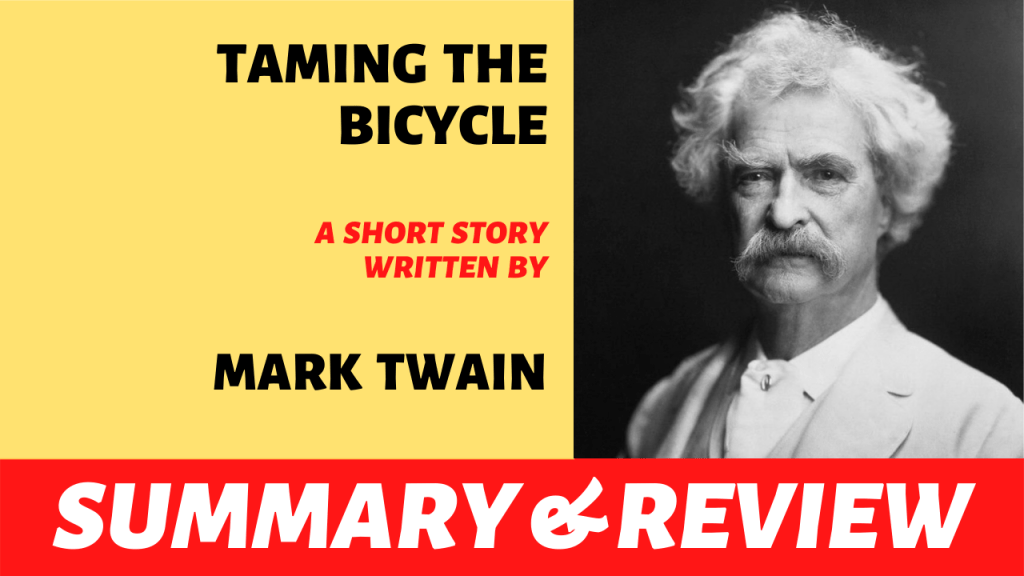
  • Taming the Bicycle by Mark Twain: Summary, Analysis and Review

    Taming the Bicycle by Mark Twain: Summary, Analysis and Review

    I wonder what your first thoughts were looking at the title of the story.

    Maybe a memory from childhood or a snapshot of some TV program where the protagonist ended up in a ditch, not able to control their bicycle?

    Well, just when you thought you had seen it all and laughed all you could at your bicycle misfortunes, Mark Twain brings you some of his own with Taming the Bicycle, published as part of his collection What is Man and Other Stories.

    Taming the Bicycle: Summary and Plot Analysis

    In the early eighties, Mark Twain learned to ride one of the old high-wheel bicycles of that period, the form of bicycle that has long been antiquated. Twain’s account of his bicycle adventures are far from it though.

    So Mr Twain saw an ad for a bicycle, thought he could do it and bought one alongwith a barrel of pond’s extract ( Guess what your friendly neighborhood Ponds cream was called back then!). He also hired an instructor from the company, who was to teach him the tricks to tame the wheely monster.

    Mine was not a full-grown bicycle, but only a colt – fifty inch – and skittish, like any other colt.

    The instructor explained a few key points and demonstrated how easy it was to ride one – mentioning that the tricky part was actually to dismount.

    Twain soon realized that it was contrary to his own experience.

    Although I was wholly inexperienced, I dismounted in the best time on record. He was on that side, shoving up the machine; we all came down with a crash, he at the bottom, I next, and the machine on top.

    One crash followed after the other and regardless of how Twain, the bicycle or the instructor were positioned at the start of practice, the end result was always the same – instructor at the bottom, bicycle on top and Twain sandwiched between the two.

    One of those practice runs even landed them in a hospital. Fortunately, the injuries were minor and Twain and his bicycle lived to tell the tale.

    Twain notes: I attribute this to my prudence in always dismounting on something soft. Some recommend a feather bed, but I think an Expert is better.

    The instructor was discharged from the hospital and shortly after, the practice sessions resumed – this time with four new assistants.

    Twain continued to struggle with this new learning experiments; skills required to master this craft always seemed to be at loggerheads with his natural instincts. Seeing the error of his ways, Twain realized that he needed to do the intelligent thing – he needed to evolve.

    The intellect has to come to the front now. It has to teach the limbs to discard their old education and adopt the new.

    He ultimately draws learning from his struggles with the German languages to conquer his new enemy – the bicycle.

    But I also see, by what I have learned of bicycling, that the right and only sure way to learn German is by bicycling method. That is to say, take a grip on one villainy of it at a time, and learn it – not ease up and shirk to the next, leaving that one half learned.

    He continues to work his way around the bicycles – to master balance, art of mounting, art of steering and art of dismounting – all of which result in rather funny endings, but not without great lessons – mostly comic.

    Mark Twain notes on the art of mounting: 

    Then the mounting art is acquired and a little practice will make it simple and easy for you, though the spectators ought to keep a rod off or two to one side, along the first, if you have nothing against them.

    And then the art of dismounting:

    Try as you may, you don’t get down as you would from a horse, you get down as you would from a house afire. You make a spectacle of yourself every time.

    After eight days of daily lessons, he is pronounced fit to paddle a bicycle without outside help. He tries to refute the argument that he could have done it himself without instruction by saying that such a  move could have been risky for him considering his natural clumsiness. 

    Consider his thoughts on a self taught man, for example:

    The self taught man seldom knows anything accurately.., and besides he brags, and is the means of fooling other thoughtless people into going and doing as he himself has done. There are those that imagine that the unlucky accidents of life – life’s experiences – are in some way useful to us. I wish I could find out how. I never knew one of them to happen twice. They always change off and swap around and catch you on your inexperienced side.

    He concludes that receiving proper instruction could have more than one benefit and in case of cycling, that added benefit could be saving up on Pond’s extract.

    So the instructor, after asking a few questions about his strength and receiving unsatisfactory answers, eventually leaves him with the advice to keep practicing.

    Then he left me, and I started out alone to seek adventures. You don’t really have to seek them – that is nothing but a phrase – they come to you.

    Devoid of the encouragement from the instructor and his assistants, Twain takes a rather solo journey of  learning the bicycle. However unbeknownst to him a boy  gives him company in his adventure, though not in the form he expected. He paints a rather funny picture of this boy and the way he supported him through his practice sessions.

    He was full of interest and comment.The first time I failed and went down he said that if he was me he would dress up in pillows, that’s what he would do.The next time I went down he advised me to go and learn a tricycle first. The third time I collapsed he said he didn’t believe I could stay on a horse-car.

    Of course, Twain does not let this teasing get to him, he continues on with his practice sessions marvelling at how the bicycle has exposed unknown areas of the path he had been using for years. Little stones, cats, dogs, anything that came along his way, was bound to make him lose control and bite the dust, his falls usually resulted in injuries to him, while the bicycle stayed indestructible. 

    Dogs eventually presented a bigger challenge than the stones on the path:

    They all liked to see me practice, and they all came, for there was very little going on in our neighborhood to entertain a dog. It took time to learn to miss a dog, but I achieved even that.

    Twain leaves us with a little bicycle wisdom as well:

    Get a bicycle. You will not regret it, if you live.

    I am afraid I can say the same for this essay by Mark Twain. Grab your copy and read it now!

    Reading this essay, in addition to grinning like an idiot when not guffawing like one, I couldn’t help but think of my initial bicycle learning days when I was a kid looking like the Vitruvian man both when sitting on and falling off my bicycle, calling my mom every time I mounted or dismounted it.

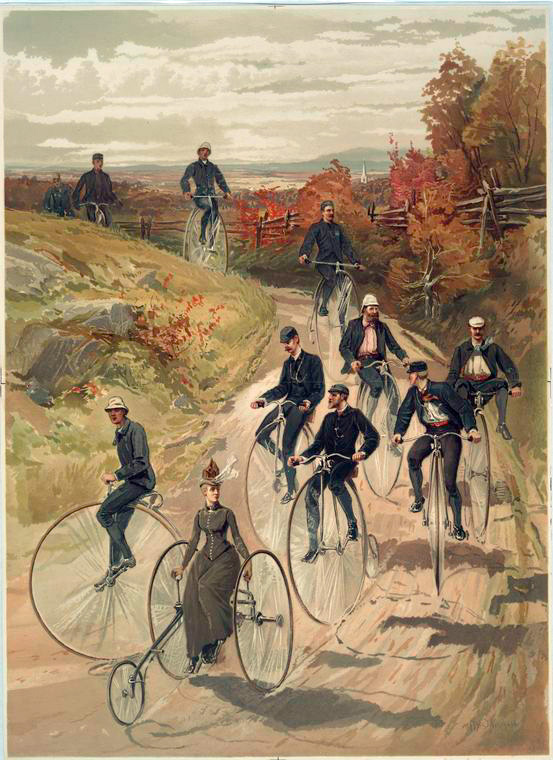
    I thought my days were hard, but when I looked at this picture to see the bicycle Twain conquered, my own traumatic ‘bicyclical’ past faded away.

    Mark Twain and his bicycle are my new favorite , and there ain’t gonna be no dismounting that bookshelf soon.

    The bicycle Mark Twain was trying to tame.

    P.S. Assuming that I was able to convince you to read Taming the Bicycle by Mark Twain, and you eventually were able to find time to do so, what section did you like the most?

    Did anything from the story remind you of your own bicycle adventures?

    We would love to hear from you! 

  • The Canterville Ghost by Oscar Wilde: Summary and Analysis

    The Canterville Ghost by Oscar Wilde: Summary and Analysis

    The Canterville Ghost is a short story written by Oscar Wilde. It was first published in 1887. Unknown to many, this was his first published prose fiction work.

    Contrary to what the title of the story may suggest, this is a humorous story at the core of which lies the differences in the American and British culture.

    The Canterville Ghost: Plot Summary and Analysis

    Mr. Otis , an American minister, was looking to buy Canterville Chase, a castle that  belonged to Sir Canterville. The castle was not inhabited by the Canterville family for decades now, the reason being that it was believed to be haunted.

    Sir Canterville declared this upfront to Mr Otis, who discarding the haunted castle rumors offered to buy both the castle and ghost – at valuation.

    Mr. Otis moved into the castle with his wife, his son (Washington), his daughter (Virginia) and his two younger twins and were greeted by the castle housekeeper, Mrs. Umney.

    They noticed the blood stain in the hall and Mrs. Umney let them know that it was from when Sir Canterville brutally murdered his wife.

    The family was far from spooked by this – rather proceeding to grab their cleaning supplies to scrub that spot right off the floor.

    The stain came right off.

    The following days, the blood stain re-appeared – although what was noticeable was that blood stain had different hues each time.

    The family finally accepted there might be some truth to the rumors, but still went about their business as usual.

    The ghost finally made an appearance one night and Mr Otis was the one to see him, but instead of being scared – he requested  that he put some oil into the chains so that he didn’t make so much noise while walking around in the night.

    The ghost was surprised, as this was not the normal reaction he was accustomed to. Never in a brilliant and uninterrupted career of three hundred years, had he been so grossly insulted.

    Taking this as an insult to his natural scaring power, he took it upon himself to make even bigger spectacles – what went on in the following days was actually opposite to what he imagined.

    The kids attacked him pea shooters, and played elaborate pranks on him – on one occasion even scaring with a replica skeleton. Insulted and tired, the ghost eventually retired to his own room – feeling even more depressed.

    Viriginia, Mr Otis’ daughter found him one day and was pained to see the ghost, visibly sad and distraught – who told her that he was very tired and had not slept in three hundred years.

    He asked for her help – knowing that she had a compassionate heart – unlike the rest of her treacherous family.

    She agreed to help him, although she was terrified of what lied ahead. They disappeared into a garden of death. 

    Desperate search ensued to find Virginia – who was nowhere to be found. The family was distraught, as was the Duke of Cheshire, who had been courting Virginia for quite some time now.

    Her mother was on the verge of a nervous breakdown, when Virginia finally came back to the house. She let the family know that Sir Simon Canterville, the ghost, was now at rest.

    The ghost, in turn, had left her a box of rare jewels as a gift for her help.

    Although Virginia never told anyone what happened in the garden of death, she always remembered Sir Simon with love and was thankful for sharing the wisdom:

    Love is stronger than life and death.

    Want to read The Canterville Ghost?

    The Canterville Ghost is a short story which is published in a collection of short stories. You are welcome to use the links given below to check the price of this book:

    Check Price on Amazon US
    Check Price on Amazon India

    The Canterville Ghost: Review and My Thoughts

    The story is a delightful read – more so because it did not turn out to be a tale of horror – which if truth be told, I do not have a stomach for.

    Although the story still had a very profound message at the end, it was the characteristic humor that stood out for me.

    So, you are buying a house and the first thing someone told you was that it was haunted.

    What would your reaction be?

    Mr Otis’ reaction on hearing this news was priceless.

    I will take the furniture and the ghost at a valuation, answered the minister.

    I wonder what Sir Canterville would have thought in his head, when he listened to that.

    Not only that, he made it plainly clear that an incident or a commodity of that nature, if known in America, would be a rage.

    I reckoned if there were such a thing as a ghost in Europe, we’d have it home in a very short time in one of our public museums, or on the road as a show.

    Thinking that Mr Otis was not able to fully understand the gravity of situation at his hand, Sir Canterville made another attempt to explain.

    The ghost has been well known for three centuries and always makes an appearance before the death of any member of the family, 

    To which Mr Otis, quickly remarked – So does the family doctor for that matter

    One hell of a lesson in lateral thinking, isn’t it?

    There is no such thing as a ghost and I guess the laws of nature are not going to be suspended for the British Aristocracy.

    Quite a jab at the British aristocracy there! 

    British never seem to have seen eye to eye on their language:

    … We really have everything in common with America nowadays, except of course, the language.

    The story is replete with differences in the British and American culture, a product, I suppose, of Wilde’s experiences in America on his lecture tours there. He pays a little homage to H.W. Longfellow as well, a celebrated American poet.

    Consider this –

    He had hoped that even Modern Americans would be thrilled by the sight of a spectre in armour, if for no more sensible reason , at least out of respect for their national poet Longfellow, over whose graceful and attractive poetry he himself had whiled away many a weary hour when the Canterville were up in town.

    Although this was a ghost story, I was still surprised to know that our ghost had actually killed his wife (I know people can be stupid, right?) for a reason that was even more surprising than the act itself – she was plain looking and didn’t cook well.

    But having been rebuked by Virginia for that, he simply responds with-

    Oh, I hate the cheap severity of abstract ethics. 

    Made me think.

    That is after picked myself up from the floor laughing.

  • A Helpless Situation by Mark Twain: Summary and Plot Analysis

    A Helpless Situation by Mark Twain: Summary and Plot Analysis

    Have you ever been in a situation when you were approached by a distant relative of a friend of a friend’s friend, whom you don’t know and have never heard of before, and they asked you for a favor?

    If so, A Helpless Situation by Mark Twain is sure to take you for a stroll down the memory lane with the added bonus of his wit and humor.

    A Helpless Situation: A Brief Summary

    In this short story, published as part of his collection The 30000 Bequest, he recounts his past experience of dealing with people asking him for favors just because he knew their relatives at some point in his life – whom he doesn’t clearly even remember now.

    He responds to the request via a letter, a letter wherein he mentions a hypothetical conversation with his publisher about a recommendation for the ‘seeker’ (for the sake of simplicity, let’s call this person a seeker)

    He refers to the letters that he receives asking for favors, talking to them in complete disbelief, clearly mocking the senders of those artifacts.

    “I have seen you a thousand times, you always look the same way, yet you are always a wonder, and you are always impossible; to contrive you is clearly beyond human genius – you can’t exist, you don’t exist, yet here you are!”

    Mark Twain is amazed by the extent these distant relatives of friends go to seek favors, knowing fully well that there is no way for the ‘influential’ person to actually know anything about them to provide a recommendation. The criterion for them to reach out is simply that the person should be influential.

    “In a word, to every person who is supposed to have influence. It always follows the one pattern : “You do not know me, BUT YOU ONCE KNEW A RELATIVE OF MINE.”

    He expresses helplessness in this situation also indicating that someone keen and talented would not be resorting to such means.

    Well, there is not a thing we can do that would be a help, for not in any instance does the latter ever come from anyone who CAN be helped.

    His logical stance to describe his helplessness is no less humorous than it is eye-opening (for all of us seekers out there!)

    The tribute to Mr Twain’s funny take cannot be over without reproducing at least a portion from the letter he sends to the seeker eventually hypothesizing the conversation that might have happened if he decided to send the recommendation.

    So, here goes:

    Publisher: She must have thought that you knew her literature and could speak for it. Is that it?

    Twain: No, she knew I didn’t.

    Publisher: Well, what then? She had a reason of some sort for believing you competent to recommend her literature, and also under obligations to do it?

    Twain: Yes, I knew her uncle

    Publisher: Knew her uncle?

    Twain: That isn’t all, there are other ties. I know the cabin her uncle lived in, in the mines, I knew his partners, too; also I came near knowing her husband before she married him.

    The comedy doesn’t end here though. 

    Publisher: How can you know it when you don’t remember it?

    Twain : I don’t know. That is, I don’t know the process, but I do know a lot of things that I don’t remember and remember a lot of things that I don’t know. It’s so with every educated person.

    Publisher: Is your time valuable?

    Twain: No. Well, not very.

    Publisher: Mine is.

    Not all of us have the wit to reply to a distant relative of a barely known friend asking us favors the same way as Mark Twain, but now thanks to A Helpless Situation, we do know how to tell them where to go, without actually saying the words.