Tag: Humor

  • The Exclamation Mark by Anton Chekhov: Summary and Analysis

    The Exclamation Mark by Anton Chekhov: Summary and Analysis

    In the closed eyes of a dozing Perekladin, a fiery comma flew like a meteor. The golden commas spun around and raced off to one side. They were replaced by fiery periods.

    This excerpt is from Chekhov’s short story Exclamation Point and is one of his earlier works, published way back in 1885. It is also available as part of a short story collection called Fifty Two stories published by Alfred A Knopf, translated by Richard Pevear and Larissa Volokhonsky.

    Punctuation marks were my regular tormentors for a good two months of my primary school student life. This was a painful reminder of those times of my life. 

    Oh, those commas, colons, and semicolons. In that, my torments were quite similar to the ones of Perekladin, but that’s where the similarities end. His story is way more fun than mine. Let’s get on with it.

    The Exclamation Mark: Summary and Plot Analysis

    Efim Fomich Perekladin is a collegiate secretary who is extremely pissed at the treatment meted out to him earlier that day at a party. A conversation on the importance of education pops at the party, and he ends up being a subject of conversation. 

    Efim, having a good post in government, is asked about the kind of education that he received.

    For us, No education is needed

    And where did you learn to write correctly?

    Habit, sir… After forty years of service, you get a knack of it.

    Embarrassed by Grisha’s response, the young man underlines the importance of a conscious understanding of language and discounts his understanding of education. 

    This unconscious reflex orthography of yours isn’t worth a kopeck. It’s mechanical production and nothing more.

    Being the highly-placed government official that the young man was, Grisha chose to smile and stay silent. He was seething with anger inside. 

    Later that evening, when he gets home looking disturbed, he explodes on his wife when she asks him about the reason he looked gloomy.

    Stop bothering me, you she-devil!

    He replays the conversation in his head and feels angrier. After all, who was the young man to think that Efim’s education was mechanical and nothing more?

    Unconscious Mechanical Production! Ah, you, devil take you! Anyhow, maybe I understand more than you do, even if I didn’t study in your universities.

    He marinates himself in that line of thoughts so much that he starts dreaming of punctuation marks. He was desperate to prove that he knew where each of them applied.

    They (question marks) are always used when there’s a request to be made or let’s say documents are being examined. 

    First the commas, then the periods, semi-colons, colons, he vividly imagined them all and felt triumphant placing them all correctly till he hit a snag with an Exclamation point. He had no clue where to use it, having never used it once, in 40 years of public service. 

    Devil take them.. When should they be used? Is it possible that I have forgotten or have I simply never used them? When does the long devil get used?

    Completely clueless, he reaches out to his wife for help. After all, she boasted about completing boarding school. She would know!

    Do you know , sweetheart, when to use exclamation points in documents?

    The answer from his wife surprises him. The exclamation point is a punctuation mark to use when expressing happiness, indignation, joy, anger etc. What use was such a thing! Why would a government official feel the need to use it? When would it ever be warranted?

    For forty years, he had been writing documents, he had written out thousands but didn’t remember a single line that expressed delight of any sort. But is there a need for feelings in documents? Even a man with no feelings can write them out.

    Exclamation points still completely crowd Efim’s imagination; he sees them everywhere. Since he hasn’t used them yet, they will just not leave him. 

    Overcome with the impulse to use the punctuation mark, he settles down at his desk and writes his name followed by an exclamation point, feeling jubilant at finally making the exclamation points vanish.

    Collegiate secretary Efim Perekladin!!! “There, take that! Take that!”

    The Exclamation Point: Review and My Thoughts

    The story was hilarious, I loved it immensely, but I have to admit, I did feel a little bit of regret for not having come across this before. It’s loaded with content that would have benefited me greatly. Oh! What would I have not given to understand the punctuation sooner (barring the peanut butter jelly sandwich lunch of course!). 

    I loved the story for many reasons – the childish fixation of an old man, the vivid imagery of the same old man, and his latent OCD, of course! 

    He was even treating the punctuation marks as people or ghosts in his imagination, to the extent of having conversations with them! 

    For him, somehow, the idea of education was totally reduced only to writing and then just the punctuation marks. I found it cute that instead of just hurling insults at the young man, in absentia, he was trying to prove to himself that he knew. 

    Efim Perekladin taught me many things – the most important of them being:

    Don’t shy away from using emotions that warrant exclamation points!

  • In a Foreign Land By Anton Chekhov: Summary and Review

    In a Foreign Land By Anton Chekhov: Summary and Review

    You are talking to a friend from a different country. And suddenly, he mentions something about your country that makes your jaw drop. 

    Your friend seems sensible enough in all other areas of his life. You wonder to yourself: maybe just this one time, I would let it slip. 

    Some days pass, you meet again, and he does that again. You get curious but still not mad enough to confront him yet. You let it pass. Well, surprise, surprise! He does it again! What would you do?

    Say, they do this not every few weeks, but with every conversation they have with you. What would you do then? 

    Let’s add another little twist. Your friend pays you so he can insult you and your country. How far would you let him go without flinching (assuming that you still mean to be friends)?

    Just take this scenario and marinate it in a little Chekhov humor, Voila! –In a Foreign Land

    Nobody likes French mustard, except maybe the French.

    This excerpt is from Chekhov’s short story In a Foreign Land. The story is a hilarious take on cultural differences in Russia and France, captured through the means of a dialogue, bordering on a monologue, between a Russian landowner and his French employee/tutor. 

    The story is one of his earlier works and was published way back in 1885. It is also available as part of a short story collection called Fifty Two Stories published by Alfred A Knopf, translated by Richard Pevear and Larissa Volokhonsky.

    In a Foreign Land: Summary and Plot Analysis

    The story opens in a dining room at lunch with what seems like a monologue between a landowner called Kamyshev and a French tutor in his employ, Shampooing. 

    The duties of a former tutor are not complicated. He has to dress decently, the smell of perfume, listen to Kamyshev’s idle talk, eat, drink, sleep – and that it seems, is all. In return, he receives room, board, and an unspecified salary.

    What seemingly begins as a generic conversation between two adults from a different cultural setting, seems to convert into a ruthless racial slurring episode quickly. 

    Kamyshev goes on to insult everything French – their food, their land, their bookish intelligence, their morality, their family values, everything! The guy leaves nothing on the table. Nothing!

    Nobody likes French mustard, except maybe the French. But a Frenchman will eat anything you give him: frogs, rats,cockroaches-brr!

    Well, what is France, honestly speaking? A little scrap of land! Send our policemen there, and a month later, he will ask to be transferred: there’s no room to turn around.

    I remember reading somewhere that you all have an intelligence acquired from books, while ours is inborn.

    With us, whoever marries, cleaves to his wife and there’s no more talking, but with you devil knows what goes on. The husband sits in a cafe all day, and his wife infests his house with Frenchmen and cancans away with them.

    One must be impartial. Pigs are pigs.

    Shampooing takes offense, and understandably so. He asks Kamyshev to relieve him of his duties and let him leave Russia to go to France. He goes and packs up his belongings.

    Even an enemy couldn’t have come up with a worse insult to my feelings than you have just done! All is finished!

    At this time, dinner is served, Kamyshev is eating alone and is overcome with a thirst for idle talk. He doesn’t have Shampooing to have a conversation with. He enquires the servant of his whereabouts and being told that he is all set to leave, goes to pay Shampooing a visit. 

    Kamyshev jokes about having lost Shampooing’s passport. Shampooing expresses his pain at France being insulted that way but admits to being attached to their family and Russia. 

    Kamyshev, hooking on to that bait, succeeds in making up with him.

    Why on earth should you be offended if I denounce the French? We denounce all sorts of people – should they all be offended? Take my other tenant. I call him this and that, Yid and Kike, pull him by the whiskers.. He doesn’t get offended. (Philosophical fallacy)

    It doesn’t even take a meal before Kamyshev repeats the same behavior he apologized for.

    The first course is eaten in silence. After the second, the same story begins, and so Shampooing’s sufferings never end.

    In a Foreign Land: Review and My Thoughts

    Now, what begins as a seemingly harmless and playful conversation doesn’t take long before taking a turn for the worse. Kamyshev is obviously aware that his behavior hurts the Frenchman, but doesn’t do anything to address his discomfort. If anything, he adds on more. 

    He obviously cares enough not to let him go and risk losing his only listener. Maybe making fun of other people doesn’t satisfy the quota of sadistic pleasure he derives from torturing people less well off than him.

    Poor Shampooing (I wonder if the naming was deliberate here!) seems like a prisoner of his circumstances. He makes a pretty decent living doing nothing but accompanying Kamyshev on his meals and listening to his idle banter or his insults. Is money fair compensation for the constant insults thrown his way? Does comfort mean more to him than his ego? Or is he really attached to his captor?

    I don’t know; I wasn’t able to decide. 

    What I do know is that, unfortunately, this was not just an 1885 problem when the story was written. It’s a much bigger problem now. 

    With more and more immigrants calling a new country their home with every passing year, the problem is exponentially magnified. And Kamyshev has taken many forms – the governments, the employers, the citizens.

    Hidden in this fantastic story is a great lesson:

    Don’t be a Kamyshev because in this day and era of frequent international turbulence, the day you could be Shampooing may not be far.

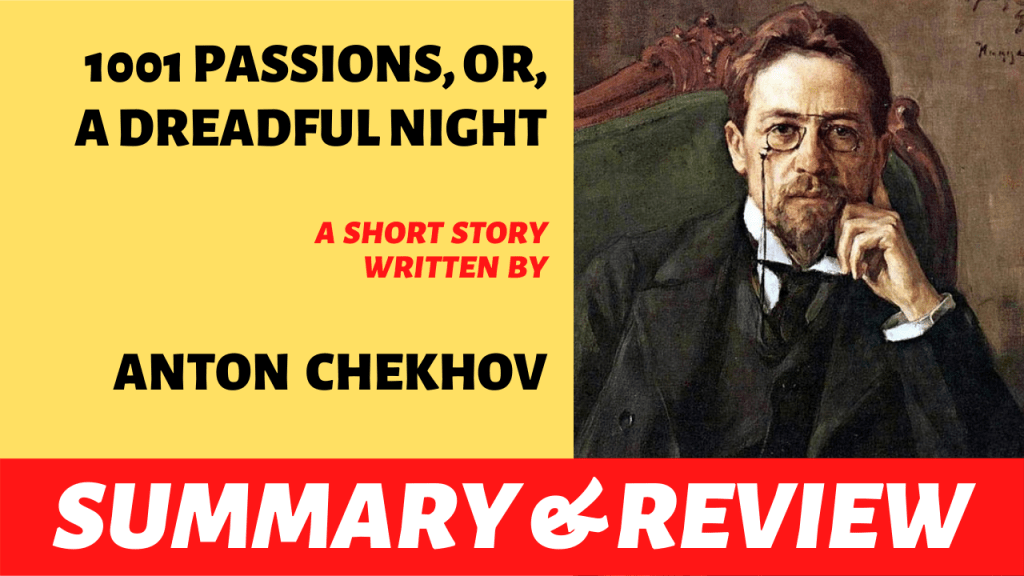
  • 1001 Passions, or a Dreadful Night by Anton Chekhov: Summary and Review

    1001 Passions, or a Dreadful Night by Anton Chekhov: Summary and Review

    Yesterday my second son was born, I was so happy I hanged myself.

    I read this, and I was completely creeped out. What! Really? Until the dormant little me kicked in, saying it could have been a dream.. and yes, it was. Thankfully! Not mine, but of the protagonist from Chekhov’s short story 1001 Passions or a Dreadful Night. 

    The story was first published in July 1880 in The Dragonfly. It is now available as part of a short story collection called ‘Prank’ published by The New York Review books translated by Maria Bloshteyn.

    1001 Passions or a Dreadful Night: Summary and Plot Analysis

    The story opens in a somewhat surreal setting at midnight. It’s raining heavily, and thunder leveled buildings around. The wind is howling, and a meteor shower is happening at the same time. A bell tolls ominously somewhere distant, and the elements are at battle with each other. 

    The protagonist Antonio is out with Theodore, husband of a woman Antonio loves. He plans to kill Antonio and have his wife all for himself. He kills both Antonio and the coachman by pushing them onto a volcano and falls to the ground weeping.

    Antonio then goes to see the woman at her apartment, kills the maid. The woman gets to see the death of her husband in Antonio’s eyes and falls in love with her. She then asks Antonio to forgive the enemies that he killed. They are blessed with a baby boy who looks like his mother, and then have a second one shortly after. It was later revealed that all of it was a dream.

    See for yourself!

    My little boy reaches out his hands to the readers, exhorting them not to listen to his Papa. His papa had no children, his papa had no wife. His papa fears marriage like the plague. My boy doesn’t lie. He is an infant. Believe him. Infancy is a holy age. None of this ever happened…. Good night.

    1001 Passions or a Dreadful Night: Review and My Thoughts

    The story was absurd to begin with. None of it was making any sense, and that made me more and more restless. It was bizarre (and surreal?)

    There was a bit Kafkaesque glimmer somewhere, and then it went too far to sound real anymore. The story was super absurd and fast-paced, but there were so many poetic expressions, I found myself fan-girling over.

    Rain and snow – those two sodden brothers – battered our faces with terrible force.

    Who doesn’t tremble before nature’s grandeur?

    The elements battled each other. Unseen forces strove to achieve a terrifying harmony of the elements. What are these forces? Will mankind ever know them?

    Death is both fetters and freedom from fetters

    The gaze is the sword of the soul.

    The groaning of the wind – what is it but a conscience groaning under the weight of horrific crimes?

    Dreams are fascinating, but of course! You don’t need someone else telling you that; you already know! However young or old you are, there would have been occasions where you would have recounted your dream in front of a close friend or a family member, beginning with ‘I had the weirdest dream!’. 

    I have done that too, but not lately, not since my brother has become intelligent enough to start policing me on it. ‘ Who doesn’t have weird dreams, come on!’. 

    He’s got a point, but I don’t tell him that.

  • In a Train Car by Anton Chekhov: Summary and Review

    In a Train Car by Anton Chekhov: Summary and Review

    Travel is so delightful. You get to know people so quickly and so well. So intimately, when you travel. I just adore travel!

    Being a colossal travel freak, I found myself nodding like crazy when I read this, and it is never a dull ride with Chekhov on the side! ( Sorry, bad rhymes! I couldn’t resist.)

    Prepare for a short but very delightful journey with Chekhov’s short story called In the Train Car. 

    The story, published in March 1880 in The Dragonfly, was considered by his family to have been the first one. It is now available as part of a short story collection called ‘Prank’ published by The New York Review books translated by Maria Bloshteyn.

    In a Train Car: Summary and Plot Analysis

    The story is set on a train journey from fun-crash station to save-yourselves-if-you-can station. See a theme right from the start, don’t you?

    Our protagonist, counting his sins in his mind and peering out of the train, feels someone trying to pickpocket him. He confronts the man, and the situation is resolved quickly, no-fuss. 

    As soon as the train halts at the next station, passengers cram the restaurant at the station.

    The scene inside the train is busy and no less interesting. One man is crying about socks and shoes stolen off of his feet, and the policemen nearby asking him not to create a ruckus instead of finding the thief. 

    There are a bunch of fare-beaters on the train – ones that prefer paying the conductor directly rather than buying the Railways ticket. There are couples separated at the station, the separated spouses running back while fellow passengers throw their belongings out – to help them, of course! Only to have the separated spouse come back again looking for their items. Some people are sitting in the wrong train.

    One word description that would fit the scene: Pandemonium.

    In a Train Car: Review and Quotes

    I loved this story, mainly because it was a nostalgic trip down memory lane. The portrayal is so fresh and vivid and, needless to say, so relatable. I was pleasantly surprised to read that there were these so-called farebeaters in Russia too!

    It’s a fine thing to be a fare-beater, dear reader! They(passengers) don’t have to line up to buy it, they don’t have to show it, and the conductors are more polite to them to boot! Everything you could possibly wish for!

    I have had my fair share of trips through train stations infested with pickpockets, losing my purse on one unfortunate occasion at a busy station. The book brought that memory back to haunt me, albeit much more dramatically than my personal experience.

    A stranger in a straw hat and a dark grey shirt runs past. He is clutching a suitcase. Oh my God, it’s mine!

    Also I can remember quite vividly how scared I used to feel every time my father would leave to get refreshments at a station, worried that he might be left behind. Through the window, I would peek as far as my vision would let me, scanning for the presence of my father! 

    The separation of Pakhom and Petrovna in the story was spot on! It was hilarious that Petrovna’s friend threw all her belongings out the train in the hope that she is able to find it – only to see her return to the carriage and curse the living storm out of her.

    You are a witch, a regular witch, Lord forgive me! What do I do now? Why didn’t you throw your own bag out? Or your ugly mug? I hope your guts crawl out of you!

    And then you have all sorts of eaters in the train – some that go through the whole journey, without taking anything else much other than air, and there are others, who wont let go of even a moment without chewing something or the other.

    Here’s a Chekhovian variety eater.

    He struggles to reply, He has got a fossilized sandwich stuck in his throat.

    And there is always one completely clueless man or woman who has the wrong ticket for the wrong date and destination. Here is one from the story, who starts bawling the minute the controller tells him that he is going in the wrong direction. The passenger’s response and the controller’s way of consolation add further to the comic element of the setting of this story.

    Don’t cry! Ask for help! Look at the size of you, you big blockhead – bawling like a baby! You’re probably married with children,and just look at you!

    There is so much to love about this story and more so, if you have ever happened to enjoy a train ride, preferably a sketchy one. Chekhov can find humor anywhere.

    I go back to my car, number 224. Everything’s the same : darkness, snoring, stale tobacco and rotgut- this is Russia alright.

    Time to book that train ride, eh? 

    Better with Chekhov than without.

  • A Letter to a Learned Neighbor By Anton Chekhov: Summary and Review

    A Letter to a Learned Neighbor By Anton Chekhov: Summary and Review

    For if man, the ruler of the world, the smartest of all breathing creatures, descended from the stupid and ignorant ape, then we would have a tail and a beastly voice.

    It sounds like something an innocent kid might ask before having been introduced to evolution. Or probably a very, very older person, whom you may have had the pleasure of talking to. 

    Well, in this specific case, this is an old and conceited landowner from Chekhov’s short story called A Letter to a Learned Neighbour. 

    The story, published in March 1880 in The Dragonfly, was considered by his family to have been the first one. It is now available as part of a short story collection called Prank published by The New York Review books translated by Maria Bloshteyn.

    A Letter to a Learned Neighbor: Plot Analysis and Review

    The story opens with a certain landowner, Vasily Semi-Bulatov, writing a letter to his neighbor, who seems to have earned a name for himself in the field of science. He begins with introducing himself to his neighbor, and the very outset belittles himself.

    A whole year has passed by since you settled here neighboring me, and insignificant nobody, and you are still not acquainted with me, pathetic flittering insect that I am.

    After offering all sorts of praise to his neighbor in his letter, he begins to express his reservations on the Scientific findings and goes on to say how distressing they are to him outright.

    Every (scientific) discovery torments me like a sharp nail hammered into my back.

    His letter is laden with spelling mistakes, exposing his boorish manner. He goes on, at length, at the so-called scientific findings that don’t make any sense to him. His reasoning for attacking such scientific findings is infantile. 

    Definitely chuckle-worthy. Consider, for example, these gems of wisdom from the old man.

    I can not stomach it in silence when scientists reason incorrectly about the night’s loominary, that is, the moon, which replaces the sun for us during the hours of darkness, when people sleep, while you are conducting electricity from place to place and fantasizing.

    (How) Could people live on the moon if it exists only during the night and disappears during the day?

    How could you see spots on the sun when you can’t even look at it with plain eyes?

    In the winter , day is short because , akin to other objects, visible and invisible, it shrinks from the cold, as the sun sets early, while the night expands from the illumination of fixtures and streetlamps because it warms up thereby. I have made many discoveries like this but have neither any award or certificates to show for it.

    Now, you might brush his ignorance aside; it seems pretty harmless, but wait till you find out that his old man considers himself a man of science when making such scientific observations that he does not have certificates and diplomas to show for.

    The letter ends with an invitation to his neighbor to come to visit their family and to bring along some clever books for her emaniseepated daughter to enjoy. 

    He also has specific instructions for the neighbor around the timing of the delivery of the letter. The learned neighbor had to make sure to slap the steward across the face if the letter was delayed beyond the specified time. 

    The old landowner doesn’t sound like an easy master, definitely quick to exercise his authority over those in a lower rung of society than him. 

    This letter should be delivered to you by my steward Trofim exactly at eight in the evening. If he brings it later than that, give him a couple of good slaps across his face, professional style.

    And as if hell-bent on exposing his true nature, and his characteristic boorish stupidity, he signs the letter with:

    I remain respectfully yours, the retired non commissioned officer of the Don Cossack Host, member of nobility, your neighbor – Vasily Semi-Bulatov

    The element of irony that Chekhov loves so much is readily apparent in the story. 

    Vasily is a pompous buffoon, making scientific observations based on nothing but his own whims and fancies with significant blunders in spelling, syntax, and diction. 

    All of that, to sound knowledgeable, boast of his credentials to get in the good books of his learned neighbor.

    It was fun to find out that this story used to be a skit that Chekhov performed for his guests. One where a third-rate professor goes on about his scientific discoveries in public. This character became Vasily Bulatov. 

    Another fun fact that I got to know was about the correspondence from the publisher.

    After submitting the story to The Dragonfly, he received feedback from the publisher “not bad at all” followed by invitation to contribute more stories. 

    Say what you will about publishers, but this one seemed to have a head over his shoulders.