Tag: emotional

  • Hell Is The Absence Of God: Summary, Analysis and Review

    Hell Is The Absence Of God: Summary, Analysis and Review

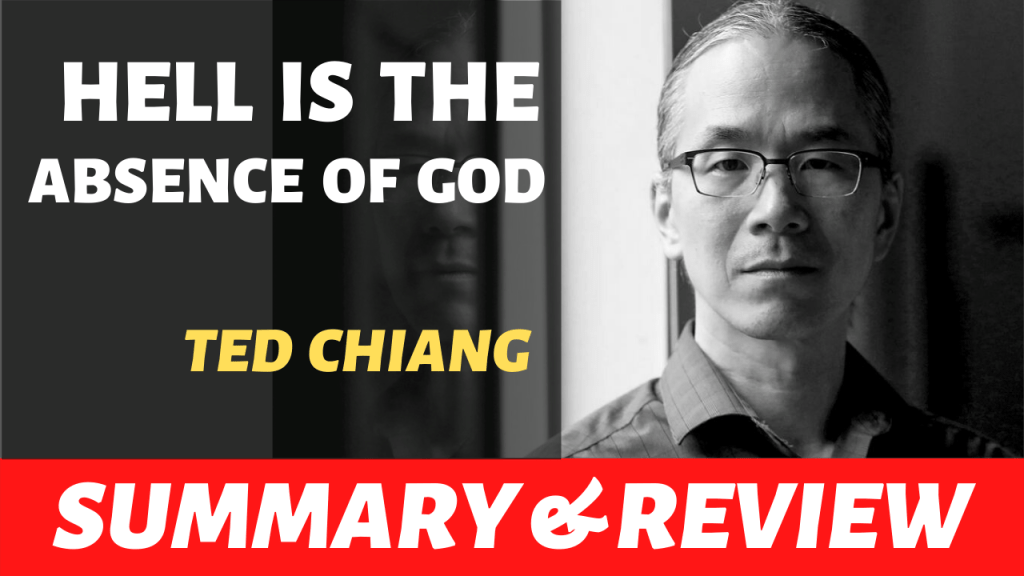
    Hell is the Absence of God is a short story (novellete) written by Ted Chiang. First published in 2001, this story primarily revolves around Neil Fisk, a recent widower, who lost his beloved wife in the aftermath of an Angel’s visitation.

    “Obedience, he might have managed, but sincere, heart-felt love (for God)? That was a ransom he couldn’t pay.”

    With this short story Hell is the absence of God, Ted Chiang takes us on an exploration, the one where angel visitations, hell and heaven are as real as the physical world around us.

    This story is one of the more celebrated stories of Ted Chiang. First published in 2001, this one has Hugo, Locus and Nebula awards to its name.

    Hell is the Absence of God: Summary and Plot Analysis

    The story primarily revolves around Neil Fisk, a recent widower, who lost his beloved wife in the aftermath of an Angel’s visitation.

    Sarah’s soul was seen to be ascending to heaven, leaving her non-devout husband in pure grief and scampering for means to find pure devotion to God. This, he feels, will help him reunite with his wife in heaven.

    He starts attending support group meetings with similar people who were affected by that visitation. These are people whose faith has strengthened even further than before, either from gratitude or from terror.

    He is not able to relate to either of those emotions and finds himself drawn to another group where people who are feeling quite the opposite, struggling to continue their devotion.

    He finds it increasingly impossible for him to be devout or committed to God now.

    The story then follows two other characters, Janice Reilly and Ethan Mead, both of whom eventually play an important role in Neil’s final fate.

    Janice Reilly is a woman who was born without legs after her mother had an angelic visitation. She is a positive individual and has made a name for herself as a motivational and spiritual speaker.

    One day, after an angelic visitation, she finds herself able-bodied. She is now disillusioned, unsure as to whether to take this act of God as a gift or punishment.

    This uncertainty spills over in her speaking engagements and the crowd begins thinning. She is yet to find a reason as to why she would get her legs back when she didn’t even wish for it.

    As an able-bodied woman, getting used to having legs, she starts getting attention from all kinds of men, which is when she gets to meet Ethan Mead.

    She thinks Ethan has a romantic interest until one day he clarifies his purpose.

    Ethan has been raised in a devout family, who thinks that God is directly or indirectly responsible for the good fortune bestowed upon them.

    His family has never had any visitation and is happy with the status quo.

    Ethan, however, has a strong feeling that God has a special purpose for him and longs for an encounter with the divine to provide him with direction. He doesn’t go to the holy sites where angelic visitations are frequent, thinking that that’s the doing of a desperate man, and patiently waits for it to come.

    The visitation does happen, and Janice gets her legs as a blessing, but nothing out of the ordinary happens for him, and having got no insights about his calling, he decides to pursue Janice to find it.

    Neil, in the meantime, is still struggling to cope with Sarah’s loss and finding devotion to God to reunite him with her in heaven.

    He gets to hear of different perspectives of people in the support group and through a woman called Valerie also comes to know of the humanist movement. The followers of the humanist movements were individuals that advocated people acting as per their own moral sense, nothing else.

    Neil felt drawn to that ideology but refrained from pursuing it for the fear of being driven further apart from Sarah if he did.

    Desperately looking for ways to reunite with Sarah, he chances upon stories of heaven’s light comes to know of people’s encounters with heaven’s light. Heaven’s light appears when angels enter or leave the mortal world.

    People witnessing heaven’s light ascend to heaven regardless of the sins in their lives, no matter how grave they are.

    This attracts people to many pilgrimage sites in the hope that they will witness the sight and ascend. Some even try to follow the angel around when it appears so that they can witness it.

    Upon discovering that Janice will be attending a shrine for a visitation to return her gift, he decides to go on the pilgrimage as well.

    In preparation, Neil uses up savings to buy a truck that could handle the harsh ride on the terrain on his hunt to witness heaven’s light. He familiarizes himself with the terrain and one day sees an angel flying over the holy site.

    He follows the angel through dangerous terrains, crashes his vehicle and is mortally wounded.

    He sees Janice and Ethan approaching  to rescue him and heaven’s light striking Janice. The light strikes him as well. Both of them turn blind.  Neil dies shortly after.

    Ethan witnesses the whole scene, sees Neil’s soul ascending to heaven initially but finally descending to hell.

    Armed with this insight that heaven’s light does not guarantee an admission to heaven, he finds his purpose – he becomes a minister and goes on to spread this message to the world.

    Neil (who is in hell now), however, finds true devotion to God he was desperately after.

    He accepts that he will never be reunited with Sarah but continues to stay devoted  because ‘Unconditional love asks nothing, not even that it be returned.’

    Hell is the Absence of God: Analysis and My Thoughts

    Ted Chiang, in an interview, had said that after watching the movie “The Prophecy”, he wanted to write a book about angels, but could not imagine a scenario where it would work.

    In this novellete, he examines, rather brilliantly, the role of faith in religion. He maintains that if God undeniably existed, then faith would no longer be applicable.

    Neil, who has now moved on to hell, still finds true devotion to God, which goes on to say that Chiang believes that it’s still possible to be devoted to God, even when you’re in hell.

    All in all, this short story presents a rather unique perspective on the role of faith in religion and how people deal with suffering or the loss of a loved one.
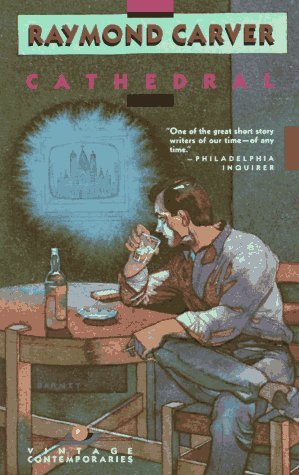
     

  • Cathedral by Raymond Carver: Summary, Analysis and Review

    Cathedral by Raymond Carver: Summary, Analysis and Review

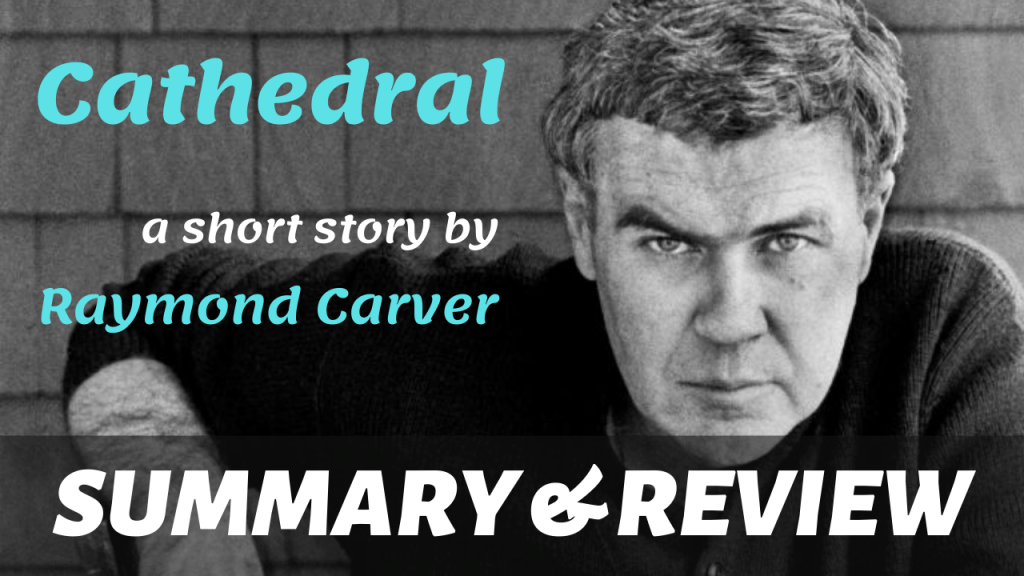
    Cathedral is a short story written by Raymond Carver. This story was included in the ‘Best American Short Stories’ (1982). It’s the story of how a man’s perspective about blind people changes dramatically when he meets an extraordinary blind man who introduces him to a new realm of experience.

    “Cathedral”

    What’s the first thing that comes to your mind when you read this word?

    My guess is that you made a mental image of a cathedral, right?

    Now here’s a question: how long do you think it’s going to take you to explain your mental image of a cathedral to me so that I see it exactly the same way you do?

    5 minutes? 15 minutes? An hour?

    And how satisfied are you once you’re done explaining it?

    Cathedral, a short story by Raymond Carver, is an immense realization of this. to say the least.

    Cathedral Short Story: Summary and Plot Analysis

    The story opens with the narrator mentioning a visit from a friend of his wife, one whom he does not seem to particularly like, considering that he is blind.

    This friend’s wife has recently died and after returning from one of his relatives’ place, he considers meeting the narrator’s wife, as they live close-by.

    The narrator knows quite a lot about this friend – he was a reader. The narrator’s wife met and was employed by this man years ago. On the last day of her job, this blind friend had touched his wife’s face and wrote a poem about it.

    Knowing all this, the narrator finds this man’s blindness ‘unsettling’, more than anything else.

    The narrator also goes on to give the us (i.e. the readers) a peek into his wife’s past-marriage to a childhood sweetheart, loneliness that had led to a suicide attempt (which she survived) followed by a failed marriage.

    Through all these experiences, she continued to keep in touch with her friend. Poems and tapes were the primary means of communication between them. They talked about everything and everyone, including the narrator.

    The narrator and his wife have a discussion about the impending visit from her friend, wherein his wife continues urging him to be nice to her friend, while the narrator continues to bring up reservations about the guest being blind.

    She tells him about that man’s wife, their married life and her struggle with a terminal disease. All this while, the narrator, seemingly immune to the grief of the blind man, continues to wonder about the unhappiness his wife would have felt thinking he could never see her.

    The narrator’s wife goes to pick her friend from the train station, while the husband waits for them at home.

    cathedral by raymond carver book cover
    Cover of Cathedral by Raymond Carver. The links to buy this book are provided at the end of this article.

    He is shocked to see that Robert (the blind man) sports a beard. This does not seem natural to the narrator. His wife introduces him to Robert and all of them engage in conversation.

    The narrator inadvertently asks Robert which side of train did he sit on his way here. He quickly realizes his mistake, but seeing that Robert is unnerved by the question, he’s a bit surprised.

    Three of them sit for dinner and stuff their faces. Many things about Robert continue to surprise the narrator, including, Robert not wearing dark glasses, his ability to smoke ‘normally’ and eat and drink effortlessly.

    All this starts to challenge the blindness stereotype that he had held in his mind for so long.

    While his wife excuses herself for a change of clothes and is gone for quite a while, both men engage in small talk and narrator switches his attention to the television which aired a program about Middle Ages, showing cathedrals from different parts of the world.

    This prompts the narrator to ask Robert if he had any idea what a cathedral looked like. Robert requests the narrator to describe one to him but finds him struggling while doing so.

    Robert then asks the narrator to bring a pen and paper and draw a cathedral. He puts his hand over the narrator’s hand, following the movement of the narrator’s hand. The narrator continues to draw and finds himself immersed in the experience, in a way that he had never felt before.

    At one point, upon Robert’s insistence, he starts drawing with his eyes closed. When he’s  done, Robert asks him to open his eyes.

    The narrator chooses not to, soaking in his newfound bliss. When he’s asked how it felt, he simply responds with “it really is something”.

    Cathedral: Review and My thoughts

    The story seems simple, doesn’t it?

    But it has a little Thich Nhat Hanh lesson (he’s a famous monk and peace activist who has published over 100 books) for us there – a lesson of mindfulness.

    Not only that, it takes a jab at how easy it is for humans to fall prey to stereotypes.

    The story sure is short, but has much to offer. The narrator’s reservations about blind people, his completely warped view of the world of disabled is, on some occasions, comical, while at others bordering on apathy.

    Some quotes from Cathedral

    One of the narrator’s blanket statements about blind people is downright comical.

    “I remembered having read somewhere that the blind didn’t smoke, because, as speculation had it, they couldn’t see the smoke they exhaled.”

    I couldn’t help but laugh when, on seeing his wife’s thigh exposed, the narrator rushed to cover it, only to put it back when he realized that the only other person in the room was blind.

    Here, read for yourself to see if it has the same effect (holding breath in anticipation of your validatory smile):

    “(While sleeping) she had turned so that her robe had slipped away from her legs, exposing a juicy thigh. I reached to draw her robe back over her, and it was then that I glanced at a blind man. What the hell! I flipped the robe open again.”

    His reminiscence about his wife’s tragic past is sad, but with a slight undertone of jealousy. That man who seemed like a stone, did expose his soft side. I couldn’t help but gush a little when I read this.

    “Her officer – why should he have a name? He was her childhood sweetheart, what more does he want?”

    And yes, why should a spouse’s ex have a name?

    Robert’s positivity and an upbeat temperament is in stark contrast with the narrator’s expectations.

    Robert seems to have it all – loving and meaningful relationships, complete immersion in what he does and an undying penchant for learning.

    “I am always learning something. Learning never ends. It won’t hurt me to learn something tonight. I got ears.”

    Couldn’t get any more cliche than that, eh? Yet valuable just the same.

    Learning. Never. Ends.

    We have great people from history and the present worldwide vouching for Robert on this one, and for good reason.

    It’s ironical that a seemingly indifferent narrator has a profound experience at the hands of someone that he was completely apathetic to, until they share an immersive experience.

    Very cleverly, Carver exposed the error of the narrator’s way by showing him that the world he thought he was lacking was actually the one capable of making him feel fulfilled.

    A world that showed him better things. A world that makes him see.

    I hope I see more from this day on.

    Want to read Cathedral?

    Cathedral is available on Amazon if you want to get yourself a copy. You are welcome to use the links given below to order a copy:

    Check Price on Amazon US
    Check Price on Amazon Canada
    Check Price on Amazon India

  • Cupid and the Paintbrush by PG Wodehouse: Summary, Plot Analysis, Review

    Cupid and the Paintbrush by PG Wodehouse: Summary, Plot Analysis, Review

    Cupid and the Paintbrush is a short story written by PG Wodehouse – an English author and one of the most popular humorists of the 20th century. The story revolves around a man who proposes marriage to his love interest through a unique contest. 

    Let’s take a look at the plot summary of the short story:

    Cupid and the Paintbrush: Summary and Plot Analysis

    The story starts with the narrator (who is not named anywhere in the story except for his initials “R.A”) talking to Marjorie – his love interest.

    The narrator tries to persuade Marjorie to get married to him. Marjorie, however, is reluctant about the idea of marrying him. She insists that she would “make him wretched”, and that he would “hate the sight of her in a few years” and that he has no idea what she’s really like.

    RA doesn’t back down and continues trying to convince Marjorie to marry him. She remarks that she has nothing against marrying him per se, and that she actually likes him too, but it’s the idea of marriage that she is unsure about.

    R.A is puzzled by this. “What is your objection to marriage in the abstract? Tell me the worst. Are you a woman with a mission?” he asks.

    “Well, I suppose, I am, in a way. I want to paint.” she replies.

    He then asks why would that stand in the way of her marrying him. She explains that she wouldn’t paint so much once she is married to him as she would get lazy.

    RA assures her that that wouldn’t happen, as he is something of an artist himself. He then proposes a bargain to Marjorie.

    “We will each paint a picture for the Academy this year, and whoever paints the better one has his or her way in the matter. Do you agree?”

    Marjorie, after a little hesitation, accepts the offer.

    The couple meets again after 15 days and discuss the progress they’ve made with their respective pictures.

    RA, very cheerfully, informs Marjorie that he has chosen an allegorical subject for his picture. He intends to “represent a beautiful young lady dressed in a neat creation of white, standing on a rustic bridge with her back to a rather sweet thing in Turneresque sunsets.” He has titled the painting “Waiting”.

    Marjorie then tells him that she is painting a landscape which has a cow in a corner.

    RA is now convinced that his painting will easily win this contest, because the President (presumably the judge of the contest) will remember the beautiful young lady from his painting, and will hand him the win.

    After the result of the contest is declared. RA pays a visit to Marjorie’s house, where he finds her crying.

    He inquires if her picture was rejected.

    “Yes” Marjorie sobs. “I see how silly I was ever to think that I could paint.”

    RA consoles her and mocks his stupid contest. Once again, he implores her to marry him.

    An emotional Marjorie says yes.

    They embrace each other and make love.

    Afterwards, RA tells Marjorie that he came in to ask her to accept his marriage proposal despite that stupid wager.

    “But you won it.” says Marjorie.

    RA then informs her that his painting also failed to impress “the Committee”.

    Marjorie is surprised. “What! You were refused?”

    “My picture was. I was accepted. By you. Don’t move.”

    Following a long silence, RA proposes that they take to photography, share the same camera and “develop off the same plate”.

    Marjorie comments that she realized that she never did think very highly of “the Academy”.

    RA replies “Exactly what I have always thought about it. Don’t move.”

    And the story ends with a rather cryptic line “She did not move”.

    You can read the full version of this short story here

    Cupid and the Paintbrush Review

    This short story by Wodehouse is, in many ways, very much like his other stories. There is an underlying theme of humor which keeps you hooked to the characters and the plot.

    However, this story is a little unusual in the way it concludes.

    In the last few lines of the story, RA asks Marjorie to “not move” and she obliges by not moving. In the very last line of the story, Wodehouse emphasizes that Marjorie didn’t move.

    This makes you wonder – is there a hidden meaning to this “do not move” reference? Has Wodehouse tried to convey something here?

    I can assure you that when you read the story for the first time (which I highly recommend, by the way), you are highly likely to be puzzled by its conclusion.

    Wodehouse has left it to readers’ imagination to make their own interpretations of the story.

    What happens at the end of Cupid and the Paintbrush?

    The end of Cupid and the Paintbrush is really cryptic as the story ends with “she did not move” in reference to Marjorie – the love interest of the narrator.

    Let me share with you two interpretations that I made of the story’s ending:

    The narrator was proposing to paint her, not marry her?

    One way to look at the ending of the story is that right from the start, he sought Marjorie’s permission to paint her. This is conveyed in the story by means of R.A proposing marriage to Marjorie, when, in fact, he was proposing painting a picture of her, and wanted her to say yes.

    Marjorie is not a real person?

    One interpretation that I drew about the story’s ending is that Marjorie is not a real person. Rather, it’s an imaginary individual who R.A (who’s a painter) has fallen in love with, wants to draw her. Maybe that’s why he keeps asking Marjorie to not move (so that he could paint her)?

    To be honest, I am really not sure what Wodehouse wanted to convey through the conclusion of this story. These are the two interpretations that I made.

    However, I would love to hear your thoughts on it.

    Here’s a challenge for you: What’s your interpretation of the ending of Cupid and the Paintbrush?

    Share your thoughts and get featured on this website!

    What do you think happens at the end of Cupid and the Paintbrush? What does it mean when R.A says the mysterious line “she did not move” in the end?

    If you want to read the original copy of this short story by PG Wodehouse, you can read it here – it’s not more than 4 pages.

    Please take a look at the story and share your interpretation of its conclusion in the Comments section. We would love to hear your thoughts.

    If your interpretation of the ending fills all gaps and connects all dots of the story convincingly, then we would feature your interpretation in this article and credit you for it.

    What our fellow FriendsofWords (FOWs) are saying

    Sanebishop, a reader of FriendsofWords, agrees with my first interpretation of the ending, i.e. RA proposed to paint Marjorie, not marry her.

    Sanebishop also presented an interesting perspective: could we be missing something that was more obvious 100 years ago, when Wodehouse originally wrote this short story?

    I must admit that I had overlooked this aspect of the story – it is a century old tale!

    Many things make sense only in a specific time period. There are many examples of stories, novels and movies that were huge successes when they first released decades ago, but if you read or watch them today, it’s possible that you may feel “That book/movie isn’t that great. I don’t understand why it got so popular.”

    Is it possible that we, reading the story today, are missing something that made sense 100 years ago?

    If that’s the case, then what is it that we’re missing?

    In the end, let me just say this – this is a really underrated and relatively unknown short story from Wodehouse.

    Believe me, I talked to a lot of people about the ending of this short story, but surprisingly, most people were unable to crack the mystery of the “did not move” line at the end.

    I was first challenged to interpret the ending of the story by a friend. In response, I came up with two interpretations, which, in my opinion, are not as watertight as I’d like them to be.

    Now, my dear reader of FriendsofWords, I present the challenge to you!

  • So Now You Know What Else Existed In The World Outside Of You, Before You Knew Only About Yourself: Franz Kafka

    So Now You Know What Else Existed In The World Outside Of You, Before You Knew Only About Yourself: Franz Kafka

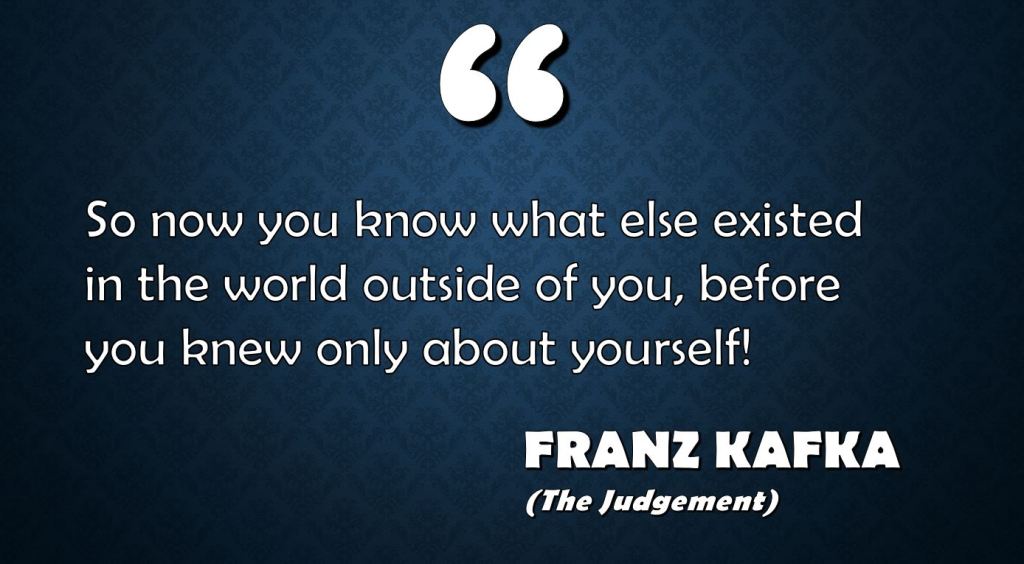
    I read this quote in Franz Kafka’s popular and absolutely amazing short story The Judgement.

    “So now you know what else existed in the world outside of you, before you knew only about yourself!”

    Reading this from the story felt like seeing through a kaleidoscope – moments from my own life where I was either saying this to someone or was at the receiving end of this ‘angry’ remark.

    In the spirit of complete honesty, I did deserve having it said to me on several occasions.

    But on all of them? Hell no!

    However, if you ask me if the people I said it to deserved it, I would probably say yes on most of those occasions.

    Where is this bias coming from? And am I alone in feeling that I am right and the world is wrong?

    Turns out that the answer is NO.

    There is a humongous volume of literature around human selfishness. Glaucon, a Greek philosopher, is known to have mentioned in a discussion with Socrates that people’s good behavior actually only exists for self-interest.

    Hell! Forget literature and just take a look around. Betrayals, fraud and meanness hog headlines in newspapers and prime time television.

    Think selfish leaders driving their own countries to war, or bringing them to the brink of bankruptcy. Think spouses fighting in front of their kids every day. Think an alcoholic father caring for his own pleasure more than the well being of the people who depend on him. Think kids insulting their parents to conform to peer ‘requirements’.

    We are selfish, aren’t we?

    Yes we are, but there is a silver lining.

    We are not all selfish to the extent of narcissism. More often than not, we feel guilty when we realize our mistake. Some of us even act on it and apologize.

    This does two things – we feel better and so does the person we wronged. There’s nothing more relieving than admitting – to someone whom you wronged – that you realize your mistake and regret your behavior towards them.

    Sometimes, when we care for a person too much, we might even swallow our pride and apologize for the mistakes we know we didn’t make (I can see those of who you are spouses or partners smiling at this).

    There are quite a few altruistic people out there – willing to risk their own lives for the greater good. And luckily the world has been producing gentle souls like those since time immemorial as well. And the world is all the better for it.

    Not all of us can be Florence Nightingale, Mother Teresa or Nelson Mandela. If you aspire to be one, go you! I am proud of you.

    But for the less ambitious ones out there, what is our role? What can we do to contribute?

    It’s pretty simple actually….

    Be Kind

    Next time when your spouse fights with you, before retorting, take your time, think what might be causing him/her to behave that way.

    Did you leave them alone to take care of the kids for a month ?

    Did you ditch three dates in a row?

    Did you not offer help with the chores when they were in desperate need?

    Next time when an ageing parent makes a rude remark, instead of getting into ‘self-defense’ mode, try to understand what might have caused them to do it.

    Are they feeling neglected?

    Are they in pain?

    Kindness, like money, grows manifold when invested right. But unlike money, it can’t be stolen or destroyed. Hoarding the currency of kindness only makes our life as well all those it touches better.

    Next time you feel that the world revolves around you, remind yourself that it has got better things to do!

    If you liked this quote from the short story The Judgement (written by renowned author Franz Kafka), you might want to take a quick look at the summary of that story. You can check it out here:

    Short summary of The Judgement: A Short Story by Franz Kafka

  • When There Is No One Left In The Living World Who Remembers You, You Disappear From This World. We Call It The Final Death

    When There Is No One Left In The Living World Who Remembers You, You Disappear From This World. We Call It The Final Death

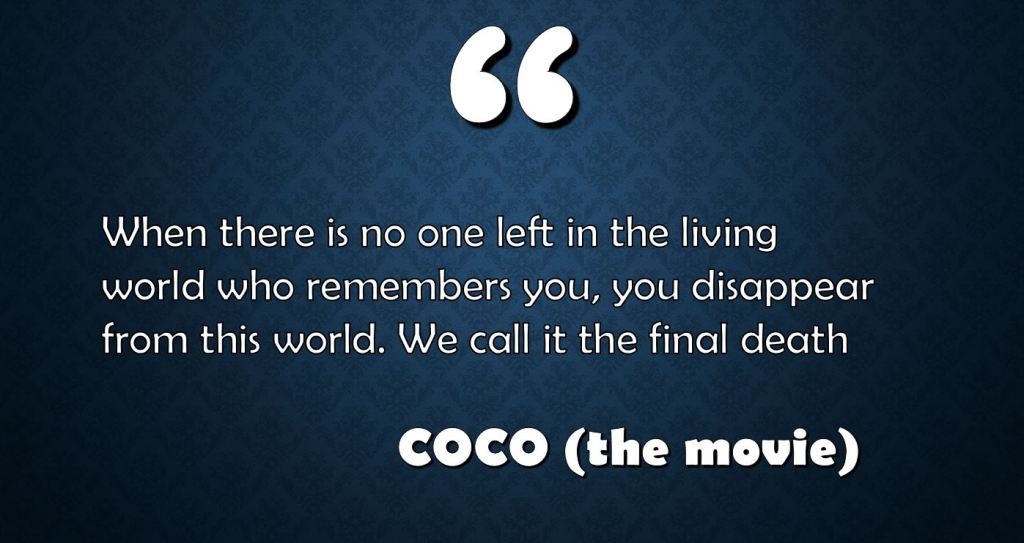
    I got to hear this line recently while watching the Disney-Pixar movie Coco.

    Without ruining the movie for you, this quote is basically about dead people who are alive in their afterlife conditional on people in the living world remembering them.

    You and I both have seen movies emphasizing the importance of familial ties and love.

    But this message from the movie does something else.

    It evokes a sense of fear.

    I replayed the sentence in my head over and over.

    “When there is no one left in the living world who remembers you, you disappear from this world.”

    Let this sink in and I promise you that it would stress you if not outright scare you.

    The good news is that you are not alone in feeling that way. Human beings, in general, are obsessed with leaving a legacy behind. Something for people they left behind to remember them by.

    Because people forgetting them when they are already gone would be… devastating?

    Where might this sense of fear be coming from?

    Could it be that we humans can’t stand the possibility that our lives mean nothing to
    others around us? That we lived our lives in a way that no one is going to remember us – does this imply that we were a failure?

    Could it be ego? Narcissism?

    We creatively manufacture ways to convince ourselves that our actions will affect the future of the world in some remarkable way.

    There is nothing wrong with wanting to have a legacy. But more often than not, the blind focus on the goal of doing something to be remembered by, takes our focus off the equally-important aspect of enjoying the journey to get there.

    If we constantly are under stress working much longer than normal hours, doing things that we don’t enjoy doing and never getting time to spend with the kid that we think we are doing it all for – what do we think the kid is going to remember us for?

    The journey is as important as the goal, if not more.

    Enjoying the journey will always entail enjoying the present. Enjoying the present would include either or all of these things – spending time with our loved ones, doing something for the less fortunate, doing things that make us happy, enjoying what we do.

    In the words of Arthur Ashe, success is a journey not a destination. The doing is often more important than the outcome.

    We are creating our legacy now.

    What’s it going to be?