I am yet to find someone my age or older that says they love doing grocery. There is something about doing grocery that has chore written all over it.
And I would be safe in assuming that chores is not something anyone would particularly look forward to doing.
So here I am on the grocery day, the day when all the gravity of the world is concentrated on my bed and the strongest electromagnetic force of the world is keeping a book glued to my hands.
Stepping out of bed is particularly difficult considering the forces I am facing. An image of an empty fridge flashes before my eyes.
Me says to meself : Come on, can’t be that lazy!
So I step out for my grocery shopping. These days, I do not see many people on the road, but like a charm or a curse, I always see at least one person that will choose that precise time to go for a run.
Incidentally this person will always have a great body and after apparently running for such a long time , didn’t break a sweat. If I was not feeling guilty until that point, I did now.
Head down, I keep walking until I see a couple in a distance walking their dog. I wasn’t able to see it clearly but what was unmistakable in that dog was its enthusiasm, and the pride of having two humans dote on him.
The dog seemed blissfully happy, full of energy like he was seeing the world for the first time.Happiness, as they say, is contagious. I suddenly felt the urge to walk faster to see the dog closely.
The strangest thing happened. As soon as I was within 5 meter distance from the dog, our eyes met and facing my direction and looking at me, the happy dog sat down.
Oh! My heart just melted.
The humans with him were trying to pull on his leash but he didn’t budge. Now, I have never had dogs, so I didn’t know what was to be done next. So I gave him one flying kiss in my head and walked on.
That one chance encounter with that lovely creature taught me a lot of things. I now believe all the great things they say about having dogs.
I have since watched Airbud, Hachiko and A Dog’s purpose, absolutely loved them and discovered that I cry more in dog movies than human ones.
So when Moby says:
“Dogs have boundless enthusiasm but no sense of shame. I should have a dog as a life coach”
.. I have no doubts that it is a 100% true and if I was as eloquent as him, I would say the same.
If I really like something about a stranger walking on the road, I would think a thousand times before I complimented them, if I did. And here is the little creature, not knowing who I was, treating me as well as a long lost friend. Imagine, the humans he was with, and I didn’t exchange any words.
The dog and I did conversed more than that.
Dogs have a way of knowing us in a way that no human can. It’s not for nothing that they are called a man’s best friend.
I wish for a lot of good things for you, and after shamelessly tweaking the epic line from Star Wars, I will say:
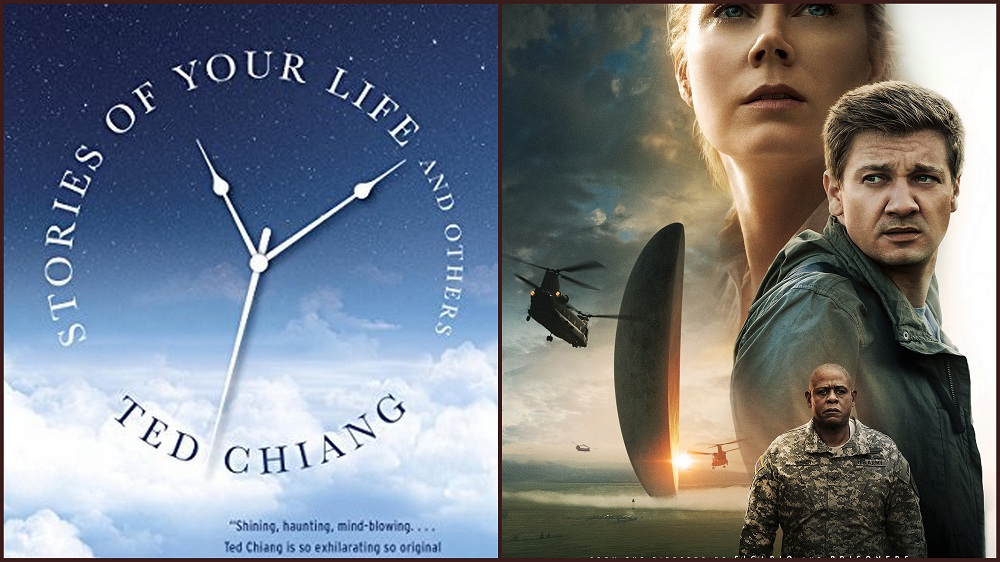
Story of Your Life is a science fiction short story written by Ted Chiang. It was first published 1998. The story revolves around a renowned linguist and how she makes a breakthrough in communicating with the aliens that have landed all over the world in massive spaceships. This story received many accolades and shot to immense popularity following the success of a Hollywood movie ‘Arrival’, which is based on this story.
“Despite knowing the journey and where it leads, I embrace it and welcome every moment.”
What would you do if you somehow chance upon the ability to be able to see your future?
Will that scare you, or will you be hopeful? Or both?
Ted Chiang, in his short story “The Story of Your Life”, brings you some answers in a very humane sci-fi manner, traversing through the themes of language and determinism.
First published in Starlight 2 way back in 1998, this story has received multiple accolades. Its most recent adaptation into a Hollywood movie – Arrival, starring Amy Adams and Jeremy Renner – is a testimony to its ever-growing popularity.
Story of Your Life: Summary and Plot Analysis
The story revolves around Louise Banks, a respected linguist, who is also the narrator of the story. Louise is recounting the events of her life to her daughter and story alternates between glimpses into her past and future.
The story opens with a couple enjoying a romantic dance on a day which happens to be the one where their daughter was conceived.
The pivotal point in the story is the arrival of aliens in spaceships that land in different parts of the world, including the US, Russia, China etc. And not just one or two, a total of 112 gigantic semi-circular spaceships land all over the planet.
These ‘devices’ serve as an audio visual link to the aliens.
This is the alien spaceship which land in different parts of the world. This image is a screenshot of the movie Arrival, which is based on this short story. (Photo Credit: Arrival Movie)
Aliens initiate communication with humans and Dr. Banks and Gary Donnelly (who is a physicist) have been brought in to assist with the process.
Aliens, whom people call ‘Heptapods’, because of their seven limbs and radially symmetrical appearance, communicate in a language that is nothing like any form of language (both written or verbal) that humans have ever known.
Louise and Gary are assigned to 9 “looking glass” sites (that’s what humans call the sites where these spaceships have landed) and start to work with them to understand their language in order to be able to communicate with them.
They work with two aliens, whom they nickname Flapper and Raspberry.
Through a series of conversations with them, Louise realizes that their written and spoken words are not related to each other at all! She and her group refer to speech as “Heptapod A” and the written form of the language as “Heptapod B”.
Through a series of experiments that Louise and her team run to understand the aliens’ language, both in linguistics and physics, they infer that the alien language has a ‘free word order’. In addition to that, their language does not seem to have any linear sequence making it even more complicated to understand.
Not much progress is made until one day Gary explains Fermat’s ‘principle of least time’ to Louise. From this fresh understanding, it dawns upon Louise that similar to the light in Fermat principle (where light knows exactly where it will end up before it chooses its path of travel), aliens know their full sentences beforehand.
Instead of experiencing events sequentially, they experience all of them at once, hence confirming why the Fermat principle resonated with them so much.
Armed with this knowledge, Louise becomes proficient in Heptapod B quickly, but it also alters her understanding of reality. She observes that her train of thought is now absurdly directionless.
She experiences complete immersion in Heptapod B and starts to think in it and perceives time the same way as Heptapods do. She now sees glimpses of a future, a daughter she does not yet have, her daughter’s death and a life she doesn’t have yet.
One day, the aliens announce that they are leaving. They shut down the looking glasses and disappear. It is never established why they came and why they left, although there were rumors flying around that implied that they found human race to be too primitive to be of interest to them.
This knowledge of the heptapod language changes Louise’s life. She knows the future now, but does nothing to alter it.
She knows that she is going to end up together with a man, have a daughter and will lose her when she is still young. Despite this knowledge of her future, she goes on ahead with her life, changing nothing.
Flash back to the present, when Gary asks her if she wants to make a baby, she says yes.
Want to read Story of Your Life by Ted Chiang?
Story of Your Life is a short story which is published in a collection of short stories written by Ted Chiang. You can use the links given below to buy this short story collection on Amazon:
Story of Your Life has won numerous awards for Ted Chiang, including the prestigious Hugo award. Mr.Chiang has this innate ability to convert extremely dense topics to something that you can not only comprehend, but think and marvel at the new perspectives that it brings.
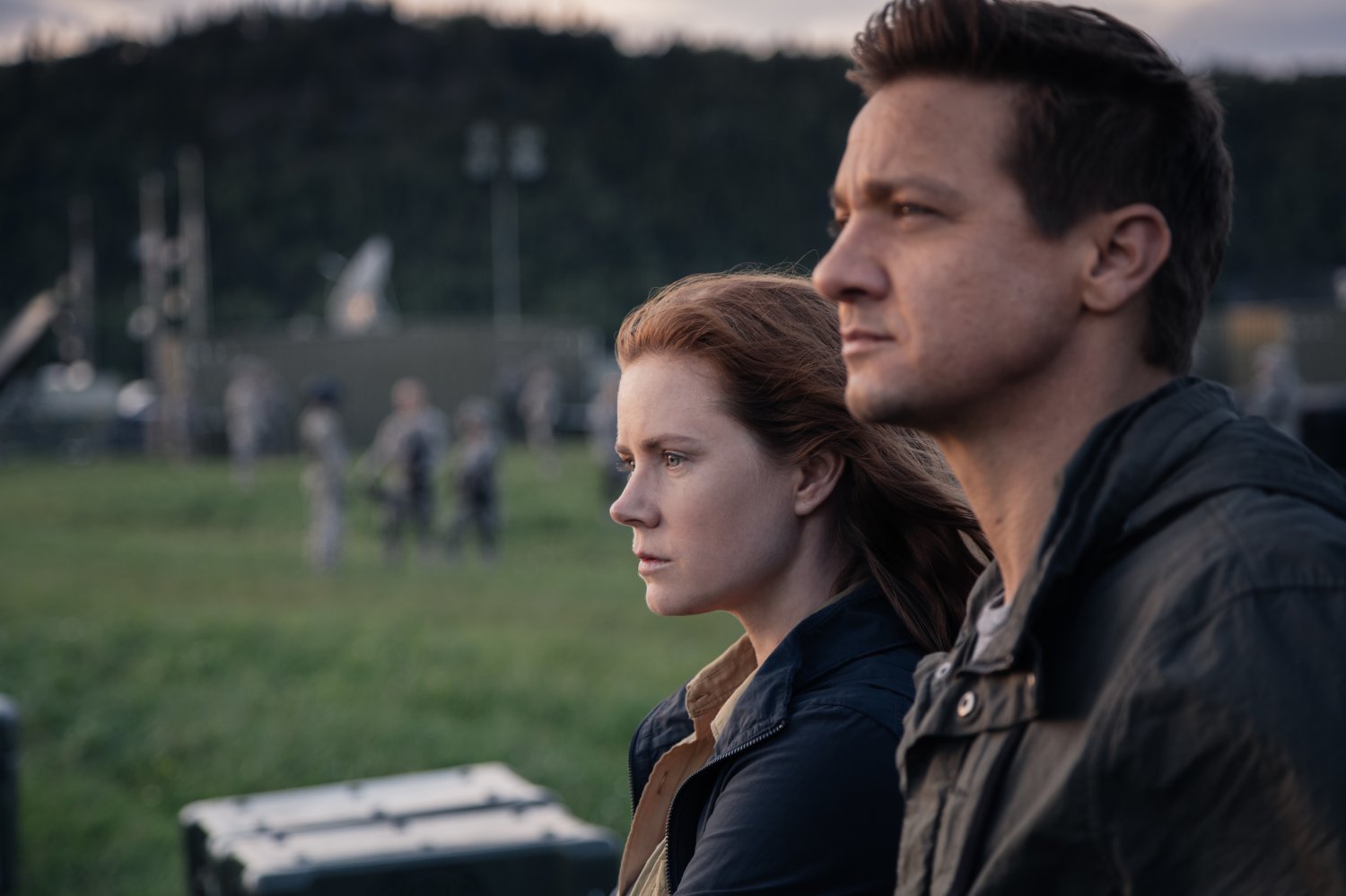
A still from the movie ‘Arrival’ – it is based on A Story of Your Life
This story brings the debate of free will and determinism to the fore. The portrayal could not have been any more gripping and profound than it is. The story shines in its intellect and humaneness.
It has got rich material that will keep both the dreamer and scientist hooked.
Consider for example, how Chiang has broken down the concept of Fermat’s principle:
“Any hypothetical path would require more time to traverse than the one actually taken. In other words, the route that the light ray takes is always the fastest possible one.”
The way that he has married science with philosophy in his story is remarkable. He is known to have remarked once: “Science fiction is very well-suited to asking philosophical questions; questions about the nature of reality, what it means to be human, how do we know the things that we think we know.”
The clarity with which he has presented the linguistic challenges, realizations and the character epiphanies are spellbinding. It speaks to the amount of research that must have gone towards this immaculate description of a linguists approach towards a new language.
And the biggest sentences had an effect similar to psychedelic posters : sometimes eye-watering, sometimes hypnotic.
7 Quotes from Story of Your Life
Here are some quotes from A Story of Your Life that I absolutely loved:
1 – Whether scientists or tourists they were an awfully incurious bunch.
(Referring to the aliens who had landed in different parts of the world but didn’t seem to do anything after they had landed)
It might be the woman in me talking but I found the depiction of mother-daughter relationship extremely heart-warming. At those specific instances in the story I forgot that I was reading science fiction.
Here are some quotes through which the author depicts the beautiful mother-daughter relationship:
2 – Even if I had never laid eyes on you before, I would be able to pick you out from a sea of babies: Not that one. No, not her either. Wait, that one over there. Yes, that’s her. She is mine.
3 – It will be like growing an errant limb, an extension of myself whose sensory nerves report pain just fine, but whose motor nerves do not convey my commands at all. It’s so unfair. I am going to give birth to an animated voodoo doll of myself. I didn’t see it in the contract when I signed up. Was this part of the deal?
A still from the movie ‘Arrival’ – it is based on A Story of Your Life
4 – My own mother could never understand why I couldn’t just be a high school English teacher. You’ll do what makes you happy and that’s all I ask for.
5 – Living with you will be like aiming for a moving target, you will always be further along than I expect. All those vows that I will give reasonable answers when I became a parent, that I would treat my own child as an intelligent, thinking individual,all for naught, I am going to turn into my mother.
6 – I can fight it as much as I want, but there will be no stopping my slide down that long dreadful slope. Not to forget a little lesson in mindfulness that Ted threw in there as a bonus read-
7 – And the lesson in mindfulness – NOW is the only moment you will perceive; you will live in the present sense. In many ways, it’s an enviable state.
And there is always this overarching message in this book, which he very nicely intrigues us with using the Book of Ages ages and the fallacy of the argument that it exists, leaving us with this gem on his favorite topic of free will vs determinism.
8 – From the beginning I knew my destination and I chose my route accordingly. But am I working toward an extreme of joy, or of pain. Will I achieve a minimum, or a maximum?
James Gleick, an American author, speaking about The Story of Your Life once said, “For us ordinary mortals, the day-to-day experience of a preordained future is almost unimaginable.
But Chiang does just that in this story, and with this brings the hope and faith that our present is all the more enriched with authors like him around.”
We, being humans, are prone to feeling these emotions more frequently than we would like to admit. The triggers that could lead us to this pit are too many to count.
Loss of a loved one, struggle with a chronic illness, a crippling disability, lack of financial resources, one or many toxic relationships in life, the list just goes on. It’s very difficult to see the light at the bottom of that pit. And humanly so.
But, like they say, darkness and light cannot co-exist. And thankfully the words of the wise bring much needed respite in our hours of struggle.
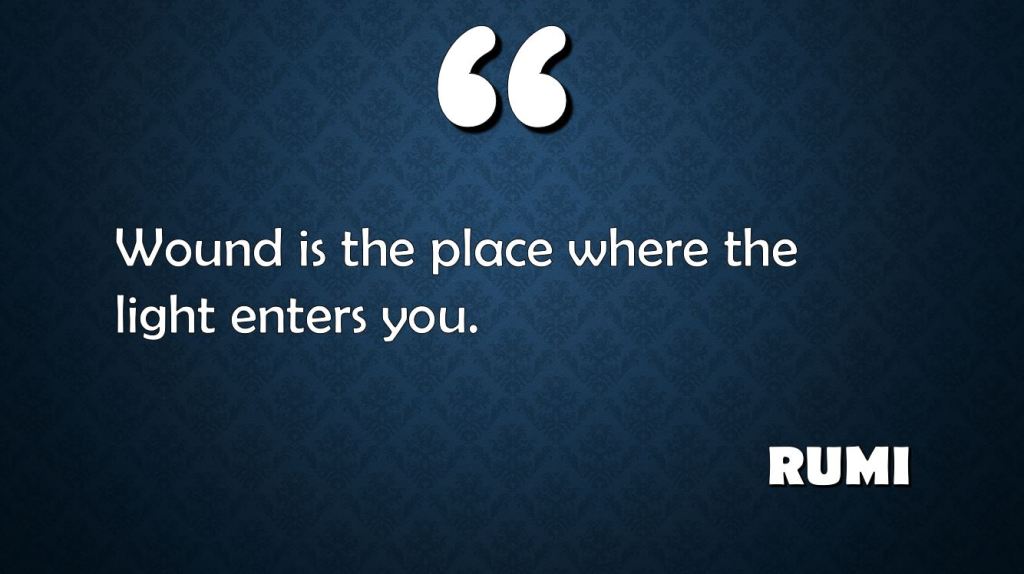
“Wound is the place where the light enters you.”
There are examples scattered all throughout the history of the world – where amid abject misfortunes, people not only came out victorious in their own life struggles beating all imaginable odds, but inspired thousands of others to look beyond the limitations of their present circumstances – emotional or material.
Imagine a world where Hellen Keller resigned to her disability, Oprah Winfrey gave in to the negativity of her early childhood and adolescence, JK Rowling gave up on her writing dreams on receiving a flurry of rejections, Steve jobs gave up on his dreams of creating exemplary tech that the world would eventually come to adore.
The pain they experienced going through those unfortunate circumstances would have been excruciating, but thankfully they braved the odds stacked against them and showed the world that if it’s imaginable, it is possible.
And this victory was not just theirs. Think of the hundreds of thousands of lives that they touched and inspired. The world certainly is a better place following their triumph. A world that now has sign language, Macs, iPads and Harry Potter!
That’s the power of a wound. It can pivot our lives towards exemplary achievement or a depressing abyss.
The direction that our life goes in, post-misfortune, depends on our own resilience in face of hardships.
Light can enter our wounds and heal them.
The catch is for us to see it and let it do its work.
The Stone boy is a short story by Gina Berriault. It was first published in 1957 in Mademoiselle magazine. The story revolves around a nine-year-old boy who accidentally shoots his older brother, but is freakishly calm about it later on.
The short story catapulted its author, Gina Berriault, to international fame when the story was made into a movie in 1984. Before this short story became so popular, her first collection of short stories – The Mistress, and Other Stories – had helped a great deal to establish Gina as a consummate writer.
The Stone Boy: Summary and Plot Analysis
The story is about a nine-year-old boy, Arnold, who lives with her mom, dad, sister and an elder brother, Eugie. Although not very expressive, he admires his elder brother, Eugie in his heart and hopes to grow up to be like him.
One morning he wakes up early to pick peas in the fields with his brother Eugie. He wakes him up and goes downstairs. He then picks up the rifle his dad gave them a few days ago to shoot ducks.
Eugie comes downstairs too, reminds Arnold that it wasn’t duck season and the two boys leave the house for an early morning trip to the fields to pick peas.
They come to the wire fence that divides the fields from the lake. Eugie passes through the fence first. Arnold follows him, but his gun is stuck in the wires.
In an attempt to untangle it, he jerks at it and accidentally fires a shot.
Feeling foolish for making this mistake and bracing himself for the impending
teasing from his brother, he reluctantly walks on but notices that his brother is lying on the ground.
Unable to understand this behavior, he looks more carefully and sees blood on the back of his head.
He realizes that the shot that he accidentally fired ended up killing his elder brother.
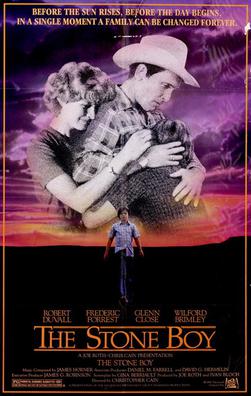
Poster of the 1984 movie The Stone Boy, which is based on the short story.
Instead of running to his family, informing them about the accident and seeking their help, he stays on in the field to pick peas as if nothing had happened.
To him, it was reasonable to complete the task that he came to do in the first place. Leaving the task incomplete for something that was beyond his control didn’t appeal to his reasoning, logical mind.
He stays on, finishes the task and goes back home. He dreads breaking the news to his family but does so with amazing calm.
Quite unsurprisingly, his family is devastated.
While his mother finds it hard to come to terms with her elder son’s death and Arnold`s pathological calm, his sister completely ignores his presence. His father, in addition to arranging for his son’s funeral, has to take Arnold to the County Sheriff.
Upon being asked to narrate the incidents from the morning that day, Arnold explains everything to his father and uncle Andy. However, he is at a loss of words when asked why he didn’t run back home to announce the news.
His father is puzzled by his cold demeanor, and Arnold starts to feel even more distant and aloof.
The spell of silence finally breaks when the Sheriff arrives.
He asks Arnold a series of questions including why he had the gun in the first place and if he had a “good relationship” with his elder brother.
Although his answers seem extremely cold, which is disconcerting, he concludes that there is no foul play and the shooting was indeed an accident. He lets Arnold and the family go. However, he does mention that the freakishly cold demeanor displayed by Arnold was indicative of a criminal mind in making.
Uncle Andy agrees with Sheriff’s explanation and goes till the extent of mocking his reasonableness. His cousin taunts him as well, saying that his father might have punished him severely if he did the same thing to his brother.
Arnold keeps growing uneasy and even more distant, the weight of judgement from everyone around weighing heavily on him. At night, he eventually goes to his mom’s room to explain to her in person about the events that transpired earlier that day, but his mother, who is still grieving, turns him away.
He feels more and more like a burden on his family – an unwelcome presence and with his brother gone and everyone else around him grieving – he shuts himself off completely, vowing never to be vulnerable again.
The following morning, when his mother asks what he wanted from her, he says “nothing” with a freakish calm, leaving his mother terrified.
The Stone Boy: Analysis and Review
Gina has managed to pack so much power in this short story – it’s unbelievable!
She makes you root for the boy, but not without questioning his judgement (or worse without judging him once). The fact that his reason is mistaken as being completely unfeeling is so inexplicably daunting.
There are certain incidents from the story that are so beautifully human yet painful, such as:
1 – “What did he mean “good friends”?
Arnold was clueless when the sheriff asked if he was ‘good friends’ with his elder brother, whom he had accidentally killed earlier that day.
It’s heart-wrenching to see how this young boy, who had so much love and admiration for his brother, unable to express himself in a socially acceptable form – is perceived to be a criminal in making and stone-cold, or rather, a stone.
2 – Arnold never tired of watching Eugie offer silent praise unto himself
Arnold loved watching his brother look into the mirror, inspecting himself and feeling proud. He secretly wondered if he could ever be able to fill his shoes. If his parents never called him, he thought, he would stay up in the loft forever, out of the way.
When Arnold broke the news to his parents, who disbelievingly went out of the house to see for themselves, Arnold sneaked out to the barn. He was ready for the punishment in case his parents never call him.
He would be prepared to forever live in the same space and stay out of their way. In that very instant, Eugie playful young brother had transformed into someone wholly guilt-ridden and prepared to face the consequences of his actions.
Gina Berriault once said – Short stories and some short novels are close to poetry–with
the fewest words they capture the essence of a situation, of a human being. It’s like trying to pin down the eternal moment.
She has done just that with Stone Boy.
Movie based on The Stone Boy
If you are one of those readers that love watching movie adaptations of your favorite reads, you are in for a treat. The movie, The Stone Boy, was released back in 1984 and had Robert Duvall as one of the lead actors.
This movie was one of the reasons why her short story catapulted to instant fame.
Do you want to read The Stone Boy?
The Stone Boy, and other famous short stories written by Gina Berriault can be found on Amazon through the links given below:
The Judgement is a short story written by Franz Kafka. It was first published in 1912. The story revolves around a young merchant and his relationship with his father. Franz Kafka was running a business while writing this story, which limited his literary creativity. This conflict inspired the protagonist of ‘The Judgement.’
“So now you know what else existed in the world outside of you before you knew only about yourself!”
The Judgement by Franz Kafka is one of his most prominent works, also perceived as the closest to his autobiographical memoir – the relationship between a father and son – one that resembles closely to his own.
The story was first published way back in 1912 as Das Urteil, in Arkadia (a literary yearbook) owned by his friend and close confidante Max Brod.
The Judgement: Summary and Plot Analysis
The protagonist of this story is a young merchant, a man called Georg Bendemann. It opens with him writing a letter to an unnamed friend, who left for Russia a few years ago to start a business – one that showed a lot of promise initially but is now in a fragile state.
On the contrary, Georg has been having tremendous success in managing his own business.
Until now, he has only been giving his friend little pieces of information – and not that frequently either. But now he decides to let his friend know about his upcoming marriage to Freida Brandenfield, a girl from an affluent family.
Georg decides to check on his father and let him know of his intentions and seek his approval to break this news to his friend.
Although, quite ill and heartbroken after his wife’s death, his father appears huge to him.
His father questions the existence of his friend and blames Georg for keeping him in the dark regarding his business dealings. He also attacks him personally saying that the death of his mother didn’t impact Georg as much as him.
Although hurt by his father’s accusations, he insists that he lay on bed, rest for a while and get his strength back.
But the father claims that he’s only asking him to lay on the bed because he wants him dead.
In a fit of rage, he also admits to knowing all about his friend and that he has been informing his friend about everything that has been happening in Georg’s life.
He ridicules Georg about his fiance, mocks her and implies that he doesn’t value anyone but himself. He completely disregards Georg’s love and care.
Georg, deeply hurt by his father’s statements, recoils.
His father’s anger still rages on. He calls Georg selfish and sentences him to death by drowning.
Georg feels a strange but powerful force that pushes him out of the room.
He then runs out of the house and onto a bridge. Then he swings himself off the railings and jumps to his apparent death, wherein the sound of the jump is muffled by sounds of traffic.
The Judgement: Analysis and Review
This story from Kafka stands out for the parallels drawn to his real life. There are a few examples of that:
1 – Kafka’s relationship with his father
Kafka’s father, Hermann, had a very forceful personality that had a deep impact on him. I couldn’t help but notice how frequently Kafka’s protagonists are shown to cower in their father’s presence, which closely resembles a fearful reverie.
When Georg goes to meet his father (whose health is failing), he still appears huge to him. All the care and devotion towards his father is met with scathing contempt.
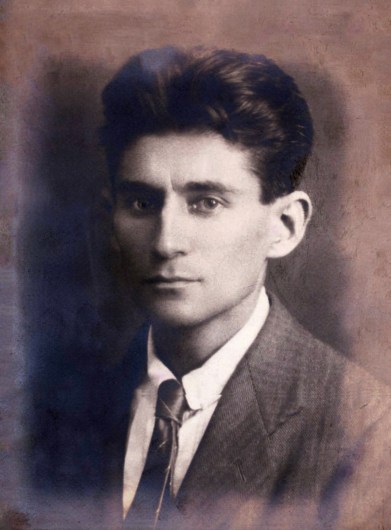
A portrait of Franz Kafka – the author of The Judgemment
2 – Kafka’s relationship with Felice Bauer (his fiance)
Similar to how Georg’s upcoming marriage is a significant plot point in the story introducing tumult, so is Kafka’s relationship to his real-life girlfriend and later, fiance, Felice Bauer. In the story, Freida is the indirect cause of Georg’s death. In real life, Kafka both dreaded and loved Felice for the impact that she had on his art.
3 – Kafka’s seclusion and Georg’s bachelorhood
Georg has been shown to love his fiance, but at the same time has also been shown indifferent in some aspects – even going to the extent of considering it a mistake or liability at some point.
Exhausted by Georg’s comments when Freida suggests that he should not have been engaged at all, Georg replied by saying -“Well, we are both to blame for that.” Same has been known to be true for Kafka’s relationship with Felice as well.
Kafka’s curse of writing in seclusion is coupled with the idea that an association with her is only going to drive him further away from his path of writing – which he considered his life’s only reward.
4 – Similarity in professions
When Kafka was running his business, he was continually pressed for time to satiate his creativity cravings, hardly getting any time to write. This was an inspiration behind the protagonist character.
The poet W. H. Auden once called Franz Kafka “the Dante of the twentieth century”.
I couldn’t agree more.
Want to read The Judgement?
The Judgement is available on Amazon if you want to get yourself a copy. You are welcome to use the links given below to order a copy: