Tag: emotional

  • The Bear Came Over The Mountain: Summary and Review

    The Bear Came Over The Mountain: Summary and Review

    The Bear Came Over The Mountain is a short story by Canadian author and Nobel laureate Alice Munro. It revolves around Grant and Fiona, an elderly couple who have been married for several decades and their struggle with Alzheimer’s and infidelity.

    “I don’t think there is anything to worry about. I expect I am just losing my mind”- Fiona, an Alzheimer’s patient, says to her husband in this poignant short story by Alice Munro.

    The story was originally published in The New Yorker in their 1999 edition. In 2006, the story was adapted into a film Away From Her directed by Sarah Polley.

    The Bear Came Over The Mountain: Summary and Plot Analysis

    The story revolves around Grant and Fiona, an elderly couple who have been married for several decades. Grant is a retired University professor who is takes Fiona to a residential facility for patients with dementia, despite resistance from her.

    He recalls how their journey together started one day, when she had whimsically proposed marriage to him wondering if it would be fun. The residential facility, where Fiona is scheduled to be staying, has a policy of patients to have no visitors for a month.

    Grant, although troubled by this, goes through this period with help from Kristy, a nurse who keeps Grant posted with Fiona’s status – health and otherwise. Grant skis and dines alone in the meantime, constantly remembering these occasions from the past with Fiona in them.

    Hateship, Friendship, Courtship, Loveship, Marriage book cover
    The Bear Came Over The Mountain is a short story within a book of short stories by Alice Munro. The book’s title is ‘Hateship, Friendship, Courtship, Loveship, Marriage’

    Grant has plenty of time to ruminate about his past during the day to the extent that he dreams about them as well.

    One of those incidents was when his decision to end a relationship with one of his students had driven her to commit suicide. This eventually ended up having him socially ostracized at the university.

    He eventually escaped the environment  promising his wife  a new chapter in their lives by moving to a Farmhouse which Fiona had inherited from her father. This, he thought, was a chance life had given him to work on his marriage, and he felt grateful for this perfectly-timed opportunity of avoiding losing Fiona.

    With his one month wait period nearly coming to an end, he prepares to meet her at the facility. On the day of the meeting, feeling the anticipation as that of a fresh affair, he buys a bouquet of flowers for her.

    He meets Kristy, who directs him to Fiona’s room. Unable to find her there, he moves to the communal area, only to see a different Fiona, with her short hair and a few extra pounds. He sees Fiona playing bridge with a man called Aubrey. Although she is friendly to Grant and answers his questions, she is eager to return to Aubrey’s side.

    Grant comes to know that Aubrey is a temporary resident at the facility and will be leaving upon his wife’s return from vacation. Grant tries to gather more information from Kristy about his wife’s new relationship but is quickly told that it is a common occurrence among patients.

    His wife’s behavior towards him continues to be the same – polite yet distant while her intimacy with Aubrey continues to grow.

    Although he is happy to see his healthy wife, her close association with Aubrey – walks in the hall and co-dependence, continues to bother him. He drifts back to incidents from his past,  where by indulging in an affair with a married woman, he becomes an infidel in his own marriage.

    He thinks of himself as a philanderer, although not liking to label himself that way.

    Grant returns to the facility to see his wife again, only to find both her and her companion distraught at the thought of separation. Aubrey’s wife, having returned from her vacation, has arrived to take Aubrey back home.

    Scared that this separation might adversely affect Fiona, he seeks Kristy’s counsel and feels relieved when told that patients usually recoup once the separation is over.

    Unfortunately that does not seem to be happening to Fiona, who continues to be distraught long after, has given up eating and refuses to leave her bed.

    The hospital staff, seeing her complete lack of willingness in participating in the recovery program, propose to move her to the intensive care section of the facility. Completely disheartened to see his wife in that sorry state, Grant decides to discuss the situation with Aubrey’s wife Marion to work out an arrangement with her.

    Grant visits Marion at her place. The two discuss their experiences of managing illnesses of their  spouses. Grant comes to know that Aubrey has been pulled out of the facility by Marion for financial reasons and Marion has no plans to bring him back. Grant requests Marion to bring Aubrey to the facility once a week. He thinks this will help heal his wife and aid faster recovery.

    Marion rejects Grant’s request. But when he returns to his house, he finds two voicemails from her proposing the idea of going to a singles dance. Puzzled by this, Grant wonders what change could have  led to Marion reaching out to him.

    He thinks it to be a great opportunity, thinking that spending more time with Marion could lead to a change of her heart r and she might eventually  accept Grant’s request for Fiona. Grant decides to call her back.

    He visits Fiona again, this time with Aubrey. Fiona recognizes Grant, this time, and not Aubrey.

    She thanks Grant for not deserting her as they embrace.

    The Bear Came Over The Mountain: Review and Theme

    Like any other Munro story, this story will leave you thinking and smiling, leaving you with a lesson or two. There are quite a few things in the story that got me thinking.

    1 – The title of the story

    Why is the story titled “The bear came over the mountain?”

    When I read the title of the story for the first time, I imagined it to have something to do with children. After all, what does a childrens’ rhyme have anything to do with dementia and that too in much older adults?

    Turns out, everything!

    There is not much left once you are atop a  mountain except to come down from it, symbolizing the descent downhill. In many ways that signifies the journey of an

    elderly alzheimer’s patient.

    So much depth and meaning hidden in a child’s rhyme! Thank you Alice for bringing it alive, in a way only you can!

    2 – (A)typical love

    Although it has been shown that Fiona and Grant love each other, their relationship does not fit the conventional mould by any measure. Difference in their financial status, Grant’s infidelity, Fiona’s blatant and somewhat inhuman disregard for a student’s suicidal attempt – all screaming that it is a perfectly imperfect relationship.

    This does not, however, stop Grant from doing whatever he possibly could  – going to

    the extent of potentially starting an affair with Aubrey’s wifeto bring Aubrey to Fiona, even when  it meant that he might drive Fiona further away from him.

    Flawed yet sweet, I was at loss to decide if I would ever want a Grant in my life.

    Courtesy New Yorker, the story is available to read online for free.

    To those of you who love comparing books/stories with their movies, I bring good news! This story has also been adapted into a film by Sarah Polley, back in 2006.

    About the author – Alice Munro

    Alice Munro (b. 1931) is a Canadian writer who has numerous literary awards to her credit including but not limited to Nobel Prize in Literature (2013) as well as Man Booker Prize (2009). She is mostly known for her collection of short stories. Almost all of her stories are set in Canada, mostly small towns. The stories navigate the lives of ordinary people in the most extraordinary ways.


     

  • Hateship, Friendship, Courtship, Loveship, Marriage: Story, Summary, Review

    Hateship, Friendship, Courtship, Loveship, Marriage: Story, Summary, Review

    Hateship, Friendship, Courtship, Loveship, Marriage is a short story written by Alice Munro. This story was published in a book of the same name which contained a few other short stories by Munro. This story revolves around the life of Johanna, a plain-looking, poor but a dedicated unmarried woman. She works for Mr McCauley, a reticent old man known in the community.

    “Hateship, Friendship, Courtship, Loveship, Marriage” – this remarkable piece from Canadian Nobel Prize Laureate Alice Munro is a short story that lets you peek into the lives of her characters –almost all of them humane, flawed and endearing.

    Hateship, Friendship, Courtship, Loveship, Marriage: Summary and Plot Analysis

    Mr McCauley has a granddaughter Sabitha who has now moved to a big city, taken in by her aunt Roxanne. Sabitha’s mother Marcelle has deceased a long time ago and her father Ken Boudreau, having changed jobs multiple times, is on the verge of bankruptcy and currently lives in Saskatchewan. Johanna is the housekeeper and takes care of Sabitha.

    Sabitha’s closest friend is Edith, who is a daughter of Mr. and Mrs.Schulz, owner of a shoe shop in the city and friends of Mr McCauley.

    The story starts with Johanna arriving at the train station to enquire about shipping furniture from Ontario to an address in Saskatchewan, she also enquires about the journey there and finalizes her tickets. Her exchanges with the station master are curt, and he considers the journey as well as the shipment pretty uncharacteristic.

    Hateship, Friendship, Courtship, Loveship, Marriage book cover
    Hateship, Friendship, Courtship, Loveship, Marriage book cover

    She then goes on to shop for a fancy dress, which she considers rather expensive, and later tells the store person about it being her possible wedding dress. She rushes back home, leaves a letter for Mr.McCauley and leaves the house for her trip to Gdynia in Saskatchewan.

    Johanna likes Sabitha but doesn’t like her friend Edith much, because Edith seems too clever for her taste. She gets to meet Ken Boudreau, McCauley’s son in law when he comes down to meet his daughter.

    Ken frequently reaches out to Mr.McCauley for financial assistance. The most recent instance was when he asked Mr. McCauley to sell his own furniture and lend him some money. Mr.Mccauley, irked by this, disregarded the request altogether.

    Sabitha and Edith, close friends in their early teens – in one of their characteristic naïve conversations, come up with an idea of forging love letters from Ken Boudreau to Johanna.

    Having been shown interest from a man, which she seldom gets, Johanna starts to respond to the forged letters, and the girls keep forging letters from Ken. With each progressive exchange between Johanna and the girls posing as Ken, the messages become more and more personal and intimate.

    Johanna ultimately decides to help Ken by shipping the furniture and running away to be with him but didn’t write a letter to Ken to inform him of this.

    Johanna finally makes her way to Ken, who lives in what seems to be a dilapidated construction in the middle of nowhere.

    Ken, down with a terrible cough aggravated by his intense smoking habits, is unable
    to notice or question her unannounced arrival.

    Johanna takes charge of the situation – she sets up the place and devotedly nurses Ken back to health. As he gets better, he thinks of having a conversation with her about her sudden and unexpected appearance in his life, but looking at the money that she has brought with her – decides against it.

    Impressed by Johanna’s resolve, substantial savings and meticulous approach – all of which he lacks – Ken surrenders to her will.

    Several years later Edith comes to know that Ken and Johanna are married and have a kid.

    Hateship, Friendship, Courtship, Loveship, Marriage: Review

    This is a fantastic short story for several reasons:

    1 – ‘Human’ characters

    The characters in her story are so amazingly ‘human’; all flawed yet intriguing. Who would not respect a person in control of their life, a person that makes things happen – our Johanna did a great job at that.

    Sabitha – just another directionless adolescent, not very clear about what she wants but doesn’t much care for it either.

    Ken – a person who cannot flourish without someone guiding and assisting them throughout, sometimes even to the extent of being a parasite.

    2 – Plain adults and cunning children

    I absolutely loved how the adults and children were portrayed in the story – Johanna, dedicated and meticulous and having lived a hard life, immediately succumbs to the feeling of love, easily trapped by a child’s prank. So much so that she completely went on a different path in her life- something she would never have imagined.

    Even while I was reading the story, I was heartbroken in the anticipation that Ken
    will break her heart. Lo and Behold! They actually marry and are a happy couple. The power that Munro gave to the child’s prank is humbling.

    3 – Ego

    McCauley’s transformation after the ‘smell of betrayal’ is so real. Shown initially as a very reticent guy, mostly apathetic to the things happening around him, he completely transforms into a bantering old man; people couldn’t recognize this man (“something’ has gotten into him”).

    And all because a housekeeper left, the one that he could not recall the age or build of. I am amazed at the power ego exercises and Munro has done justice to this monster in her work here.

    4 – Superbly titled story

    When I first picked up the story I read the title of the story multiple times to understand what it might mean. In addition, to be a mouthful to speak, it had a certain childish ring to it- an endearing one at that.

    Only when I read the story did I realize that growing up we played a variation of that too! I quickly drifted to my childhood days where games like that made dollops of sense. I believe any writer who can have you traverse through your own life reading their words- is a force to reckon.

    While accepting her Nobel Prize, Alice Munro remarked, “I want my stories to move people”… and move she does, with this gem of a story!

  • If You’re Not Yet Like Me: Summary, Plot Analysis and Review

    If You’re Not Yet Like Me: Summary, Plot Analysis and Review

    If You’re Not Yet Like Me is a short story written by Edan Lepucki. It is a story of a single woman – Joellyn – who lives alone in an apartment in New York. Joellyn happens to be narrating the stories of her (failed) romance with an unemployed, terribly-dressed man named Zachary to her unborn child.

    If You’re Not Yet Like Me: Summary and Plot Analysis

    Joellyn is a very relatable vision of a woman in her mid 20s to early 30s – a woman that is insecure yet boisterous, independent with a burning desire of companionship, compassionate yet indifferent, funny yet grappling with solitude. A woman that seems smart at some occasions and lost in others.

    Joellyn is an independent, confident woman living in the big city when one day she comes across an unremarkable gentleman Zachary at a crowded coffee house – one of those days where people order complicated coffee and the barista is cornered with a backlog.

    She strikes a conversation with Zachary, who was right behind him in the queue. Although Joellyn finds nothing remarkable about Zachary, she ends up setting a date with him later that night against her better judgement.

    She keeps her end of the bargain and shows up for the date only to re-affirm that Zachary is still as invisible a guy, as the one she met earlier that day. She carefully observes the events of their date, Zachary ordering beer and a salad with onions – making her think if he already found her as repulsive as she did.

    When he offers to buy another drink , she does not decline and ends up making another impulsive decision to invite him over to her place, despite the precautionary measures she takes earlier in the day to avoid this scenario.

    They end up having a good time together; although Joellyn’s impression of Zachary does not change much, she begins to soften for him over the time they spent together.

    Over beachwalks, pinatas, Imagine- land and pinatas , she starts to bond with Zachary, starts feeling warm and cozy in his presence and begins imagining his husband like behavior towards her, only to have the relationship end one day over Zachary not seeing how this could work out for them.

    Instead of trying to salvage the relationship, Joellyn ends up putting the blame of the failure of their relationship on his ‘invisibility’, driving a final nail in the coffin. Although she is heartbroken, instead of composing herself and starting afresh, she ends up making a mistake with an ex and ending up pregnant with his child.

    If You’re Not Yet Like Me: Review

    The story is told by Joellyn to her unborn child perhaps as a lesson for her not to make the same mistakes as her mother did.

    Although the story and the characters seem a little less developed to begin with, Lepucki does a good job to make up on the relatability front. The characters are quite relatable and so are the struggles of an adult still trying to find her bearings. The humor in the story did muffle the blow of the tale of a failed romance.

    If You’re Not Yet Like Me: Quotes

    There are some quotes from the story that made me laugh to myself, because I did find them relatable-

    “The coffee table covered with Venn diagram stains of cup’s past”

    This would probably apply to any anti-coaster adult that has lived alone at some point either in hostels, dorms, or hotel rooms. It brought back a flurry of memories from my college days where we had a variety of geometrical shapes adorning my study table, coffee table, bedside table – you name it.

    I remember quoting University of Minnesota research to my friends about how people with cluttered desks are geniuses actually, and as such, they should be left alone devising their genius plans to make the world a better place (atleast for them!)

    “The ending changes everything that came before it”

    This is what Joellyn tells her unborn child when revealing who her father is. She blatantly announces that she did not shed her superficiality after the heart break.

    Although it did seem to her at one point that her story could have been one of the Happy Ever Afters, but it never became that. The sad end to their short lived romance is all that stuck in her mind, the beautiful journey before that faded away into oblivion.

    I guess whether you will like the book depends on what you care for more – the destination or the journey.

  • Bartleby The Scrivener: Summary, Analysis, Quotes, Review and Free PDF

    Bartleby The Scrivener: Summary, Analysis, Quotes, Review and Free PDF

    Bartleby The Scrivener: A Story of Wall Street is a short story or novella written by American author Herman Melville. It was first  published in two parts in the November and December 1853 issues of a magazine. It tells the story of Bartleby – a scrivener (a clerk or scribe) who works for a Manhattan lawyer and grows increasingly enigmatic as the story progresses.

    “Happiness courts the light, so we deem the world is gay, but misery hides aloof, so we deem that misery there is none.”

    Seeing what we want to see and feel commands so much power on us humans that we are even more blinded to what we don’t want to see or feel widening the gap between happiness and misery disproportionately.

    This is an excerpt from ‘Bartleby the scrivener’ the first short story by the American writer Herman Melville, first published in Putnam magazine, way back in 1853.

    Bartleby the Scrivener: Summary and Plot Analysis

    The story revolves around an unnamed Manhattan lawyer and his mysterious new hire, Bartleby. As their relationship revolves, the personality of Bartleby still remains an enigma to the narrator and the readers alike.

    The narrator of the story is an unnamed, unambitious elderly man that has a snug law-copying business He has two scriveners in his employ already: Turkey and Nippers, both of whom are eccentric – while the former is more civil in the first half of the day, while the latter in second. Another employee, Ginger Nut, who is a young office boy completes the staff.

    As the business grows, the narrator advertises for the position of another scrivener- Bartleby: more forlorn and calmer than his other staff. In the initial period of his employment, Bartleby seems very meticulous producing high-quality work in high volumes, never taking lunch breaks and continues to remain reticent and oblivious to the banter or the tantrums of his other colleagues.

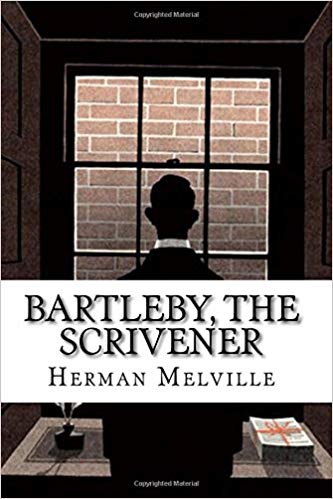
    Bartleby the Scrivener book cover
    The cover of Bartleby the Scrivener: A Story of Wall Street

    One fine day, upon being asked by the narrator to proofread, Bartleby responds with ‘I would prefer not to’, and after that, it becomes his response to pretty much everything that is asked of him. This irks the narrator as well as the other employees, but Bartleby’s stance remains steadfast in that matter.

    The volume of his work declines at a steady pace until one point where he does absolutely nothing but stares at a brick wall out of his office window all day long. Having had to come to work one Sunday, the narrator notices that Bartleby had started living in the office premises.

    The mystery surrounding his constant presence in the office premises and his continual staring at the brick wall deepens and the narrator, thinking that if word spread it could bring bad reputation for his business. In order to devise a plan to mitigate this risk, he makes several futile attempts at trying to know more about him or reason with him to leave the premises.

    Neither money nor the prospect of working someplace new appeals to Bartleby and he continues to live in the office. The narrator was compassionate enough not to have him forcibly removed from the premises.

    Left with no choice, the narrator moves office to another location without letting Bartleby know the whereabouts.

    Although thinking the narrator rid himself of Bartleby, the mystery surrounding his permanent presence at the premises is not solved, until one day, the new tenants come to mention to him the inconvenience that Bartleby’s presence was causing them – he continued to sit on the stairs all day and slept in the doorway at night.

    herman melville portrAIT
    Herman Melville – the author of Bartleby the Scrivener

    The narrator is again brought in to reason with Bartleby, going to the extent of inviting him over to his own residence to live with him, but his request fall on deaf ears. The narrator eventually comes to know that he was forcibly removed from the premises and imprisoned nearby in the Tombs.

    He goes to visit Bartleby in prison, to find him even quieter than usual. He bribes the turnkey to make sure that Bartleby gets enough food. He comes back later another day to check on him only to find out that he died of starvation.

    He comes to know afterwards through rumors, that Bartleby used to work in a “dead-letter” office (a dead letter office is a facility within a postal system where undeliverable mail is processed). 

    The narrator attributes that to be the reason why a man of his temperament, having worked in an even darker environment, might have sunk deeper into depression.

    The story closes with narrator’s exasperated sigh “Ah Bartleby! Ah humanity!”

    Bartleby the Scrivener Analysis

    To think that all this novella received was critical disdain at the time of its release confuses me and pains me at the same time. I couldn’t help but draw parallels between Bartleby’s and author’s life – if Bartleby’s dispassionate No to the kind of work that he didn’t want to do was any indication of the kind of work that was demanded of Melville- but maybe that’s taking my imagination too far.

    Regardless, this short story raises many poignant themes- As relevant as they are now, almost two centuries from when Melville first brought the story to life.

    Bartleby The Scrivener Quotes

    I might give alms to his body, but his body didn’t pain him –it was his soul that suffered, and his soul I couldn’t reach.

    The narrator feels- and rightly so- that Bartleby doesn’t respond to any requests or temptations because his soul is broken. His complete denial to accept any assistance or to find solace in sharing leaves him completely isolated-leaving little chance for people around him to be able to help him, feeling guilty and helpless themselves in return.

    “Nothing so aggravates an earnest person as a passive resistance.”

    How many times have I seen a person being driven completely crazy , and I mean grinding-teeth crazy -by someone that only resists passively, no debating, no reasoning, no active participation in the argument, but sitting back peacefully and saying No to everything that is asked.

    If I was the narrator I would have gone crazy far before Bartleby dies of starvation.

    “I would prefer not to”

    Maybe that was the only thing that Bartleby felt he did, that made him empowered. Having the ability to say Yes or No to things that he did or didn’t want to do. Bartleby is an enigma. Offices should be kinder to their Bartlebys. I am going to be kinder to myself.

    Thank you, Mr Melville, for giving me that voice.

    I can now say ‘I would prefer not to’ aloud.

    “Happiness courts the light, so we deem the world is gay, but misery hides aloof, so we deem that misery there is none.”

    Seeing what we want to see and feel commands so much power on us humans that we are even more blinded to what we don’t want to see or feel widening the gap between happiness and misery disproportionately.

    Bartleby The Scrivener PDF Free Download

    You can download a PDF copy of  Bartleby The Scrivener by clicking here.

    This is a PDF document where you can read Bartleby The Scrivener for free!