Tag: stoicism

  • If You Desire to be Good, Begin by Believing that You are Wicked – Epictetus

    If You Desire to be Good, Begin by Believing that You are Wicked – Epictetus

    I was roaming in the neighborhood library one day, glancing through the books on the shelves to pick one for reading. I noticed that the library folks had put up some quotes from famous personalities on the walls. Francis Bacon, Newton, and Gandhi were all featured. 

    As I head to check out my book, I notice another quote from Epictetus on the wall opposite me. This one by Epictetus – 

    If you desire to be good, begin by believing that you are wicked.

    My first reaction to that was slight confusion – given what wicked means in our times.

    A: Yo, did you finally get that Xbox S you wanted?

    B: Nope, I got an Xbox X instead.

    A: Wicked!

    Thankfully, my brain woke up and reminded me that Epictetus belonged to a time when wicked didn’t mean what it means today. So he must have meant that you must accept the belief that you are an absolute beginner at the craft you plan to master. Your slate needs to be wiped clean. You need to be comfortable being level zero. 

    That’s the only way to avoid your ego working against you. 

    Acquisition of true knowledge of any kind- has to start with humility and a sincere love of learning.

  • Whenever You Are About To Find Fault With Someone, Ask Yourself The Following Question – What Fault Of Mine Most Nearly Resembles The One I Am About To Criticize: Marcus Aurelius

    Whenever You Are About To Find Fault With Someone, Ask Yourself The Following Question – What Fault Of Mine Most Nearly Resembles The One I Am About To Criticize: Marcus Aurelius

    I read this the other day and felt an itch, I would grand it up a little bit by calling it a philosophical version of Hell’s itch. Suffice to say that the itch is painful.

    Fun fact #1

    In my life so far, I am yet to meet a person that likes to be criticized. And I know people that hate the word ‘criticism’  more than COVID.

    Fun Fact #2

    I am yet to meet a person that has not criticized at least one person in their life.

    If you are an ordinary Earthling like me, there is a good chance that both fun facts may apply to you too.

    We don’t like people finding faults in our behavior and pointing them out to us. And there is a good possibility that we disregard the opinion as well as the person that enlightens us with this critical feedback.

    Sometimes things get worse when someone points a fault that we know we have. Ironically the way we use to respond to this criticism is holding resentment or criticizing the person that pointed out our flaw.

    So what is it about this whole criticism game? Why do we so readily dish it out when we can not take it? Why does abstaining from criticism feel like such a Herculean task?

    The reason is simple.

    We love ourselves, sometimes to a fault, plus we all have ego that gets the better of us from time to time.

    After all, the world revolves around us. Doesn’t it?

    Enter Marcus Aurelius.

    “Whenever you are about to find fault with someone, ask yourself the following question: What fault of mine most nearly resembles the one I am about to criticize?” 

    Now this is a very twisted game. Instead of a quick-fix to the criticism problem, when I can simply attack a person when they attack me, feeling a fleeting yet instant second of win, I have to think before I retort now.

    Man, that’s a tough thing to do.

    A conversation that could earlier go like this:

    Dave: What an idiot! How many times do I have to tell you how to do this before you can do it yourself?

    Paul: If you are such an Einstein, why dont u do it yourself?

    Is now going to look like this:

    Dave: What an idiot! How many times do I have to tell you how to do this before you can do it yourself?

    Paul: Yes, you are right. I should have done it myself. I was being as lazy as you.

    OR

    Paul: Yeah, you are right, I guess I am as lazy as you. Let me help you out (same as the last one , minus the sass)

    You and I both know that this entails  a lot of work.

    And a hell lot more deep breathing.

    But I see two very obvious advantages of going through with this exercise:

    1 – I am not going to retort by saying something nasty and then simmer in guilt for days on end.

    2 – My friend whom I did the favor of not criticizing, would probably take the cue and not be an ass next time.

    Basically. it all boils down to patience.

    Next time I am ready to spit venom, I might take a deep breath and selfishly count the days I am going to simmer in guilt of the aftermath of a criticism bout.

    That, I hope, will stop me in my tracks.

    There is more to ‘look before you leap’ than I thought.

  • If Anyone Tells You That A Certain Person Speaks ill Of You, Do Not Make Excuses About What Is Said Of You But Answer, “He Was Ignorant Of My Other Faults, Else He Would Not Have Mentioned These Alone.”: Epictetus

    If Anyone Tells You That A Certain Person Speaks ill Of You, Do Not Make Excuses About What Is Said Of You But Answer, “He Was Ignorant Of My Other Faults, Else He Would Not Have Mentioned These Alone.”: Epictetus

    On one of my random internet surfing days, I came across this meme:

    I am not saying I hate you, but I would unplug your life support to charge my phone meme

    Now if you are like me, you did smile looking at it, didn’t you?

    What you might not have done is put up a mental roster of people that you hate enough to say this.

    I am no angel but I couldn’t think of any person I would actually do that to.

    Although, there are a few that come quite close.

    Jokes aside, I am sure we all have someone that we do not particularly like or find disagreeable, but some people take it to the next level. They’ll say nasty things about others behind their backs.

    And sometimes, these people may not necessarily be on your “I-don’t-like-these-people” list. They may be people whom you considered friends.

    Some of us confront people whom we don’t like and even clear the air. This is a relatively rare occurrence as both parties have to be patient and have an open mind.

    A more common manifestation is hurt and a gnawing feeling to seek revenge. Instead of clearing the air, people try to get back at them by saying things behind their backs too.

    Unless you have complete control over your emotions – you are NEVER going to be indifferent to people saying bad things about you behind your back.

    Like any other human response to an unpleasant situation – you are either going to fight, after all, you love yourself and have to defend yourself to save your honor.

    Or, you may choose to flee (ah, f**k this shit!)

    Sometimes, choosing one of these responses can make things better. But more often than not, they don’t.

    Here is when Epictetus comes to rescue.

    “If anyone tells you that a certain person speaks ill of you, do not make excuses about what is said of you but answer, “He was ignorant of my other faults, else he would not have mentioned these alone.”

    Your first reaction to reading this could be:

    “Wow, this guy is smart”

    OR

    “What a load of c**p, I would rather show them their place.”

    Regardless of the category you belong to, I strongly recommend trying this when someone badmouths you. It works like a charm.

    Epictetus never ever fails to deliver when it comes to practical advice.

    Get ready for your next mic drop moment, thanks to him.

  • Flee Sloth; For the Indolence of the Soul is the Decay of the Body: Cato the Younger

    Flee Sloth; For the Indolence of the Soul is the Decay of the Body: Cato the Younger

    You know what a sloth is, right?

    It is a lethargic, unbelievably slow and might I say adorable animal that lives on treetops and travels 41 yards per day – less than half the length of a football field – on average.

    Cato the Younger, in his famous quote, urges you to “flee sloth.”

    Does he mean flee from a sloth?

    Well, Cato definitely didn’t mean that (I hope).

    But what he means is scarier than that for me.

    Ever seen or been a person that sets an alarm and never EVER wakes up to it?

    Not very proud to say, but I am exactly that person. Every Sunday evening I re-resolve to turn my life around by waking up at 6 in the morning, go for a short run and have breakfast before I start work.

    I have managed to actually do that on precisely ZERO days.

    I am so proficiently a sloth slave that I shut the alarm off in my sleep. And then wonder why didn’t it ring. If ‘sleep shutting an alarm’ was a disease, I suspect that I am in a fairly advanced state.

    So when I was reading a book the other day, this quote felt like a tight slap on the face:

    “Flee sloth; for the indolence of the soul is the decay of the body.”

    Sleeping in till late does make me feel happy that I got good sleep, but that transforms into guilt instantly as soon as I open my eyes in the morning.

    Oh Darn! Not again.

    It’s not that I haven’t tried doing it. I have.

    I have read books on avoiding laziness. I have read numerous books on the benefits of waking up early. I have watched TED talks by people who have had their lives transformed by waking up early.

    What I have failed to do, is act on all that knowledge.

    Maybe reading this was a sign. I have sloth’ed around too much. Today, being a Sunday evening, I am ready for the transformation in my life.

    Time to set the alarm. And hang this advice from Cato right beside the clock.

    Flee sloth; for the indolence of the soul is the decay of the body.

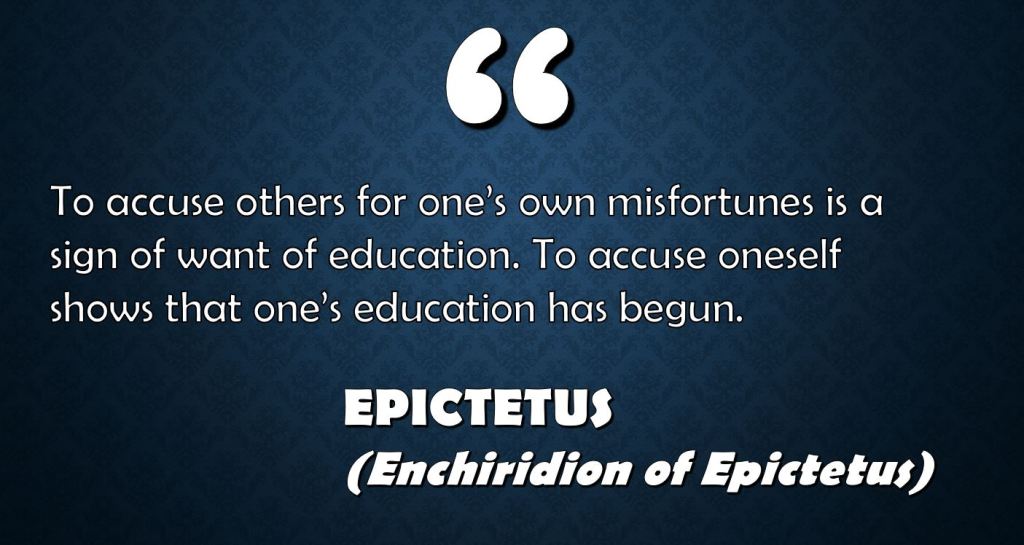
  • To Accuse Others for One’s Own Misfortunes is a Sign of Want of Education. To Accuse Oneself Shows that One’s Education has Begun

    To Accuse Others for One’s Own Misfortunes is a Sign of Want of Education. To Accuse Oneself Shows that One’s Education has Begun

    Wikipedia defines accusation as:

    “….is a statement by one person asserting that another person or entity has done something improper. The person who makes the accusation is an accuser, while the subject against whom it is made is the accused.”

    Now I do not need to be a sScientist to tell you this, but I have a strong inclination to say that almost all of us have donned either of those two roles if not both at some point in our past.

    Why is it so easy for us to do that?

    The answer is simple.

    Self-interest guides a lot of our decision making. We, as a species, are known for that.

    Destroyed forests, ruined marine life, destruction of habitats of non-human life forms, to say a few, are a testimony to that. Truth be told, most of us care more about ourselves than others.

    The Blame Game

    We all think we deserve the best things in the world. And what do we do when something gets in the way of that?

    We blame.

    We blame people.

    We blame circumstances.

    To use psychological terms, we self serve.

    This is when Epictetus holds a mirror to ourselves by this quote:

    “To accuse others for one’s own misfortunes is a sign of want of education; to accuse oneself shows that one’s education has begun and to accuse neither oneself nor others shows that one’s education is complete.”

    So, where do we start?

    We start with self awareness. We spend some time getting to know the person we are. Be cognizant of our strengths and accepting of our weaknesses.

    Let’s consider an example.

    We may want to be a rocket scientist or an astronaut, but ignoring the fact that we suck at Sciences and Math is not going to make the journey easier. Not for us and certainly not for the space mission.

    That is NOT to say that we can not be one in the future; we very well can, if we persist and acquire the required skills.

    Blaming poor scores on a deliberately tough paper set by the teacher is not helping us in any way. By doing that, all we are doing is preserving our ego, not to feel bad that very instant.

    But what we fail to appreciate is the impact such an attitude has on the effort we are capable of putting in.

    Blaming your spouse for your bad mood does not make your mood better, does it? It does just the opposite, and what’s worse is that it atleast doubles the time it’s going to take you both to return to normalcy.

    The answer, as they say, always lies within.

    When something goes awry, instead of looking for factors that help you escape blame, focus on solving the problem at hand. And this is where self awareness will come in handy.

    To err is human. With the acceptance of that error, we acknowledge to ourselves the areas of improvement. And nothing bad ever comes out of self improvement.

    Realization that you are the master of your own fate is sometimes scary, yes, but also empowering.

    As Epictetus points out:

    “..to accuse oneself shows that one’s education has begun”

    Pat yourself on the back for taking a brave step in the direction of this education.

    Remember what our beloved Aristotle said:

    Well begun is half done.