Star Wars has slowly and steadily crept into my hard drive and minimal wardrobe. It has taken decades to be where it is in my life, but I can safely say it is here to stay.
And more than anything else, it is because of Yoda.
Yoda is the grammar-agnostic voice of wisdom, one that makes both my heart and my vocabulary feel good about themselves.
The Star Wars franchise is laden with Yoda’s wise words, and I love that his advice makes its way past time and space to us earthlings.
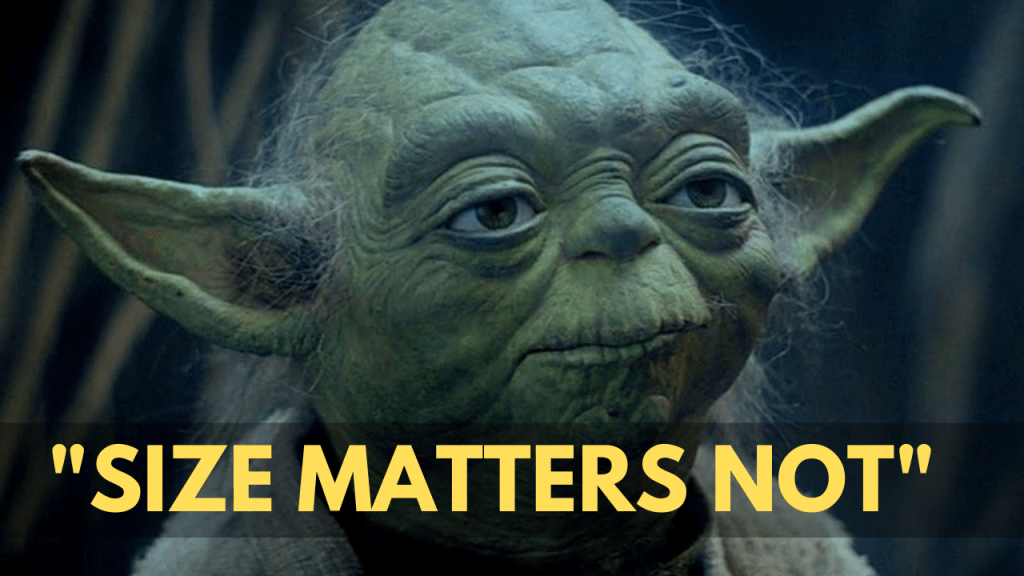
Size matters not. Look at me. Judge me by my size, do you?
Yoda says this in a conversation with Luke, who expresses dismay at his inability to lift his ship out of the swamp.
The ship’s too big.
Soon, Yoda lifts Luke’s ship out of the swamp. Yoda says it’s no different lifting a ship than lifting a rock.
Fascinating stuff, really.
Star Wars aside, I have always found telekinesis incredibly enchanting.
The first few scenes of the movie Birdman, when Riggan Thomson (played by Michael Keaton) was moving things around with his mind and levitating, got my heart racing, but not for long alas!
Just a few seconds later, they indicate it was all in his imagination.
Not that it’s a surprise; telekinesis, of course, is not real. Unless you are in the Marvel Universe or Harry Potter movies.
But the idea of having the objects come to you than you moving around to fetch them tells you loud and clear, who the boss is, no?
Moving away from daydreaming for a minute, the idea of size not mattering is not new. History is replete with figures of authority that had short stature.
I can recall my middle school history teacher regularly citing Napolean as an influential figure, despite his short stature (by the way, he wasn’t that short either).
Maybe that was my teacher’s indirect way to… empower(?) the shorter kids in the class, who the taller, burly ones may frequently bully. Or it was simply him teaching us history. Whatever it was, it had a profound impact on me.
If you removed size from the equation, the playing field was leveled, wasn’t it? In this new imaginary world of mine, the bully’s size didn’t matter, the length of your essays didn’t matter, your height didn’t matter, and your ‘assets’ didn’t matter. What an egalitarian middle school society!
I must have floated on that feeling for a solid five days until I witnessed a basketball match, by mistake, on my way to class. One of my friends, the shortest in the class, was playing basketball with some of my classmates.
It was painful for my eyes and my heart, the twenty seconds of her struggling to get to the ball. It broke my heart just a little bit.
In what now seems like ages later, I chanced upon Yoda’s timeless wisdom, and that memory from childhood came rushing back. I was more mature now.
Yoda (800 years old): Size doesn’t matter.
Me: I know, this was life-transforming advice for me; big fan, big fan!
It happens to be dinner time, and I am eating AND watching this TV series. In one of the scenes, this guy is going about telling people that he is a cop/a Fed/a spy, whichever is convenient in the situation.
At best, people throw a confused look, and at worst, they exclaim, “Oh yeah? What’s with the accent?”
Naturally, in a world these people can make sense of, a Fed/cop/spy can’t have an accent. It just doesn’t sit right.
Of course, I take it personally. After all, where’s the fun in watching something if you don’t picture yourself in the protagonist’s shoes. It’s freakishly easy for me to create this world in my mind, where I am this guy, and people are mocking my accent.
If someone said that to me as they did to that guy, I could see myself reacting in either of these two ways:
Start bawling like a kid right there, which is quite embarrassing considering the grown-ass woman that I am
Smack the perpetrator in the face
As you can see, both of these reactions aren’t ideal and rightfully sit on two ends of the situational response spectrum. Both of them reflect a lack of maturity and emotional resilience to differing degrees.
I consider a middle route between the two, maybe just tears welling in the eyes and me slapping the perpetrator lightly on their face, but that response seems even more pitiable, so I drop it off my simulation.
Thankfully, my attention returns to the show soon enough, and I catch the guy’s response to the perpetrator.
Poker face followed by ‘Oh yeah, what’s with yours?”
What the hell! Why didn’t I think of that!?
Sense returns to me eventually, and I have this epiphany, “Who doesn’t?”
Reading means a lot! A whole lot! Read, and you’ll see at once how sharply your horizons change. And you can get hold of books anywhere.
This excerpt from Chekhov’s short story Reading is a hilarious take on reading and people’s perception about this habit. The story is one of his earlier works, published in 1884. It is also available as part of a short story collection called Fifty Two stories published by Alfred A. Knopf, translated by Richard Pevear and Larissa Volokhonsky.
Reading: Summary and Plot Analysis
The story opens in a government office where Impresario Galamidov and bureau chief Semipalatov are discussing the art and beauty of Russian actresses.
Semipalatov seems to be smitten by one particular young actress and is virtually speechless when he is interrupted by the office clerk, Merdyaev, to sign some official documents. Put off by the sudden interruption, he instead starts ridiculing the ignorance of this man.
You said we no longer have any Gogolian types… But here you see! Isn’t he one? Scruffy, out at the elbows, and look how he writes! Illiterate, like a cobbler! Just look!
Galamidov, taking a quick look at those papers, concludes that Merdyaev does not read much and suggests he picks up the habit to do so. After all, books are easy to get and open horizons.
He even offered to bring some to the office, which he did the next day. Merdyaev was handed a book to read; he was anxious from the very beginning.
His crossed eyes shifted anxiously and seemed to be looking for help from the objects around him.
The old office accountant Budylda tried to console him and offered some friendly advice regarding this Semipalatov mandated reading business. He advised that the clerk read just about enough to keep the chief off his back but warned against the repercussions of much involvement in the clever stuff.
Read a little, and then, God grant, he will forget, and you can drop it. Don’t be afraid. And above all, Don’t get involved in it… Read but don’t get involved in this clever stuff.
Merdyavev tried and tried but couldn’t make anything of it. On an encounter with the chief one day, he froze upon being asked to give a synopsis of what he had read.
The chief was not impressed and implored him to re-read other office folks to pick up books and begin reading. Almost everyone went along with the request except for the accountant, Buldylda. He was having none of it.
No, excuse me, Your Excellency, I’d sooner take my retirement. I know what comes of some of these critiques and writings. On account of them, my older grandson calls his own mother a fool right to her face and gulps milk all through Lent. Excuse me sir!
After repeated tries of making sense of the book given to Merdyaev, feeling helpless, the accountant asked to put in a request to the chief on his behalf to excuse him from reading.
I’ll pray to God eternally for you! Ask his excellency to excuse me… I can’t read. I read day and night, don’t sleep, don’t eat… My wife’s worn out from reading aloud to me, but , God, strike me dead, I understand nothing! Do me this great service!
Budylda tried doing that multiple times, but it just didn’t work. Semipalatov continued reproaching the staff for their ignorance until one fine day, Merdyaev showed up in the office, completely distraught, sobbing and asking for an apology for making counterfeit money and throwing a baby down a well.
Semipalatov, confused, asked Budylda about such behavior and was told that the reading drove him insane.
Merdyaev recovered but not completely. And to this day, he trembles and turns away from the sight of books.
Reading: Review and My Thoughts
The story is an absolute delight. A story on reading itself, how fascinating!
I loved every character in the story, Semipalatov for his relentless pursuit of making his staff more art-friendly, and Budylda for his wisdom in doing and advising others to do just the opposite of that.
Merdyaev, for being the scared rabbit who went through hell and high water to avoid reading and finally freeing the whole office of the curse of reading. If not for him, their office would still be eventful. It would still have life.
If I were to pick up my favorite quote from the story, it would have to be Galamidov saying:
Reading means a lot! A whole lot! Read, and you’ll see at once how sharply your horizons change. And you can get hold of books anywhere.
I am sure you have read this or heard this in some form or the other from someone in your life. Books are a whole new world and a perfect fit for a creature you seldom see at parties. When you do, in a corner glued to the only person they know from the lot or their cellphones, pretending to monitor social media feeds while actually scrolling through stories.
More often than not, this creature, when awake, is found cuddling books when not reading them.
You might be that creature, and his story seems to be dedicated to you.
To me, it felt like Chekhov speaking to his readers, donning Galamidov’s form in the story. Still, unlike Semapalatov’s staff, we are not complaining.
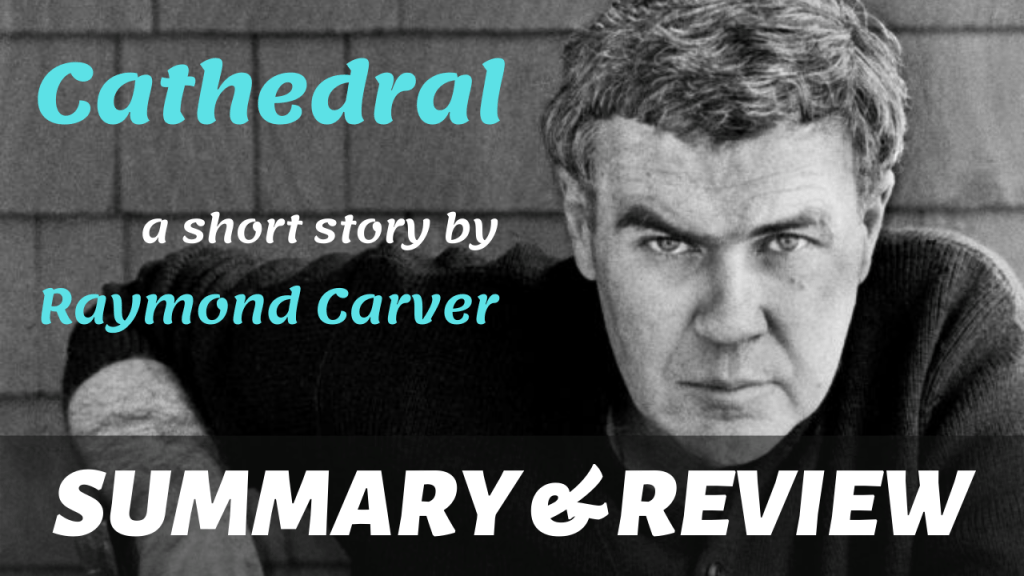
Cathedral is a short story written by Raymond Carver. This story was included in the ‘Best American Short Stories’ (1982). It’s the story of how a man’s perspective about blind people changes dramatically when he meets an extraordinary blind man who introduces him to a new realm of experience.
“Cathedral”
What’s the first thing that comes to your mind when you read this word?
My guess is that you made a mental image of a cathedral, right?
Now here’s a question: how long do you think it’s going to take you to explain your mental image of a cathedral to me so that I see it exactly the same way you do?
5 minutes? 15 minutes? An hour?
And how satisfied are you once you’re done explaining it?
Cathedral, a short story by Raymond Carver, is an immense realization of this. to say the least.
Cathedral Short Story: Summary and Plot Analysis
The story opens with the narrator mentioning a visit from a friend of his wife, one whom he does not seem to particularly like, considering that he is blind.
This friend’s wife has recently died and after returning from one of his relatives’ place, he considers meeting the narrator’s wife, as they live close-by.
The narrator knows quite a lot about this friend – he was a reader. The narrator’s wife met and was employed by this man years ago. On the last day of her job, this blind friend had touched his wife’s face and wrote a poem about it.
Knowing all this, the narrator finds this man’s blindness ‘unsettling’, more than anything else.
The narrator also goes on to give the us (i.e. the readers) a peek into his wife’s past-marriage to a childhood sweetheart, loneliness that had led to a suicide attempt (which she survived) followed by a failed marriage.
Through all these experiences, she continued to keep in touch with her friend. Poems and tapes were the primary means of communication between them. They talked about everything and everyone, including the narrator.
The narrator and his wife have a discussion about the impending visit from her friend, wherein his wife continues urging him to be nice to her friend, while the narrator continues to bring up reservations about the guest being blind.
She tells him about that man’s wife, their married life and her struggle with a terminal disease. All this while, the narrator, seemingly immune to the grief of the blind man, continues to wonder about the unhappiness his wife would have felt thinking he could never see her.
The narrator’s wife goes to pick her friend from the train station, while the husband waits for them at home.
Cover of Cathedral by Raymond Carver. The links to buy this book are provided at the end of this article.
He is shocked to see that Robert (the blind man) sports a beard. This does not seem natural to the narrator. His wife introduces him to Robert and all of them engage in conversation.
The narrator inadvertently asks Robert which side of train did he sit on his way here. He quickly realizes his mistake, but seeing that Robert is unnerved by the question, he’s a bit surprised.
Three of them sit for dinner and stuff their faces. Many things about Robert continue to surprise the narrator, including, Robert not wearing dark glasses, his ability to smoke ‘normally’ and eat and drink effortlessly.
All this starts to challenge the blindness stereotype that he had held in his mind for so long.
While his wife excuses herself for a change of clothes and is gone for quite a while, both men engage in small talk and narrator switches his attention to the television which aired a program about Middle Ages, showing cathedrals from different parts of the world.
This prompts the narrator to ask Robert if he had any idea what a cathedral looked like. Robert requests the narrator to describe one to him but finds him struggling while doing so.
Robert then asks the narrator to bring a pen and paper and draw a cathedral. He puts his hand over the narrator’s hand, following the movement of the narrator’s hand. The narrator continues to draw and finds himself immersed in the experience, in a way that he had never felt before.
At one point, upon Robert’s insistence, he starts drawing with his eyes closed. When he’s done, Robert asks him to open his eyes.
The narrator chooses not to, soaking in his newfound bliss. When he’s asked how it felt, he simply responds with “it really is something”.
Cathedral: Review and My thoughts
The story seems simple, doesn’t it?
But it has a little Thich Nhat Hanh lesson (he’s a famous monk and peace activist who has published over 100 books) for us there – a lesson of mindfulness.
Not only that, it takes a jab at how easy it is for humans to fall prey to stereotypes.
The story sure is short, but has much to offer. The narrator’s reservations about blind people, his completely warped view of the world of disabled is, on some occasions, comical, while at others bordering on apathy.
Some quotes from Cathedral
One of the narrator’s blanket statements about blind people is downright comical.
“I remembered having read somewhere that the blind didn’t smoke, because, as speculation had it, they couldn’t see the smoke they exhaled.”
I couldn’t help but laugh when, on seeing his wife’s thigh exposed, the narrator rushed to cover it, only to put it back when he realized that the only other person in the room was blind.
Here, read for yourself to see if it has the same effect (holding breath in anticipation of your validatory smile):
“(While sleeping) she had turned so that her robe had slipped away from her legs, exposing a juicy thigh. I reached to draw her robe back over her, and it was then that I glanced at a blind man. What the hell! I flipped the robe open again.”
His reminiscence about his wife’s tragic past is sad, but with a slight undertone of jealousy. That man who seemed like a stone, did expose his soft side. I couldn’t help but gush a little when I read this.
“Her officer – why should he have a name? He was her childhood sweetheart, what more does he want?”
And yes, why should a spouse’s ex have a name?
Robert’s positivity and an upbeat temperament is in stark contrast with the narrator’s expectations.
Robert seems to have it all – loving and meaningful relationships, complete immersion in what he does and an undying penchant for learning.
“I am always learning something. Learning never ends. It won’t hurt me to learn something tonight. I got ears.”
Couldn’t get any more cliche than that, eh? Yet valuable just the same.
Learning. Never. Ends.
We have great people from history and the present worldwide vouching for Robert on this one, and for good reason.
It’s ironical that a seemingly indifferent narrator has a profound experience at the hands of someone that he was completely apathetic to, until they share an immersive experience.
Very cleverly, Carver exposed the error of the narrator’s way by showing him that the world he thought he was lacking was actually the one capable of making him feel fulfilled.
A world that showed him better things. A world that makes him see.
I hope I see more from this day on.
Want to read Cathedral?
Cathedral is available on Amazon if you want to get yourself a copy. You are welcome to use the links given below to order a copy:
“….is a statement by one person asserting that another person or entity has done something improper. The person who makes the accusation is an accuser, while the subject against whom it is made is the accused.”
Now I do not need to be a sScientist to tell you this, but I have a strong inclination to say that almost all of us have donned either of those two roles if not both at some point in our past.
Why is it so easy for us to do that?
The answer is simple.
Self-interest guides a lot of our decision making. We, as a species, are known for that.
Destroyed forests, ruined marine life, destruction of habitats of non-human life forms, to say a few, are a testimony to that. Truth be told, most of us care more about ourselves than others.
The Blame Game
We all think we deserve the best things in the world. And what do we do when something gets in the way of that?
This is when Epictetus holds a mirror to ourselves by this quote:
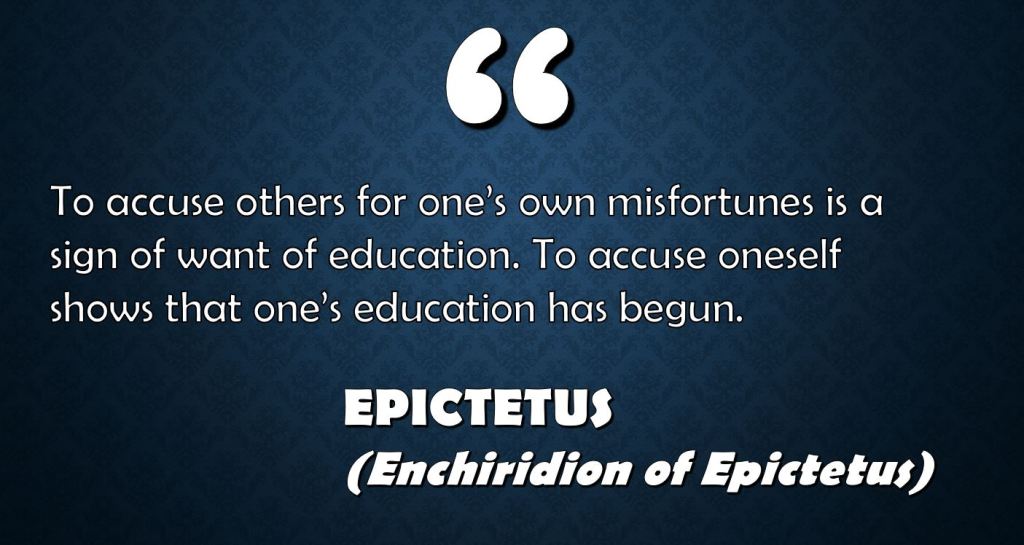
“To accuse others for one’s own misfortunes is a sign of want of education; to accuse oneself shows that one’s education has begun and to accuse neither oneself nor others shows that one’s education is complete.”
So, where do we start?
We start with self awareness. We spend some time getting to know the person we are. Be cognizant of our strengths and accepting of our weaknesses.
Let’s consider an example.
We may want to be a rocket scientist or an astronaut, but ignoring the fact that we suck at Sciences and Math is not going to make the journey easier. Not for us and certainly not for the space mission.
That is NOT to say that we can not be one in the future; we very well can, if we persist and acquire the required skills.
Blaming poor scores on a deliberately tough paper set by the teacher is not helping us in any way. By doing that, all we are doing is preserving our ego, not to feel bad that very instant.
But what we fail to appreciate is the impact such an attitude has on the effort we are capable of putting in.
Blaming your spouse for your bad mood does not make your mood better, does it? It does just the opposite, and what’s worse is that it atleast doubles the time it’s going to take you both to return to normalcy.
The answer, as they say, always lies within.
When something goes awry, instead of looking for factors that help you escape blame, focus on solving the problem at hand. And this is where self awareness will come in handy.
To err is human. With the acceptance of that error, we acknowledge to ourselves the areas of improvement. And nothing bad ever comes out of self improvement.
Realization that you are the master of your own fate is sometimes scary, yes, but also empowering.
As Epictetus points out:
“..to accuse oneself shows that one’s education has begun”
Pat yourself on the back for taking a brave step in the direction of this education.