Category: Quotes

A collection of things that my mind thinks, or has ever thought of

  • “Just when I thought I was out, they pull me back in” – The Godfather

    “Just when I thought I was out, they pull me back in” – The Godfather

    I keep watching and re-watching the Godfather trilogy; I must admit that the third one isn’t as regular of a re-run for me as the other two. 

    There are plenty of timeless Marlon Brando dialogues – delivered with immaculate precision in the movie. 

    But the post is not about him. 

    The post is about Al Pacino’s Michael’s iconic line:

    Just when I thought I was out, they pull me back in.

    Years of guilt from killing his brother burst out of Michael, alongwith the anger and frustration around losing control of the empire he had so painstakingly built. 

    Pacino was so true to the character in that scene. His facial expressions, his voice- everything was so spot on! You could feel his emotions. 

    In short, it was quite the scene. In my book, it’s the best scene in the last installment of this trilogy.

    Well, I watched the movie when I was a kid (or at least I thought I was). That’s the world of a don, I thought. It happens to dons, their stooges, and maybe some other people. All in fiction, though. I didn’t see myself ever saying these words in my life. 

    And the kid that I was, of course, I was wrong.

    Since I grew up, saying that I might have used this sentence at least 500 times would not be an overstatement. Plenty of WhatsApp messages, gifs, Teams chats, Google chats, and inadvertent emails are a testimony to that. 

    No no, this is not restricted to formal/informal friendly settings. It has flooded over to engulf my work life too.

    Don’t you hate it when something you did for someone as a favor gets added to the list of your regular responsibilities, and then eventually you become the only person responsible for the work? 

    Years pass by, and you continue to be accountable for it. 

    You are frustrated with all your requests to move on to other work, learn new things, and fall on deaf ears. You are bored after all, and why wouldn’t you?

    Then one fine day, your good karma pays off. Your manager is in an excellent mood, and you restrike the iron when it is hot. Things go unexpectedly well. 

    Et voila! The albatross is finally off your neck. The ancient mariner has been saved.

    Or so it would seem.

    The desk phone rings; there is an urgent issue that they need your help with. Heart races in reflex and then plummets to the depths of hell when the albatross strikes again. You help and it is resolved. But apparently, you have impressed them so much that they can’t see another person taking the work on, at least in the ‘near’ future.

    And that’s precisely when an image of Michael Corleone flashes before your eyes- extremely agitated.

    Just when I thought I was out, they pull me back in.

    You understand him better now. It is challenging to cope when your end goal is, deceptively, just whiskers away before disappearing into dark oblivion. 

    That ‘I was almost out’ thought consumes you to the core. As you continue to see the scene unfolding in your mind’s eye, you see Michael having a heart attack soon after.

    And a switch flips on.

    You are mature. You are an adult. You can do better than Don Michael Corleone.

  • “When 900 years old, you reach… Look as good, you will not.” – Yoda, Return of the Jedi

    “When 900 years old, you reach… Look as good, you will not.” – Yoda, Return of the Jedi

    I was (re)watching The Return of the Jedi the other day, and this exchange between Yoda and Skywalker made me gasp for breath. As usual, I exaggerate. 

    Surprisingly, it was not the image of my looks at 900 that disturbed me the most, and I think that had to do with the world average mortality rate of less than a tenth of that. 

    So, naturally, I got worried about how I would look at the more believable 90, assuming my junk-laden city lifestyle even allows me to survive that long. Considering my imagination is limited given my mediocre intelligence, I seek the intelligence of search engines out there – and surprisingly, the images brought by the algorithm do precisely the opposite of what I was hoping for.

    Even with all those age-defying state-of-the-art remedies out there, it does not look like we have advanced that much against age.

    Yes, you must be wearing sunscreen every time you step out in the sun (and sometimes without the sun for the habit), you may buy the last advanced age-defying serum from the shelf, you may spend three hours in the gym every day, you may have defeated bugs bunny and popeye in the carrot/salad/spinach-eating contest.

    But the truth remains: cells are born, they mature, and eventually die. 

    It’s ingrained in our DNA. We might be able to slow down the aging process, but not to the extent they showed in In Time – the Justin Timberlake, Amanda Seyfried starrer. 

    The wrinkles have a way of catching up… eventually. I wonder though, if seeing myself growing old is more painful than people telling me that I am?

    Would I be less gloomy and more prepped if I somehow brought myself to accept this eventuality if not embrace it?

    Would I be less depressed and anxious about the things I can’t control?

    While secretly thinking, ‘would that reduce my stress levels enough to reduce the cortisol production in my body, thus reducing inflammation in my body and slowing, if not halting, the pace of aging? 

    Of course, I can’t claim to know the answers to these questions. I do not. There is only one Yoda, and he breathed his last quite a while ago.

    But one thing I do.

    My favorite Yoda quote this is.

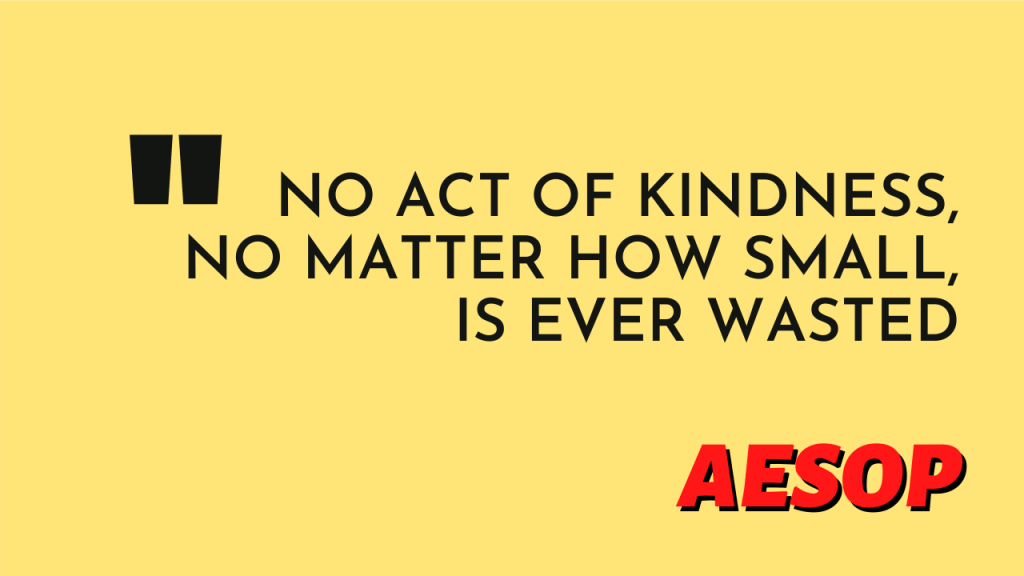
  • No Act of Kindness, No Matter How Small, is Ever Wasted: Aesop

    No Act of Kindness, No Matter How Small, is Ever Wasted: Aesop

    Growing up, Aesop’s fables were my constant companion- in and out of school. The very first illustrated copy that I owned was an abridged version for kids that contained a dozen short stories.

    The Hare and the Tortoise, Crow and the Pitcher, Bell and the cat were some of the predominant few that are probably commonly known childhood staples.

    Now these were no ordinary tales, although they would definitely seem so on the surface. Every story however small it was, would come with a moral, our teacher invariably asking after reading us a story, “So kids, what did we learn from this?”

    The Hare and the tortoise teaches us that slow and steady wins the race, Crow and the Pitcher instills a sense of entrepreneurship and Bell and the cat focuses on devising ideas that are actually actionable.

    The little kid brain of my mine would come alive with the chatter of those characters Aesop created, and as years passed by, all of these animals started becoming more and more human.

    A classmate that just played and didn’t study became the grasshopper from the “Ants and the Grasshopper”, a very intelligent but lazy friend who was never a top 5 in the class became the hare from the “The Hare and the Tortoise” and the enterprising kid from a disadvantaged family became the Crow in the “Crow and the Pitcher”.

    The lines between the stories and life became quite blurred. Needless to say his words were a huge influence on me growing up.

    One story of his, which I have realized I have grown fonder(?) of, over the years is that of the Lion and the mouse. Let me quickly recap it for here for if you have never had the chance to read it or memory betrays you at this point. So, here goes:

    There was a forest in which lived a lion and a mouse. The mouse accidentally ran over the Lion’s nose, which awoke the lion from his nap. The lion, visibly agitated, was about to kill the mouse when she begged him for mercy promising to help him in the future.

    The lion, although amused by this offer, was generous enough to let her go. Some time passed, and one day, the lion was captured by the hunters and was roaring as he was trying to let himself free of the nets. The mouse, upon hearing and recognizing Lion’s voice, comes to the rescue, nibbles on the ropes of the net and sets him free, ultimately making good on his promise.

    Every time I am done reading an Aesop fable, I still hear my Primary school teacher’s voice in my head. “So what’s the moral of story kids?”

    Pretty simple and straightforward. Isn’t it?

    No act of Kindness is ever wasted. But let me atrociously paraphrase it – BE KIND.

    Given the situation all of us find ourselves in, with a virus bringing the world to an unanticipated grinding halt, I can’t stop myself from saying that doing that is more important now than ever.

    It is so heart breaking to see stories of mass unemployment and people hardly being able to make ends meet.

    But then I also see people stepping up and helping out – sometimes by funding campaigns to save local restaurants, sometimes, tipping a restaurant 200 times their check, there is even a group of young professionals in the apartment building that I live in – which volunteers to do the grocery run to help out the elderly so they help them avoid the risk of infection.

    The full bins earmarked for food donation at the local grocery stores, make me hopeful.

    The other day when I was out for a walk, I noticed a poster stapled to one of the pillars by the road side that said “A smile doesn’t cost you anything, but can make someone’s day”. Couldn’t agree more, having been on the receiving end of such kindness on so many occasions.

    There is a colleague at the office, whom I have seen taking the kindness mantra to heart. She has a sticky note on her desktop that says:

    BE KIND

    BE KIND

    BE KIND

    BE KIND

    BE KIND

    (in bold letters, very hard to miss)

    I just couldn’t help myself and ended up asking her, why so many times? And what unkind thing do you do anyway? (She is a really pleasant woman, you would love talking to, by the way) and she tells me this.

    “When in conversations with people, I try to ‘really’ listen when they are speaking,

    I try to make eye contact and smile every now and then.

    Don’t think of me as Mother Teresa or anything, just that I hope that they extend the same courtesy to me when their turn comes”

    This may sound selfish on the surface, but that’s one selfish thing that wouldn’t harm anyone in the world. Or would it?

    Definitely not – Aesop agrees.

  • Whenever You Are About To Find Fault With Someone, Ask Yourself The Following Question – What Fault Of Mine Most Nearly Resembles The One I Am About To Criticize: Marcus Aurelius

    Whenever You Are About To Find Fault With Someone, Ask Yourself The Following Question – What Fault Of Mine Most Nearly Resembles The One I Am About To Criticize: Marcus Aurelius

    I read this the other day and felt an itch, I would grand it up a little bit by calling it a philosophical version of Hell’s itch. Suffice to say that the itch is painful.

    Fun fact #1

    In my life so far, I am yet to meet a person that likes to be criticized. And I know people that hate the word ‘criticism’  more than COVID.

    Fun Fact #2

    I am yet to meet a person that has not criticized at least one person in their life.

    If you are an ordinary Earthling like me, there is a good chance that both fun facts may apply to you too.

    We don’t like people finding faults in our behavior and pointing them out to us. And there is a good possibility that we disregard the opinion as well as the person that enlightens us with this critical feedback.

    Sometimes things get worse when someone points a fault that we know we have. Ironically the way we use to respond to this criticism is holding resentment or criticizing the person that pointed out our flaw.

    So what is it about this whole criticism game? Why do we so readily dish it out when we can not take it? Why does abstaining from criticism feel like such a Herculean task?

    The reason is simple.

    We love ourselves, sometimes to a fault, plus we all have ego that gets the better of us from time to time.

    After all, the world revolves around us. Doesn’t it?

    Enter Marcus Aurelius.

    “Whenever you are about to find fault with someone, ask yourself the following question: What fault of mine most nearly resembles the one I am about to criticize?” 

    Now this is a very twisted game. Instead of a quick-fix to the criticism problem, when I can simply attack a person when they attack me, feeling a fleeting yet instant second of win, I have to think before I retort now.

    Man, that’s a tough thing to do.

    A conversation that could earlier go like this:

    Dave: What an idiot! How many times do I have to tell you how to do this before you can do it yourself?

    Paul: If you are such an Einstein, why dont u do it yourself?

    Is now going to look like this:

    Dave: What an idiot! How many times do I have to tell you how to do this before you can do it yourself?

    Paul: Yes, you are right. I should have done it myself. I was being as lazy as you.

    OR

    Paul: Yeah, you are right, I guess I am as lazy as you. Let me help you out (same as the last one , minus the sass)

    You and I both know that this entails  a lot of work.

    And a hell lot more deep breathing.

    But I see two very obvious advantages of going through with this exercise:

    1 – I am not going to retort by saying something nasty and then simmer in guilt for days on end.

    2 – My friend whom I did the favor of not criticizing, would probably take the cue and not be an ass next time.

    Basically. it all boils down to patience.

    Next time I am ready to spit venom, I might take a deep breath and selfishly count the days I am going to simmer in guilt of the aftermath of a criticism bout.

    That, I hope, will stop me in my tracks.

    There is more to ‘look before you leap’ than I thought.

  • If Anyone Tells You That A Certain Person Speaks ill Of You, Do Not Make Excuses About What Is Said Of You But Answer, “He Was Ignorant Of My Other Faults, Else He Would Not Have Mentioned These Alone.”: Epictetus

    If Anyone Tells You That A Certain Person Speaks ill Of You, Do Not Make Excuses About What Is Said Of You But Answer, “He Was Ignorant Of My Other Faults, Else He Would Not Have Mentioned These Alone.”: Epictetus

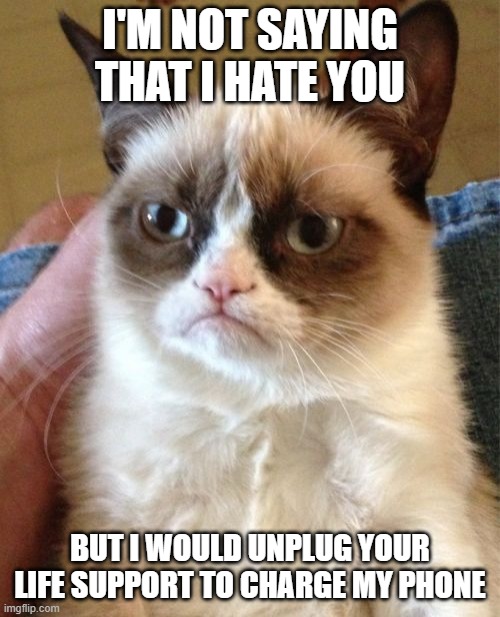
    On one of my random internet surfing days, I came across this meme:

    I am not saying I hate you, but I would unplug your life support to charge my phone meme

    Now if you are like me, you did smile looking at it, didn’t you?

    What you might not have done is put up a mental roster of people that you hate enough to say this.

    I am no angel but I couldn’t think of any person I would actually do that to.

    Although, there are a few that come quite close.

    Jokes aside, I am sure we all have someone that we do not particularly like or find disagreeable, but some people take it to the next level. They’ll say nasty things about others behind their backs.

    And sometimes, these people may not necessarily be on your “I-don’t-like-these-people” list. They may be people whom you considered friends.

    Some of us confront people whom we don’t like and even clear the air. This is a relatively rare occurrence as both parties have to be patient and have an open mind.

    A more common manifestation is hurt and a gnawing feeling to seek revenge. Instead of clearing the air, people try to get back at them by saying things behind their backs too.

    Unless you have complete control over your emotions – you are NEVER going to be indifferent to people saying bad things about you behind your back.

    Like any other human response to an unpleasant situation – you are either going to fight, after all, you love yourself and have to defend yourself to save your honor.

    Or, you may choose to flee (ah, f**k this shit!)

    Sometimes, choosing one of these responses can make things better. But more often than not, they don’t.

    Here is when Epictetus comes to rescue.

    “If anyone tells you that a certain person speaks ill of you, do not make excuses about what is said of you but answer, “He was ignorant of my other faults, else he would not have mentioned these alone.”

    Your first reaction to reading this could be:

    “Wow, this guy is smart”

    OR

    “What a load of c**p, I would rather show them their place.”

    Regardless of the category you belong to, I strongly recommend trying this when someone badmouths you. It works like a charm.

    Epictetus never ever fails to deliver when it comes to practical advice.

    Get ready for your next mic drop moment, thanks to him.