Category: Quotes

A collection of things that my mind thinks, or has ever thought of

  • Flee Sloth; For the Indolence of the Soul is the Decay of the Body: Cato the Younger

    Flee Sloth; For the Indolence of the Soul is the Decay of the Body: Cato the Younger

    You know what a sloth is, right?

    It is a lethargic, unbelievably slow and might I say adorable animal that lives on treetops and travels 41 yards per day – less than half the length of a football field – on average.

    Cato the Younger, in his famous quote, urges you to “flee sloth.”

    Does he mean flee from a sloth?

    Well, Cato definitely didn’t mean that (I hope).

    But what he means is scarier than that for me.

    Ever seen or been a person that sets an alarm and never EVER wakes up to it?

    Not very proud to say, but I am exactly that person. Every Sunday evening I re-resolve to turn my life around by waking up at 6 in the morning, go for a short run and have breakfast before I start work.

    I have managed to actually do that on precisely ZERO days.

    I am so proficiently a sloth slave that I shut the alarm off in my sleep. And then wonder why didn’t it ring. If ‘sleep shutting an alarm’ was a disease, I suspect that I am in a fairly advanced state.

    So when I was reading a book the other day, this quote felt like a tight slap on the face:

    “Flee sloth; for the indolence of the soul is the decay of the body.”

    Sleeping in till late does make me feel happy that I got good sleep, but that transforms into guilt instantly as soon as I open my eyes in the morning.

    Oh Darn! Not again.

    It’s not that I haven’t tried doing it. I have.

    I have read books on avoiding laziness. I have read numerous books on the benefits of waking up early. I have watched TED talks by people who have had their lives transformed by waking up early.

    What I have failed to do, is act on all that knowledge.

    Maybe reading this was a sign. I have sloth’ed around too much. Today, being a Sunday evening, I am ready for the transformation in my life.

    Time to set the alarm. And hang this advice from Cato right beside the clock.

    Flee sloth; for the indolence of the soul is the decay of the body.
  • To Accuse Others for One’s Own Misfortunes is a Sign of Want of Education. To Accuse Oneself Shows that One’s Education has Begun

    To Accuse Others for One’s Own Misfortunes is a Sign of Want of Education. To Accuse Oneself Shows that One’s Education has Begun

    Wikipedia defines accusation as:

    “….is a statement by one person asserting that another person or entity has done something improper. The person who makes the accusation is an accuser, while the subject against whom it is made is the accused.”

    Now I do not need to be a sScientist to tell you this, but I have a strong inclination to say that almost all of us have donned either of those two roles if not both at some point in our past.

    Why is it so easy for us to do that?

    The answer is simple.

    Self-interest guides a lot of our decision making. We, as a species, are known for that.

    Destroyed forests, ruined marine life, destruction of habitats of non-human life forms, to say a few, are a testimony to that. Truth be told, most of us care more about ourselves than others.

    The Blame Game

    We all think we deserve the best things in the world. And what do we do when something gets in the way of that?

    We blame.

    We blame people.

    We blame circumstances.

    To use psychological terms, we self serve.

    This is when Epictetus holds a mirror to ourselves by this quote:

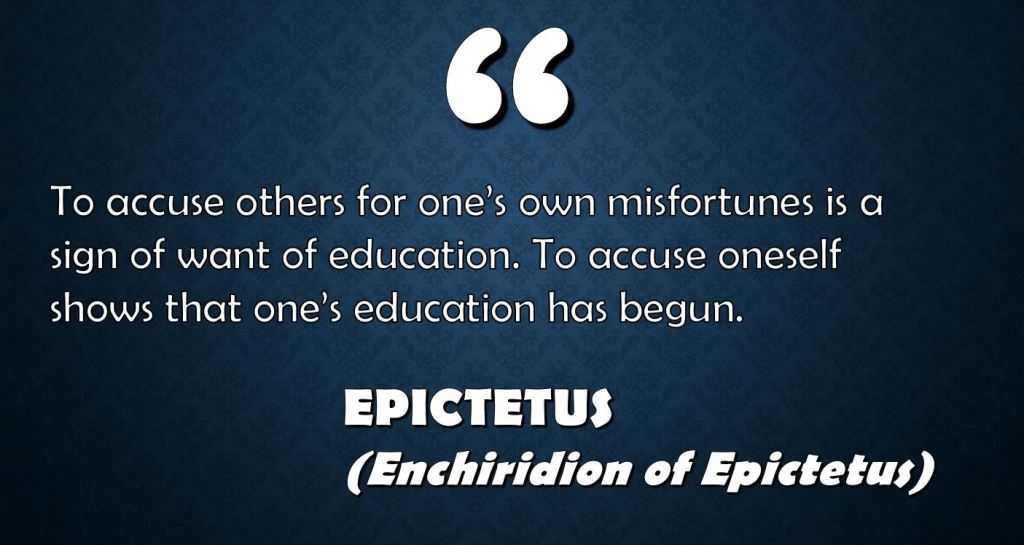
    “To accuse others for one’s own misfortunes is a sign of want of education; to accuse oneself shows that one’s education has begun and to accuse neither oneself nor others shows that one’s education is complete.”

    So, where do we start?

    We start with self awareness. We spend some time getting to know the person we are. Be cognizant of our strengths and accepting of our weaknesses.

    Let’s consider an example.

    We may want to be a rocket scientist or an astronaut, but ignoring the fact that we suck at Sciences and Math is not going to make the journey easier. Not for us and certainly not for the space mission.

    That is NOT to say that we can not be one in the future; we very well can, if we persist and acquire the required skills.

    Blaming poor scores on a deliberately tough paper set by the teacher is not helping us in any way. By doing that, all we are doing is preserving our ego, not to feel bad that very instant.

    But what we fail to appreciate is the impact such an attitude has on the effort we are capable of putting in.

    Blaming your spouse for your bad mood does not make your mood better, does it? It does just the opposite, and what’s worse is that it atleast doubles the time it’s going to take you both to return to normalcy.

    The answer, as they say, always lies within.

    When something goes awry, instead of looking for factors that help you escape blame, focus on solving the problem at hand. And this is where self awareness will come in handy.

    To err is human. With the acceptance of that error, we acknowledge to ourselves the areas of improvement. And nothing bad ever comes out of self improvement.

    Realization that you are the master of your own fate is sometimes scary, yes, but also empowering.

    As Epictetus points out:

    “..to accuse oneself shows that one’s education has begun”

    Pat yourself on the back for taking a brave step in the direction of this education.

    Remember what our beloved Aristotle said:

    Well begun is half done.

  • Do You Ask What is the Proper Limit to Wealth? It is First to Have What is Necessary and Second to Have What is Enough – Seneca’s Letter from a Stoic

    Do You Ask What is the Proper Limit to Wealth? It is First to Have What is Necessary and Second to Have What is Enough – Seneca’s Letter from a Stoic

    Every time I watch the movie Crazy Rich Asians, two things happen:

    Thing #1

    My jaws drop like an idiot. Realizing that, I brace myself, close my mouth and smile like an idiot, my eyes shine like a maniac every ten minutes (or so my people that watch it with me tell me). This continues throughout the movie.

    Thing #2

    I imagine how it would feel, living a life like that – a plush life with all imaginable ‘material’ comforts. Lurking in that imaginary world somewhere is what I call a ‘No Monster’ aka who-are-you-kidding-that’s-not-your-life monster. I inevitably end up sad having recently lost imaginary wealth I acquired a couple of hours ago.

    Who doesn’t want limitless wealth!

    Everyone I know wouldn’t mind having that. I am sure you know other people like that. Chances are you are one of them. Or maybe, you are a lucky one who doesn’t drool over the idea of limitless wealth.

    Lucky for me, having had parents and teachers who introduced me to the magical world of books, I always end up reading to comfort myself.

    I recently chanced upon this quote from Seneca in the book Letters from a Stoic

    Do you ask what is the proper limit to wealth? It is, first, to have what is necessary, and second to have what is enough.

    Hmm… with a brain that is still reeling from the aftermath of Crazy Rich Asians, I attempt to dissect the quote.

    Do you ask what is the proper limit to wealth? It is, first, to have what is necessary.

    Makes you think, eh? How can having just what is necessary make you wealthy?

    But think again, it does make sense.

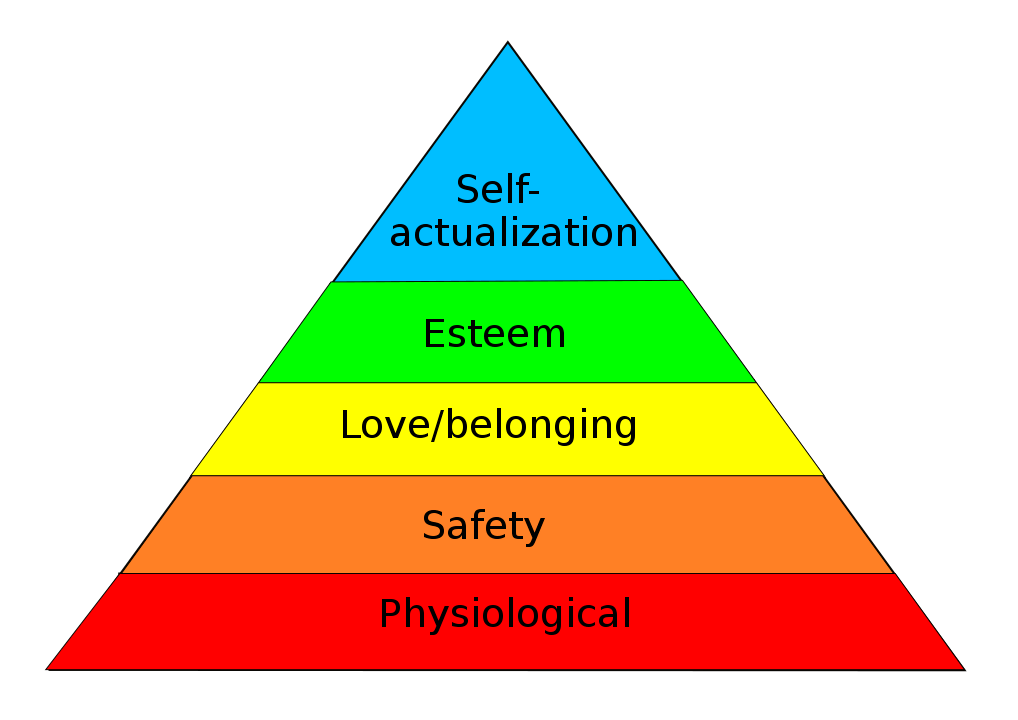
    Think Maslow’s Hierarchy of Needs.

    the pyramid representing Maslow's hierarchy of needs
    Maslow’s hierarchy of needs, represented as a pyramid. As you can notice, the more basic needs of a human being lie at the bottom. As we satisfy one level of needs, we then seek to fulfill the next level of need. This goes on till we reach the top of the pyramid.

    The basic necessities are a must-have – the foundation upon which your future wealth is going to be built.

    If I have what is necessary, I am already halfway there.

    I know I have a roof on my head, food on the table and very fortunately, family and friends that refuse to leave my side, regardless of my excellence at annoying them.

    This is where Seneca packs a power punch: ‘To have what is enough’ needs an ability to control our mind, our whims and fancies. To be able to have the discretion to tell ‘enough’ from ‘too much’.

    After all, we have seen countless examples of people operating in extremes.

    Working insane hours to get that bonus, stabbing people in the back to get that promotion (not literally, I hope), having cosmetic surgeries done on them so many times that they resemble a walking mannequin.

    And even that doesn’t seem enough.

    So, what’s your ‘enough’?

    Having enough could mean having things that facilitate enjoying your life with the ones you hold close, sharing joys and sorrows with them, living a healthy life and growing old gracefully.

    I realize that this doesn’t define ‘enough’ for everybody.

    But that’s the thing, right? It’s you who decides what’s your ‘enough’.

    Just remember this – if at the end of the day, you are not happy or at ease, you’re not doing things right.

    In that case, you might want to recheck your definition of ‘enough’.

    I often find solace in this lovely song from Jungle book (dedicated to all The Jungle Book fans out there!)

    I am not saying that I am immune to Crazy Rich Asians now, because I am not.

    But atleast now I know whose words to seek comfort in next time want and doubt grip me.

    And I thank Seneca for that.

  • So Now You Know What Else Existed In The World Outside Of You, Before You Knew Only About Yourself: Franz Kafka

    So Now You Know What Else Existed In The World Outside Of You, Before You Knew Only About Yourself: Franz Kafka

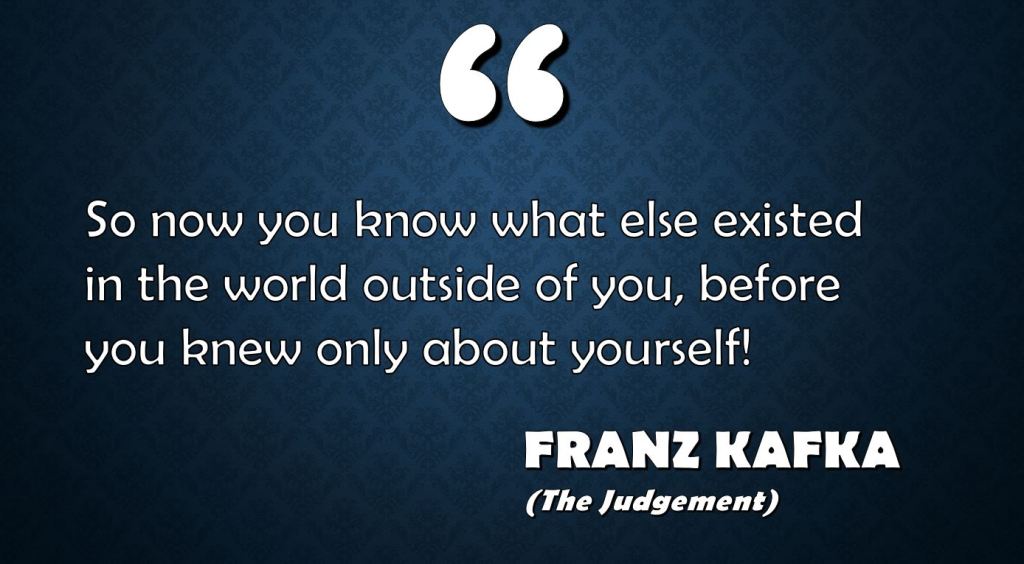
    I read this quote in Franz Kafka’s popular and absolutely amazing short story The Judgement.

    “So now you know what else existed in the world outside of you, before you knew only about yourself!”

    Reading this from the story felt like seeing through a kaleidoscope – moments from my own life where I was either saying this to someone or was at the receiving end of this ‘angry’ remark.

    In the spirit of complete honesty, I did deserve having it said to me on several occasions.

    But on all of them? Hell no!

    However, if you ask me if the people I said it to deserved it, I would probably say yes on most of those occasions.

    Where is this bias coming from? And am I alone in feeling that I am right and the world is wrong?

    Turns out that the answer is NO.

    There is a humongous volume of literature around human selfishness. Glaucon, a Greek philosopher, is known to have mentioned in a discussion with Socrates that people’s good behavior actually only exists for self-interest.

    Hell! Forget literature and just take a look around. Betrayals, fraud and meanness hog headlines in newspapers and prime time television.

    Think selfish leaders driving their own countries to war, or bringing them to the brink of bankruptcy. Think spouses fighting in front of their kids every day. Think an alcoholic father caring for his own pleasure more than the well being of the people who depend on him. Think kids insulting their parents to conform to peer ‘requirements’.

    We are selfish, aren’t we?

    Yes we are, but there is a silver lining.

    We are not all selfish to the extent of narcissism. More often than not, we feel guilty when we realize our mistake. Some of us even act on it and apologize.

    This does two things – we feel better and so does the person we wronged. There’s nothing more relieving than admitting – to someone whom you wronged – that you realize your mistake and regret your behavior towards them.

    Sometimes, when we care for a person too much, we might even swallow our pride and apologize for the mistakes we know we didn’t make (I can see those of who you are spouses or partners smiling at this).

    There are quite a few altruistic people out there – willing to risk their own lives for the greater good. And luckily the world has been producing gentle souls like those since time immemorial as well. And the world is all the better for it.

    Not all of us can be Florence Nightingale, Mother Teresa or Nelson Mandela. If you aspire to be one, go you! I am proud of you.

    But for the less ambitious ones out there, what is our role? What can we do to contribute?

    It’s pretty simple actually….

    Be Kind

    Next time when your spouse fights with you, before retorting, take your time, think what might be causing him/her to behave that way.

    Did you leave them alone to take care of the kids for a month ?

    Did you ditch three dates in a row?

    Did you not offer help with the chores when they were in desperate need?

    Next time when an ageing parent makes a rude remark, instead of getting into ‘self-defense’ mode, try to understand what might have caused them to do it.

    Are they feeling neglected?

    Are they in pain?

    Kindness, like money, grows manifold when invested right. But unlike money, it can’t be stolen or destroyed. Hoarding the currency of kindness only makes our life as well all those it touches better.

    Next time you feel that the world revolves around you, remind yourself that it has got better things to do!

    If you liked this quote from the short story The Judgement (written by renowned author Franz Kafka), you might want to take a quick look at the summary of that story. You can check it out here:

    Short summary of The Judgement: A Short Story by Franz Kafka

  • When There Is No One Left In The Living World Who Remembers You, You Disappear From This World. We Call It The Final Death

    When There Is No One Left In The Living World Who Remembers You, You Disappear From This World. We Call It The Final Death

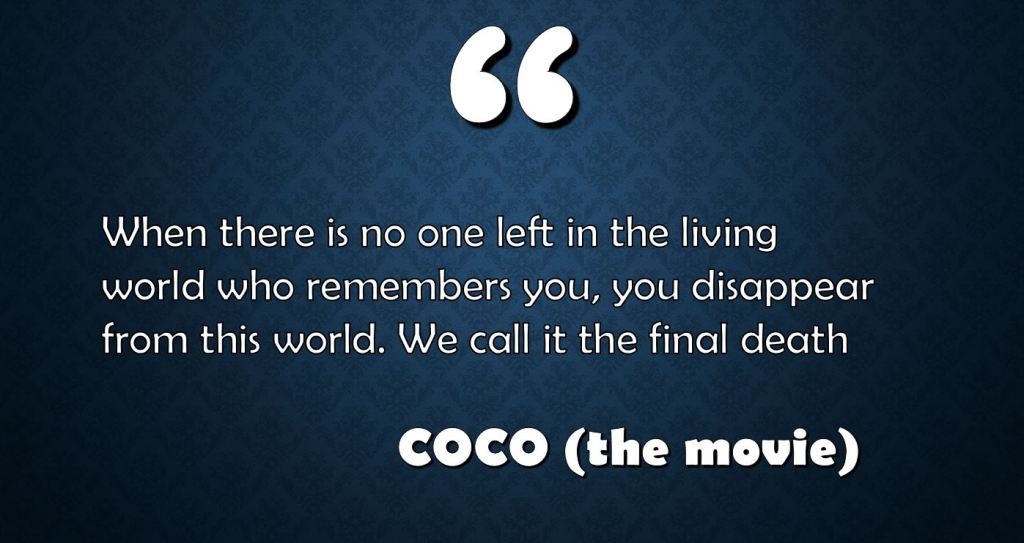
    I got to hear this line recently while watching the Disney-Pixar movie Coco.

    Without ruining the movie for you, this quote is basically about dead people who are alive in their afterlife conditional on people in the living world remembering them.

    You and I both have seen movies emphasizing the importance of familial ties and love.

    But this message from the movie does something else.

    It evokes a sense of fear.

    I replayed the sentence in my head over and over.

    “When there is no one left in the living world who remembers you, you disappear from this world.”

    Let this sink in and I promise you that it would stress you if not outright scare you.

    The good news is that you are not alone in feeling that way. Human beings, in general, are obsessed with leaving a legacy behind. Something for people they left behind to remember them by.

    Because people forgetting them when they are already gone would be… devastating?

    Where might this sense of fear be coming from?

    Could it be that we humans can’t stand the possibility that our lives mean nothing to
    others around us? That we lived our lives in a way that no one is going to remember us – does this imply that we were a failure?

    Could it be ego? Narcissism?

    We creatively manufacture ways to convince ourselves that our actions will affect the future of the world in some remarkable way.

    There is nothing wrong with wanting to have a legacy. But more often than not, the blind focus on the goal of doing something to be remembered by, takes our focus off the equally-important aspect of enjoying the journey to get there.

    If we constantly are under stress working much longer than normal hours, doing things that we don’t enjoy doing and never getting time to spend with the kid that we think we are doing it all for – what do we think the kid is going to remember us for?

    The journey is as important as the goal, if not more.

    Enjoying the journey will always entail enjoying the present. Enjoying the present would include either or all of these things – spending time with our loved ones, doing something for the less fortunate, doing things that make us happy, enjoying what we do.

    In the words of Arthur Ashe, success is a journey not a destination. The doing is often more important than the outcome.

    We are creating our legacy now.

    What’s it going to be?