
Author: Swati

  • After Visiting 20+ Countries, What’s the One Thing You Remember the Most?

    After Visiting 20+ Countries, What’s the One Thing You Remember the Most?

    I was watching The Graham Norton Show the other day. It seemed one of the older ones. That little episode featured Jack Whitehall, Jennifer Lawrence, and James McAvoy. One clip from that episode became somewhat famous, where Mr. Whitehall had a funny anecdote about poop. 

    Jennifer Lawrence burst out laughing when he was done. So did I, all the while being disgusted by my imaginings of the scene.

    That episode reminded me of something rather than someone -a friend from the past. Although his story was much less disgusting, it was fun, nevertheless. I could hardly even call it a story. It was a fact of his life.

    A little context before I jump in: many a time, an icebreaker question that people ask is, “If you get X million in a windfall gain, what would you do with the money?”

    The response could be many things, but ‘travel the world’ usually features in the top 10 of almost every list I have ever come across, including my own.

    Same with this gentleman. Travel was # 3 on his list.

    I later found out that traveling was a passion for the guy. He had already been to around 20 different countries. I was intrigued. 

    He recounted his adventures from being in a variety of different places in Europe, Australia, and Africa. Beautiful places, all. 

    As he entertained requests to point out peculiarities from each of his visits, I imagined myself in all those places, experiencing the culture, the food, and the natural beauty. My imagination had been doing a terrific job of replacing him from all the pictures by me. It was fun visiting all these twenty countries in my head.

    Threatened by my wild imagination, my brain kicked in. He was the hero of these stories. Not me. And I started paying attention.

    Spain was beautiful, the language, the romance, the culture. It was amazing. The hotel that we stayed at had great washrooms.

    Italy has the best food I have ever had in my life. Those people really know how to live. We lived in budget hotels there, but they were spotless. The bathrooms were spick and span!

    .. and so forth

    A curious thing dawned on me. Every time he described a place, by the third or fourth sentence of every description, he would come to the washroom, water closet, powder room, the dunny, or some other version of it. It was becoming evident that clean washrooms were a significant part of his successful travel playbook. 

    Don’t get me wrong; I like clean rooms, washrooms, and everything. My childhood was especially marinated in the ‘Cleanliness is Godliness’ philosophy. Thanks to working parents, who could use more hands cleaning up the mess than making it.

    But it mattered more to the gentleman going by his mention of washrooms at least 30 times in a conversation about 20 countries he visited. 

    It made me question my priorities. 

    Maybe I am not as clean as I am supposed to be. But the lazy being that I am, I was quick to settle on the following: 

    He is way too clean; maybe a freak! He must have some early onset of germophobia or something.

    I let my imagination run wild again. Wilder this time. 

    I imagined getting my hands on his photo albums from all his travels and one photograph after the other – they were all pictures of the loos he had visited. 

    From the most basic to the most exquisite. But all undeniably sparkling clean. 

    No mountains, no beaches, no sunrise, no sunset. Just the loo.

    And then I forgot all about him. 

    Time can do that to you until one day, far from my apartment, loaded on two liters of water with an urgent need to go. 

    I never realized I had a photographic memory until that day as the images from that guy’s photo album played in my head.

  • Mammon and the Archer by O.Henry: Summary, Analysis and Review

    Mammon and the Archer by O.Henry: Summary, Analysis and Review

    Mammon and the Archer is one of the more popular short stories by O. Henry. Published more than a century ago, the story is about wealth, love, and time and how one of those enables the others. 

    It is centered around a wealthy businessman who, by means of his wealth, creates circumstances for his son to propose to a woman who will soon leave the States for Europe.

    Mammon and the Archer: Summary and Plot Analysis

    The story opens in the library of Rockwall mansion. A retired soap manufacturer Anthony Rockwall – the owner – worships ‘Mammon’ (Hebrew for Money). He lives with his son, Richard, in a fifth avenue New York mansion, served by an apparent army of servants.

    He calls for a servant to send for his son. When the young Rockwall shows up, he is gently reprimanded about his frugality before the conversation turns to what money can and can’t do.

    Richard’s opinion that there are certain things money can’t buy is troubling to his old man. After all, he is a Mammon-worshiper, and all his life hasn’t been able to find one thing money can’t do.

    Noticing his son being off for the past few weeks, he enquires about the reason behind his torment and soon learns that he is in love with a woman who’s soon to be leaving for Europe.

    Richard hasn’t been able to get a chance to reveal his emotions or ask for her hand for want of time with her. Even millionaires, he says, can’t buy time.

    Richard’s Aunt Ellen values love over money and even reprimands Rockwall Senior for being so materialistic. She goes on to hand over his wife’s ring to Richard, for it brought luck in love, and he was to give it to the woman he loved.

    As if the gift ignited something in him, he slipped the ring on and ordered a cab right away to meet Miss Lantry.

    He picks her up, and they head to the theater. On the way, he accidentally drops his mother’s ring and stops for a minute to pick it up. During that time, however, there is enormous traffic congestion, and Richard and Miss Lantry are stranded in the cab.

    Fast forward a few hours, Aunt Ellen tells Anthony that Richard proposed, and Miss Lantry accepted amid the holdup. She proclaims the power of love, and Anthony does nothing to refute her argument. 

    It is later revealed that Anthony engineered the holdup with the help of a man named Kelly for a paltry thousand dollars and change. 

    Mammon and the Archer: Review and My Thoughts

    While most of O.Henry’s stories celebrate love over riches, in this one, you could see him leaning on the Mammon’s side. Anthony considers money a powerful tool, and his belief in it is steadfast. At the same time, his son Richard isn’t as thoroughly convinced.

    Here’s Anthony’s take on wealth and its power

    Said the rules of power couldn’t be bucked for a yard by a team of ten millionaires.

    I bet my money on money every time. I have been through the encyclopedia down to Y looking for something you can’t buy with it; and I expect to have to take the appendix next week.

    And here’s Richard’s –

    No, dad, this is one tangle that your money can’t unravel 

    We can’t buy one minute of time with cash; if we could, rich people will live longer.

    Richard’s aunt Ellen, is the same as Ricaard when it comes to matters of the heart. We do hear from her:

    Love is all powerful.

    But in the story, proud denunciation of her brother’s materialistic worldview is in contrast to the final twist: money actually can buy you time. And that was why Richard could afford the tete-a-tete and the resulting proposal. Only in part, though.

    Money wasn’t the only reason.

    Anthony Rockwell, unlike his neighbors, is a self-made man and a caring one. His interactions with his son and his sister reveal that he loves them, despite being a money worshipper. His love for money hasn’t corrupted his emotions for human beings. He spoils his son, gently reprimanding his son for his moderate expenses despite his wealth – 

    You have got as much money to waste as any of them, and yet you stick to what’s decent and moderate.

    At the same time, he doesn’t shy away from solving his son’s problems and affording him time using money.

    While Ellen and Richard are oblivious to Anthony’s part in enabling the proposal and reiterate the Love Reigns theory, he doesn’t feel the need to correct them. Which again speaks to the truth of his love for them.

    That goodness of heart, however, doesn’t stop him from making a wry comment to Mr.Kelly about a kind of naked fat boy, shooting arrows at people- who was nowhere to be seen when the proposal took place.

    Mammon (money), not the fat boy (cupid), was responsible for bringing the lovebirds together.

    Or you might say Anthony Rockwall played cupid.

  • Do or DO NOT; There is No Try: Yoda

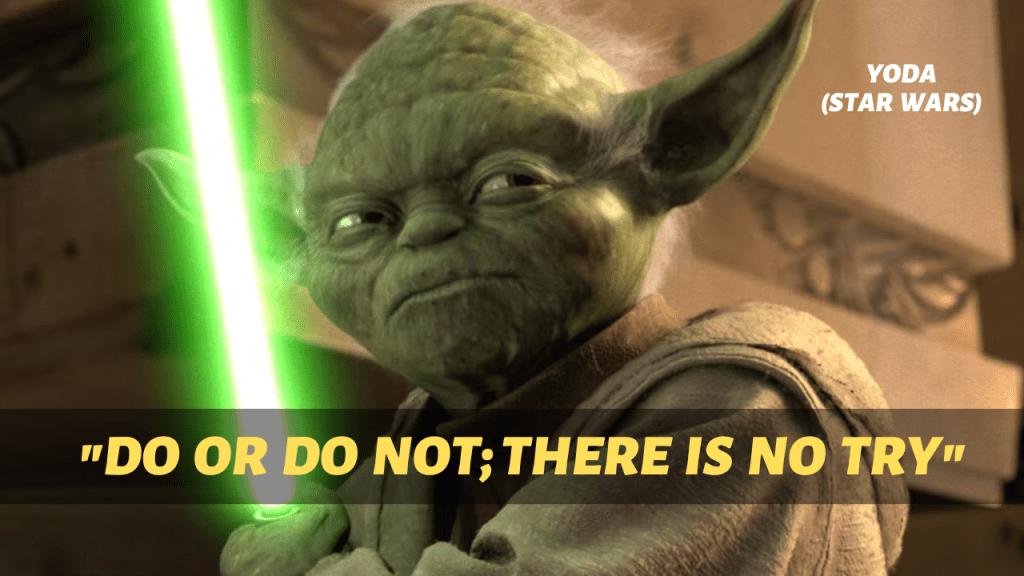
    Do or DO NOT; There is No Try: Yoda

    This character from Star Wars can be seen on T-shirts, Legos, games, soft toys, and miniature figurines, just to name a few. Now, I know a bunch of characters will come to mind, given the popularity of this movie series. But what if I told you, you had to pick the Ancient Wise one? Who will you be taking with you to the meditation/yoga retreat?

    Yoda, I hope.

    Yoda from Star Wars

    There is a reason why Yoda is everywhere. An epitome of wisdom, an inspiration to all Jedi warriors. Look beyond his grammar, and you will find that brief quips are loaded with deep, timeless wisdom.

    Do or Do Not; There is no try.

    To refresh your memory, this is something he says in Dagobah, part of the last instructions to Luke Skywalker, in a bid to make him more committed to the cause. It was all or none when it came to commitment, and the sooner Luke learned that the better, if not easier, his journey would be.

    We have seen the all-time greats constantly marking genius as someone who can distill the most complicated concepts into simple consumable nuggets. 

    Einstein, Feynman, and Shakespeare were all fans of simplicity and simple explanations to drive complexity home.

    Back to basics: 1 or 0. 

    Yes or No. 

    On or Off. 

    You are either in it or out of it. You only have one option.It is as simple as that. 

    You are either getting a 100% on the test , or you are failing. 

    There was a fascinating TED talk by Salman Khan, founder of Khan academy, where he spoke about honing expertise by aiming for a complete wholesome understanding than targeting a certain pass percentage in tests. Isn’t it intimidating to be 100% on everything you touch?

    Needless to say, it is. 

    The Jedi Master was a harsh taskmaster. He wanted it done. He wanted the Jedi masters to be in it. Clear head, clear commitment. 

    The simplest of chinks in the armor can take the greatest warriors down. Luke couldn’t afford it, and the sooner he accepted that, the better for him.

    It might not be hard to digest that there might have been some influence of the Yoda philosophy in James Cameron’s advice when he said:

    “If you set your goals ridiculously high and it’s a failure, you will fail above everyone else’s success.”

    Frankly, there is no other way.

    How do you, my dear reader, feel about that? Is there really no try, just a “do or don’t”?

  • Is This Dream As Weird As It Gets?

    Is This Dream As Weird As It Gets?

    You walk into a restaurant you like, not having eaten for the last 18 hours. The girl at the counter looks pretty, but you have no time to stop n’ chat. You are on a mission—a mission to get a table. 

    Immediately. 

    Right this second. 

    The restaurant seems like a stock market, with loud people yelling at each other from across the room. The lamps at the table are blinding. Your memory of this place was lovely. 

    “This doesn’t look like the same one. Maybe it is. Too difficult to tell.”

    Brain fog. 

    You see a live hog sitting at the table. Now that can’t be true!

    You close your eyes, and open them again. The hog is gone, and so is the receptionist. 

    You close your eyes again to resume the previous scene. A Live hog sitting on my table is better than no table.

    A lady walks right up; she is looking for a receptionist too. She looks pregnant. You need to be polite and let her go first. But hey, there is no proof she is pregnant. She might be obese. Or may not even be there. She might be a hog, for all you know. 

    The receptionist is taking forever. Maybe she has jumped behind the food counter and is working on the fries. Perhaps the fries are complimentary. Maybe the loaves of bread are. Perhaps even the tomato ketchup.

    Are the tissues on her desk edible? Ooooh, Candy cane! Candy canes with caps! 

    Weird, but what the hell, if she takes one more minute, you are chewing that cane. Lollipops are hanging from the ceiling, candy canes on her desk, a Nanaimo bar for a paperweight, and incensed thin mints. 

    Oh, here she comes; she has chocolates in her hand.

    You can’t take it anymore and snatch that bar right out of her hand. 

    She lets out a scream, and so do you. She disappears, and you are sitting in your bed, wide awake, having chewed up half your comforter.

    Must be a dream.

  • The Last Leaf by O.Henry: Summary, Analysis and Review

    The Last Leaf by O.Henry: Summary, Analysis and Review

    The Last Leaf is one of the most popular short stories penned by O.Henry. First published in the early 1900s, this was part of his short story collection, The Trimmed Lamp.

    The Last Leaf by O Henry: Summary and Plot Analysis

    The story, set in Greenwich village, revolves around the lives of two young female artists – Sue and Johnsy, who live together in a small flat on the third floor of an old house. 

    Johnsy, suffering from pneumonia, is critically ill. She lies in her bed without moving, continually staring outside the window, worrying Sue. Her prognosis doesn’t look good, and the doctor expects her end to be near, given her complete lack of will to live, rendering the medicines ineffective.

    Sue tries to make Johnsy a bit more interested in things around her, but to no avail. Sue begins to paint instead but is soon distracted by Johnsy counting backward, looking outside the window. Sue comes to know that Johnsy was counting the leaves left on the ivy creeper, visible from their window. Johnsy also proclaims that the moment of the last leaf from the creeper falling would be her last breath. 

    Sue, worried sick at Johnsy’s statement, tries to show how absurd that thought was and to convince her not to think such things. 

    Knowing that her efforts did little to convince Johnsy, Sue rushes to seek help from another painter downstairs – a 60-year-old man named Behrman. 

    Behrman’s lifelong ambition was to paint a masterpiece, but so far, he hasn’t been able to paint it. 

    Sue mentions her concerns about Johnsy’s lack of will to leave and her belief that she will sleep forever once the last leaf falls. Seeing no sense in such imaginings, Behrman laughs it off but agrees to honor Sue’s request to pose.

    Johnsy was surprised to see the last leaf still clinging to the creeper the following day and the following evening despite the storm. 

    Filled with remorse at her depression and lack of response to her friend Sue, Johnsy stops thinking of death and moves on. 

    Sue is delighted to see her having soup and combing her hair – something she sees as a sign of the return of her desire to live. The visit by the doctor confirms that Johnsy is well on the path to recovery.

    Once fully recovered, Sue lets Johnsy know of Behrman’s death from pneumonia, painting the last leaf which kept her alive.

    The Last Leaf: Review and My Thoughts

    This story brought back flashes of Gift of Magi; however, I surprise myself when I say that I find this one more saddening than the latter. 

    The lonesomest thing in all the world is a soul when it is ready to go on its mysterious far journey. The fancy seemed to possess her more strongly as one by one the ties that bound her to friendship and to earth were loosed.

    While somber at the core, there are a lot of other flavors in the story. Consider the unnamed physician, for example. There is a certain weird comic relief from the unnamed physician that visits Johnsy, 

    I will do all that science, so far as it may filter through my efforts, can accomplish. But whenever my patient begins to count carriages in her funeral procession, I subtract 50 percent from the curative power of medicines. 

    If you will get her to ask one question about the new winter styles in the cloak sleeves , I will promise you a one-in-five chance for her instead of a one-in-ten.

    And then there is quite the strong emotion that Sue betrays, when asked if love with a man was what was root of Johnsy’s misery.

    Has she anything on her mind worth thinking about twice – a man, for instance?

    “A man?” said Sue, with a twang in her voice. Is a man worth – but no, doctor; there is nothing of the kind.

    Not once is there a mention of the families of either Sue or Johnsy. And as far as I can recall, not of Behrman either.

    The girls seem poor and young but devoted to each other and the craft. 

    The old man downstairs: a drunk but soft-hearted; he is willing to go the distance for them. There is a certain purity in their emotion – otherworldly, seemingly embodying art itself.

    O.Henry has painted for us quite the life of struggling artists. I marvel at how astute the painting is. Almost as good, if not better, than Behrman’s masterpiece.