The Stone boy is a short story by Gina Berriault. It was first published in 1957 in Mademoiselle magazine. The story revolves around a nine-year-old boy who accidentally shoots his older brother, but is freakishly calm about it later on.
The short story catapulted its author, Gina Berriault, to international fame when the story was made into a movie in 1984. Before this short story became so popular, her first collection of short stories – The Mistress, and Other Stories – had helped a great deal to establish Gina as a consummate writer.
The Stone Boy: Summary and Plot Analysis
The story is about a nine-year-old boy, Arnold, who lives with her mom, dad, sister and an elder brother, Eugie. Although not very expressive, he admires his elder brother, Eugie in his heart and hopes to grow up to be like him.
One morning he wakes up early to pick peas in the fields with his brother Eugie. He wakes him up and goes downstairs. He then picks up the rifle his dad gave them a few days ago to shoot ducks.
Eugie comes downstairs too, reminds Arnold that it wasn’t duck season and the two boys leave the house for an early morning trip to the fields to pick peas.
They come to the wire fence that divides the fields from the lake. Eugie passes through the fence first. Arnold follows him, but his gun is stuck in the wires.
In an attempt to untangle it, he jerks at it and accidentally fires a shot.
Feeling foolish for making this mistake and bracing himself for the impending
teasing from his brother, he reluctantly walks on but notices that his brother is lying on the ground.
Unable to understand this behavior, he looks more carefully and sees blood on the back of his head.
He realizes that the shot that he accidentally fired ended up killing his elder brother.
Instead of running to his family, informing them about the accident and seeking their help, he stays on in the field to pick peas as if nothing had happened.
To him, it was reasonable to complete the task that he came to do in the first place. Leaving the task incomplete for something that was beyond his control didn’t appeal to his reasoning, logical mind.
He stays on, finishes the task and goes back home. He dreads breaking the news to his family but does so with amazing calm.
Quite unsurprisingly, his family is devastated.
While his mother finds it hard to come to terms with her elder son’s death and Arnold`s pathological calm, his sister completely ignores his presence. His father, in addition to arranging for his son’s funeral, has to take Arnold to the County Sheriff.
Upon being asked to narrate the incidents from the morning that day, Arnold explains everything to his father and uncle Andy. However, he is at a loss of words when asked why he didn’t run back home to announce the news.
His father is puzzled by his cold demeanor, and Arnold starts to feel even more distant and aloof.
The spell of silence finally breaks when the Sheriff arrives.
He asks Arnold a series of questions including why he had the gun in the first place and if he had a “good relationship” with his elder brother.
Although his answers seem extremely cold, which is disconcerting, he concludes that there is no foul play and the shooting was indeed an accident. He lets Arnold and the family go. However, he does mention that the freakishly cold demeanor displayed by Arnold was indicative of a criminal mind in making.
Uncle Andy agrees with Sheriff’s explanation and goes till the extent of mocking his reasonableness. His cousin taunts him as well, saying that his father might have punished him severely if he did the same thing to his brother.
Arnold keeps growing uneasy and even more distant, the weight of judgement from everyone around weighing heavily on him. At night, he eventually goes to his mom’s room to explain to her in person about the events that transpired earlier that day, but his mother, who is still grieving, turns him away.
He feels more and more like a burden on his family – an unwelcome presence and with his brother gone and everyone else around him grieving – he shuts himself off completely, vowing never to be vulnerable again.
The following morning, when his mother asks what he wanted from her, he says “nothing” with a freakish calm, leaving his mother terrified.
The Stone Boy: Analysis and Review
Gina has managed to pack so much power in this short story – it’s unbelievable!
She makes you root for the boy, but not without questioning his judgement (or worse without judging him once). The fact that his reason is mistaken as being completely unfeeling is so inexplicably daunting.
There are certain incidents from the story that are so beautifully human yet painful, such as:
1 – “What did he mean “good friends”?
Arnold was clueless when the sheriff asked if he was ‘good friends’ with his elder brother, whom he had accidentally killed earlier that day.
It’s heart-wrenching to see how this young boy, who had so much love and admiration for his brother, unable to express himself in a socially acceptable form – is perceived to be a criminal in making and stone-cold, or rather, a stone.
2 – Arnold never tired of watching Eugie offer silent praise unto himself
Arnold loved watching his brother look into the mirror, inspecting himself and feeling proud. He secretly wondered if he could ever be able to fill his shoes. If his parents never called him, he thought, he would stay up in the loft forever, out of the way.
When Arnold broke the news to his parents, who disbelievingly went out of the house to see for themselves, Arnold sneaked out to the barn. He was ready for the punishment in case his parents never call him.
He would be prepared to forever live in the same space and stay out of their way. In that very instant, Eugie playful young brother had transformed into someone wholly guilt-ridden and prepared to face the consequences of his actions.
Gina Berriault once said – Short stories and some short novels are close to poetry–with
the fewest words they capture the essence of a situation, of a human being. It’s like trying to pin down the eternal moment.
She has done just that with Stone Boy.
Movie based on The Stone Boy
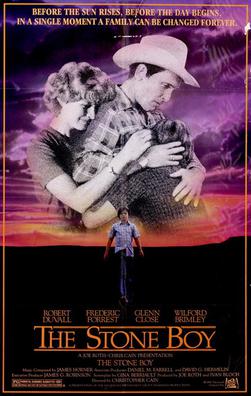
If you are one of those readers that love watching movie adaptations of your favorite reads, you are in for a treat. The movie, The Stone Boy, was released back in 1984 and had Robert Duvall as one of the lead actors.
This movie was one of the reasons why her short story catapulted to instant fame.
Do you want to read The Stone Boy?
The Stone Boy, and other famous short stories written by Gina Berriault can be found on Amazon through the links given below:
Check Price on Amazon US
Check Price on Amazon Canada
Check Price on Amazon India