I call myself a Nolan fan, mostly of his earlier works (to be clear, I fully comprehend what went down in Interstellar and Tenet. wink, wink). The Prestige happens to be my favorite Christopher Nolan movie of all time. I must have seen it more than five times. And given how obsessed I am with it, that number will not be static.
So why the sudden rant about The Prestige?
There are many things I love about the movie, the passionate characters dedicated to their craft and their willingness to go to any levels necessary, the not-so-friendly competition between the magicians, the beautiful women that don’t shy away from holding a mirror to their men, the visionaries, the acolytes – you name it.
But something from the movie that trumps them all in my little universe is the question, “Are you watching closely?”
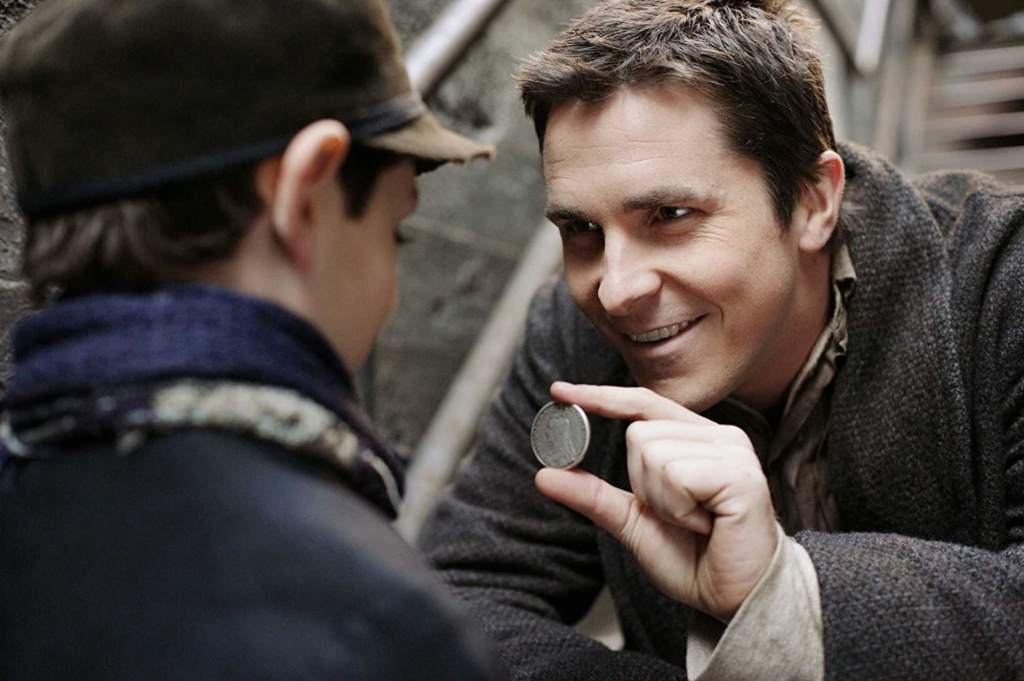
Alfred Borden (played by Christian Bale) during the famous scene in The Prestige
Borden would say that multiple times in the movie, enthralling the audience with his majestic magic tricks. The guy is cheeky enough to challenge his crowd into watching him closely, daring them to expose the flaw in his tricks.
He would not shy away from putting his happiness and even his life on the line for the love of the craft that he held so dear.
Why does the fear of being exposed not threaten him? What infuses in him the bravery of the daredevil? Is it mastery of the craft? Is the attraction of the spotlight much too intriguing?
I have never found an answer that I could find satisfying enough for more than two days.
Are you watching closely?
Like in the movie, this question works on so many levels.
Say I was watching closely, closely enough to have been able to find a flaw in his tricks? Where would that have got me?
Maybe on that path of obsession to be looking for flaws in every magic trick from there on? And why just magic? Maybe that spilled over to every other area of my life?
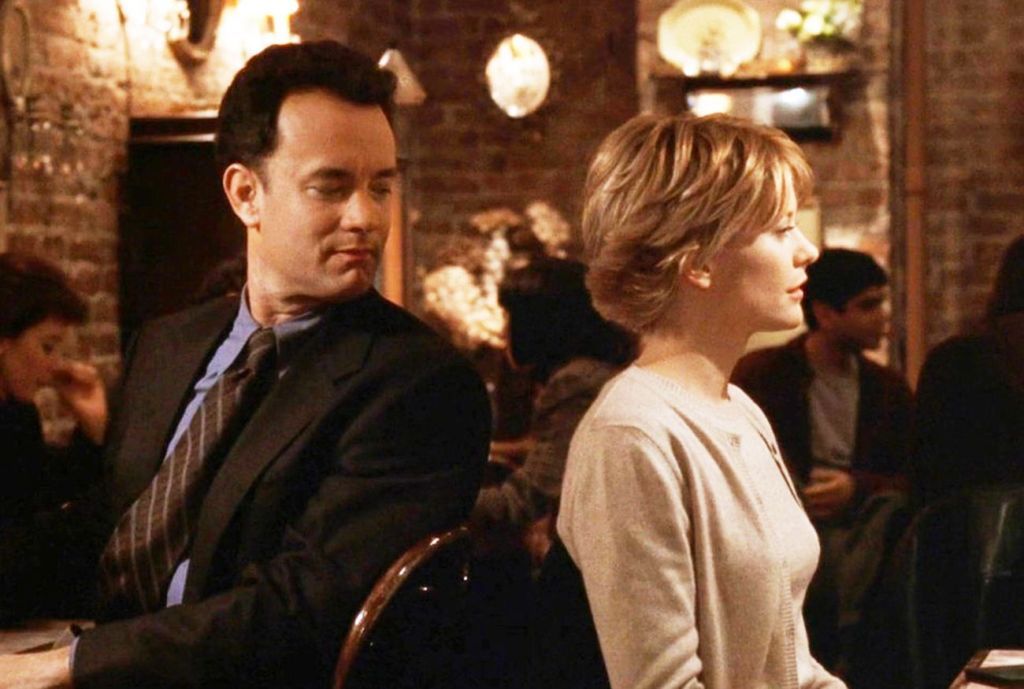
What if I watched every ‘good relationship’ closely enough to see the cracks in it? Maybe I started dissecting every argument I see being made so that I could see where all it had been patched to create the illusion of the truth? Perhaps I would even doubt the perfect relationship between a Mr. Fox and a Ms. Kelly from You’ve Got Mail.
Mr. Fox and Ms. Kelly in You’ve Got Mail
After all, Mr. Fox only went back to see her on their blind date because she was pretty, did he not?
I wonder if watching everything closely would turn me into a disbeliever,a cynic? And do I want to be that?
I do want to see things for what they are. I do! But to what extent do I go? Where do I stop? At what point do I become a Hypocrite if I choose to close my eyes to the truth? And would happiness/contentment elude me if I do?
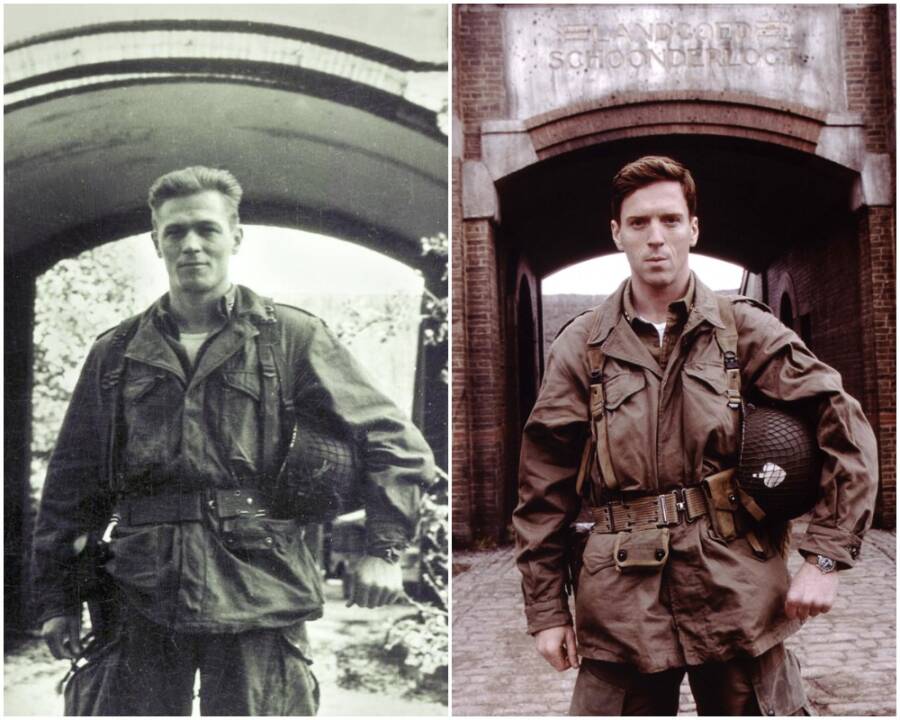
The real Richard Winters (left) and Damian Lewis, who plays the character of Richard Winters in Band of Brothers
I love Richard Winters from the Band of Brothers and Sean Connery in The Hunt for Red October (who doesn’t?), but I made it a point never to research them enough to get to a point where I could find a fly in that love ointment. I am not oblivious to the dangers of doing this.
This logic (if you could even call it that) has a lot of flaws. I have researched enough about Ostrich burying their heads to make their problems disappear. Surprise, Surprise! That isn’t true either, but it is a Roman myth.
So if Alfred Borden were ever to ask me, “Are you watching closely?” he would have a question coming right back at him “Do I want to?”
Every now and then, I would see some images being circulated in the media, beginning with ‘Happiness is..’ so and so. Eating, drinking, sleeping, talking, you name it.
All of those apply to me, by the way. Occasionally, all at the same time. Aside from that, maybe, meeting an old friend I haven’t seen in a very long time in a chance encounter would make the cut. Because it lets me do all the things I love over again… eating, drinking etc., you get the gist.
More often than not, friendship is built on similarities. I am sure you have heard of birds of the same feather flock together.
Now, what happens when you started off being similar, but then you grew more dissimilar over the years? Imagine you and your friend grew up to belong to different social strata; would that alone be enough to strangle your friendship?
“Enough now! Why this tone? You and I have been friends from childhood – no need to go bowing to rank!”
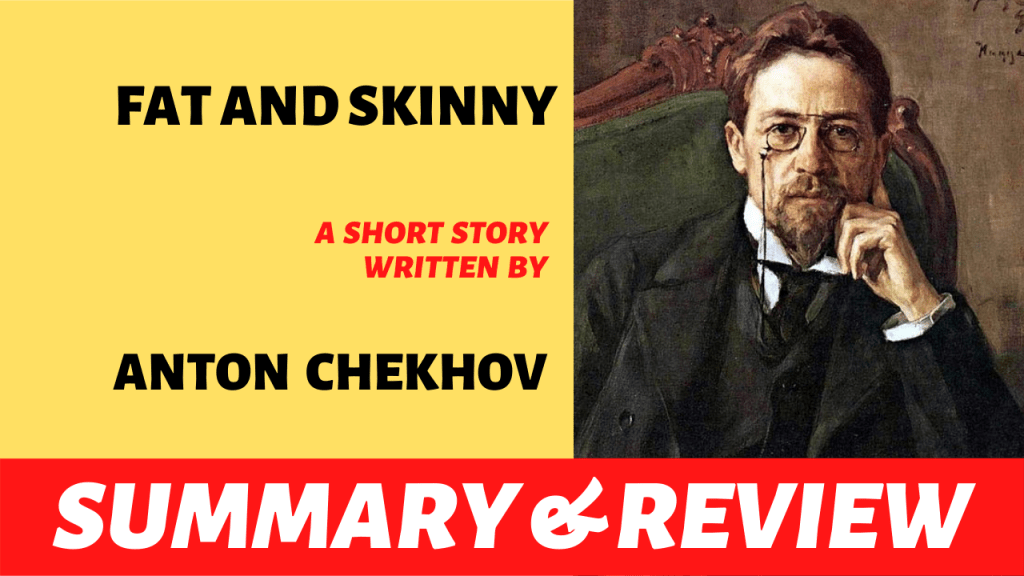
This excerpt from Chekhov’s short story ‘Fat and Skinny’ explores just that- themes of friendship, society, class, and hypocrisy. The story is one of his earlier works, published way back in 1883. It is also available as part of a short story collection called Fifty Two Stories published by Alfred A. Knopf, translated by Richard Pevear and Larissa Volokhonsky.
Disclaimer: Fat and Skinny are just characters in the story; no offense is meant to people of either size by using the references. I have been part of both those size groups in my life so far and currently belong to the former group.
Fat and Skinny: Summary and Plot Analysis
The story opens with a chance encounter between two old friends at a train station- one fat and one skinny. Misha, the fat one, and Porfiry, the skinny one, are visibly happy seeing one another. The tears in their eyes are genuine.
While the fat one is traveling alone, the skinny one is traveling with his family and loses no time in making the introductions for Misha, his wife Louisa, and his son Nathaniel.
They begin talking about work when Misha asks if Porfiry worked for the government and if he had worked his way up. Porfiry makes his living working as a collegiate assessor, supporting his meager salary by a very modest side business and his wife’s music lessons. They are making it work somehow.
Porfiry enquires the same of Misha and gets to know that he has done very well for himself and holds an important government position.
Porfiry’s immediate reaction is of shock, which is quickly replaced by what seems to be a completely fake display of happiness and veneration.
The environment suddenly turns very formal. He starts addressing Misha as ‘sir’. His wife is in shock, whereas his child tries to look more proper for the occasion, standing in attention, buttoning up his shirt.
Misha, detecting a change in the environment, immediately asks his friend to drop the act; they were childhood friends after all!
However, this seems to have an opposite effect on Porfiry, who becomes more formal and servile in his conversations with him. This sickens Misha to the core, who turned to bid farewell; they part company but not before bowing down to Misha with his whole body.
Fat and Skinny: Review and My Thoughts
This story, laden with sharp observations, hits a raw nerve- drawing the contrast between the purity of a friendship in childhood to the utilitarian alliance between the same people in adulthood.
The love between the two friends is evident. Their eyes are filled with tears when they see each other (awwww!); everything between them is still very innocent and pure. They are nostalgic, reminiscing of all the fun they had as children, nicknames, and whatnot.
As soon as the topic of their work and the class came up; things began to change. Even the seemingly disinterested wife and child either cannot hide their shock or are too eager to impress. The minute the friend turns out to be from a different class, he is not a friend anymore – he is an authoritative figure to be revered or impressed.
Maybe Misha is not the one that cares about authority much, Porfiry is still the same childhood friend, but not. The divide of class between them is something that their friendship doesn’t survive. It’s sad to see two friends drifting apart because of that.
The story is sad and painful- because it is realistic. It happens all too often, regardless of whether you live and work in a country with a high or low power distance index. The story is just a painful reminder that there are friends that you are going to lose to sheer ‘class’.
The story made me sad, so I went to seek comfort in Mark twain’s words:
An enemy can partly ruin a man, but it takes a good-natured injudicious friend to complete the thing and make it perfect.
Losing a friend doesn’t sound half as bad now, does it?
Growing up, Aesop’s fables were my constant companion- in and out of school. The very first illustrated copy that I owned was an abridged version for kids that contained a dozen short stories.
The Hare and the Tortoise, Crow and the Pitcher, Bell and the cat were some of the predominant few that are probably commonly known childhood staples.
Now these were no ordinary tales, although they would definitely seem so on the surface. Every story however small it was, would come with a moral, our teacher invariably asking after reading us a story, “So kids, what did we learn from this?”
The Hare and the tortoise teaches us that slow and steady wins the race, Crow and the Pitcher instills a sense of entrepreneurship and Bell and the cat focuses on devising ideas that are actually actionable.
The little kid brain of my mine would come alive with the chatter of those characters Aesop created, and as years passed by, all of these animals started becoming more and more human.
A classmate that just played and didn’t study became the grasshopper from the “Ants and the Grasshopper”, a very intelligent but lazy friend who was never a top 5 in the class became the hare from the “The Hare and the Tortoise” and the enterprising kid from a disadvantaged family became the Crow in the “Crow and the Pitcher”.
The lines between the stories and life became quite blurred. Needless to say his words were a huge influence on me growing up.
One story of his, which I have realized I have grown fonder(?) of, over the years is that of the Lion and the mouse. Let me quickly recap it for here for if you have never had the chance to read it or memory betrays you at this point. So, here goes:
There was a forest in which lived a lion and a mouse. The mouse accidentally ran over the Lion’s nose, which awoke the lion from his nap. The lion, visibly agitated, was about to kill the mouse when she begged him for mercy promising to help him in the future.
The lion, although amused by this offer, was generous enough to let her go. Some time passed, and one day, the lion was captured by the hunters and was roaring as he was trying to let himself free of the nets. The mouse, upon hearing and recognizing Lion’s voice, comes to the rescue, nibbles on the ropes of the net and sets him free, ultimately making good on his promise.
Every time I am done reading an Aesop fable, I still hear my Primary school teacher’s voice in my head. “So what’s the moral of story kids?”
Pretty simple and straightforward. Isn’t it?
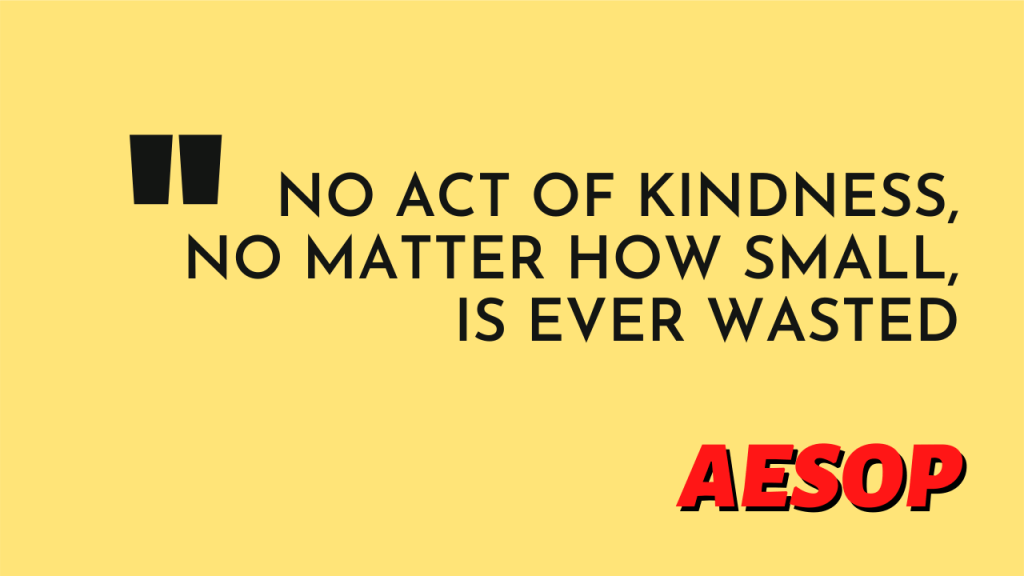
No act of Kindness is ever wasted. But let me atrociously paraphrase it – BE KIND.
Given the situation all of us find ourselves in, with a virus bringing the world to an unanticipated grinding halt, I can’t stop myself from saying that doing that is more important now than ever.
It is so heart breaking to see stories of mass unemployment and people hardly being able to make ends meet.
But then I also see people stepping up and helping out – sometimes by funding campaigns to save local restaurants, sometimes, tipping a restaurant 200 times their check, there is even a group of young professionals in the apartment building that I live in – which volunteers to do the grocery run to help out the elderly so they help them avoid the risk of infection.
The full bins earmarked for food donation at the local grocery stores, make me hopeful.
The other day when I was out for a walk, I noticed a poster stapled to one of the pillars by the road side that said “A smile doesn’t cost you anything, but can make someone’s day”. Couldn’t agree more, having been on the receiving end of such kindness on so many occasions.
There is a colleague at the office, whom I have seen taking the kindness mantra to heart. She has a sticky note on her desktop that says:
BE KIND
BE KIND
BE KIND
BE KIND
BE KIND
(in bold letters, very hard to miss)
I just couldn’t help myself and ended up asking her, why so many times? And what unkind thing do you do anyway? (She is a really pleasant woman, you would love talking to, by the way) and she tells me this.
“When in conversations with people, I try to ‘really’ listen when they are speaking,
I try to make eye contact and smile every now and then.
Don’t think of me as Mother Teresa or anything, just that I hope that they extend the same courtesy to me when their turn comes”
This may sound selfish on the surface, but that’s one selfish thing that wouldn’t harm anyone in the world. Or would it?
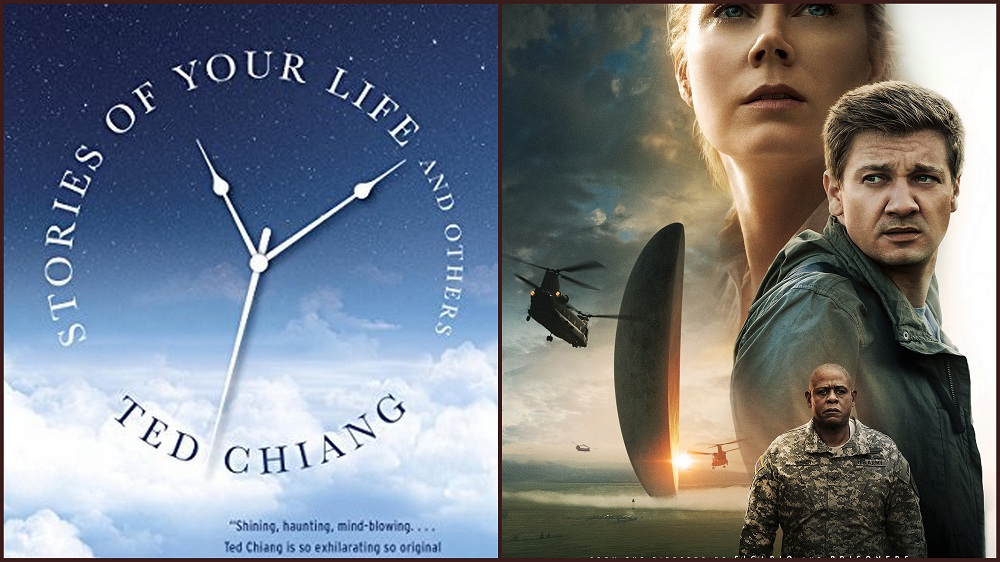
Story of Your Life is a science fiction short story written by Ted Chiang. It was first published 1998. The story revolves around a renowned linguist and how she makes a breakthrough in communicating with the aliens that have landed all over the world in massive spaceships. This story received many accolades and shot to immense popularity following the success of a Hollywood movie ‘Arrival’, which is based on this story.
“Despite knowing the journey and where it leads, I embrace it and welcome every moment.”
What would you do if you somehow chance upon the ability to be able to see your future?
Will that scare you, or will you be hopeful? Or both?
Ted Chiang, in his short story “The Story of Your Life”, brings you some answers in a very humane sci-fi manner, traversing through the themes of language and determinism.
First published in Starlight 2 way back in 1998, this story has received multiple accolades. Its most recent adaptation into a Hollywood movie – Arrival, starring Amy Adams and Jeremy Renner – is a testimony to its ever-growing popularity.
Story of Your Life: Summary and Plot Analysis
The story revolves around Louise Banks, a respected linguist, who is also the narrator of the story. Louise is recounting the events of her life to her daughter and story alternates between glimpses into her past and future.
The story opens with a couple enjoying a romantic dance on a day which happens to be the one where their daughter was conceived.
The pivotal point in the story is the arrival of aliens in spaceships that land in different parts of the world, including the US, Russia, China etc. And not just one or two, a total of 112 gigantic semi-circular spaceships land all over the planet.
These ‘devices’ serve as an audio visual link to the aliens.
This is the alien spaceship which land in different parts of the world. This image is a screenshot of the movie Arrival, which is based on this short story. (Photo Credit: Arrival Movie)
Aliens initiate communication with humans and Dr. Banks and Gary Donnelly (who is a physicist) have been brought in to assist with the process.
Aliens, whom people call ‘Heptapods’, because of their seven limbs and radially symmetrical appearance, communicate in a language that is nothing like any form of language (both written or verbal) that humans have ever known.
Louise and Gary are assigned to 9 “looking glass” sites (that’s what humans call the sites where these spaceships have landed) and start to work with them to understand their language in order to be able to communicate with them.
They work with two aliens, whom they nickname Flapper and Raspberry.
Through a series of conversations with them, Louise realizes that their written and spoken words are not related to each other at all! She and her group refer to speech as “Heptapod A” and the written form of the language as “Heptapod B”.
Through a series of experiments that Louise and her team run to understand the aliens’ language, both in linguistics and physics, they infer that the alien language has a ‘free word order’. In addition to that, their language does not seem to have any linear sequence making it even more complicated to understand.
Not much progress is made until one day Gary explains Fermat’s ‘principle of least time’ to Louise. From this fresh understanding, it dawns upon Louise that similar to the light in Fermat principle (where light knows exactly where it will end up before it chooses its path of travel), aliens know their full sentences beforehand.
Instead of experiencing events sequentially, they experience all of them at once, hence confirming why the Fermat principle resonated with them so much.
Armed with this knowledge, Louise becomes proficient in Heptapod B quickly, but it also alters her understanding of reality. She observes that her train of thought is now absurdly directionless.
She experiences complete immersion in Heptapod B and starts to think in it and perceives time the same way as Heptapods do. She now sees glimpses of a future, a daughter she does not yet have, her daughter’s death and a life she doesn’t have yet.
One day, the aliens announce that they are leaving. They shut down the looking glasses and disappear. It is never established why they came and why they left, although there were rumors flying around that implied that they found human race to be too primitive to be of interest to them.
This knowledge of the heptapod language changes Louise’s life. She knows the future now, but does nothing to alter it.
She knows that she is going to end up together with a man, have a daughter and will lose her when she is still young. Despite this knowledge of her future, she goes on ahead with her life, changing nothing.
Flash back to the present, when Gary asks her if she wants to make a baby, she says yes.
Want to read Story of Your Life by Ted Chiang?
Story of Your Life is a short story which is published in a collection of short stories written by Ted Chiang. You can use the links given below to buy this short story collection on Amazon:
Story of Your Life has won numerous awards for Ted Chiang, including the prestigious Hugo award. Mr.Chiang has this innate ability to convert extremely dense topics to something that you can not only comprehend, but think and marvel at the new perspectives that it brings.
A still from the movie ‘Arrival’ – it is based on A Story of Your Life
This story brings the debate of free will and determinism to the fore. The portrayal could not have been any more gripping and profound than it is. The story shines in its intellect and humaneness.
It has got rich material that will keep both the dreamer and scientist hooked.
Consider for example, how Chiang has broken down the concept of Fermat’s principle:
“Any hypothetical path would require more time to traverse than the one actually taken. In other words, the route that the light ray takes is always the fastest possible one.”
The way that he has married science with philosophy in his story is remarkable. He is known to have remarked once: “Science fiction is very well-suited to asking philosophical questions; questions about the nature of reality, what it means to be human, how do we know the things that we think we know.”
The clarity with which he has presented the linguistic challenges, realizations and the character epiphanies are spellbinding. It speaks to the amount of research that must have gone towards this immaculate description of a linguists approach towards a new language.
And the biggest sentences had an effect similar to psychedelic posters : sometimes eye-watering, sometimes hypnotic.
7 Quotes from Story of Your Life
Here are some quotes from A Story of Your Life that I absolutely loved:
1 – Whether scientists or tourists they were an awfully incurious bunch.
(Referring to the aliens who had landed in different parts of the world but didn’t seem to do anything after they had landed)
It might be the woman in me talking but I found the depiction of mother-daughter relationship extremely heart-warming. At those specific instances in the story I forgot that I was reading science fiction.
Here are some quotes through which the author depicts the beautiful mother-daughter relationship:
2 – Even if I had never laid eyes on you before, I would be able to pick you out from a sea of babies: Not that one. No, not her either. Wait, that one over there. Yes, that’s her. She is mine.
3 – It will be like growing an errant limb, an extension of myself whose sensory nerves report pain just fine, but whose motor nerves do not convey my commands at all. It’s so unfair. I am going to give birth to an animated voodoo doll of myself. I didn’t see it in the contract when I signed up. Was this part of the deal?
A still from the movie ‘Arrival’ – it is based on A Story of Your Life
4 – My own mother could never understand why I couldn’t just be a high school English teacher. You’ll do what makes you happy and that’s all I ask for.
5 – Living with you will be like aiming for a moving target, you will always be further along than I expect. All those vows that I will give reasonable answers when I became a parent, that I would treat my own child as an intelligent, thinking individual,all for naught, I am going to turn into my mother.
6 – I can fight it as much as I want, but there will be no stopping my slide down that long dreadful slope. Not to forget a little lesson in mindfulness that Ted threw in there as a bonus read-
7 – And the lesson in mindfulness – NOW is the only moment you will perceive; you will live in the present sense. In many ways, it’s an enviable state.
And there is always this overarching message in this book, which he very nicely intrigues us with using the Book of Ages ages and the fallacy of the argument that it exists, leaving us with this gem on his favorite topic of free will vs determinism.
8 – From the beginning I knew my destination and I chose my route accordingly. But am I working toward an extreme of joy, or of pain. Will I achieve a minimum, or a maximum?
James Gleick, an American author, speaking about The Story of Your Life once said, “For us ordinary mortals, the day-to-day experience of a preordained future is almost unimaginable.
But Chiang does just that in this story, and with this brings the hope and faith that our present is all the more enriched with authors like him around.”
When I first came across this quote, a short film started playing in my head:
Someone (not me, I promise!) is carrying a cat by its tail; the cat, seeing that its upside down, is understandably confused and angry, violently lunging to attain a normal posture. After several attempts, it finally manages to strike the person with its paw. Tables have turned and now the man is angry and confused.
And the cat, well, it’s beaming with pride. It has had vengeance.
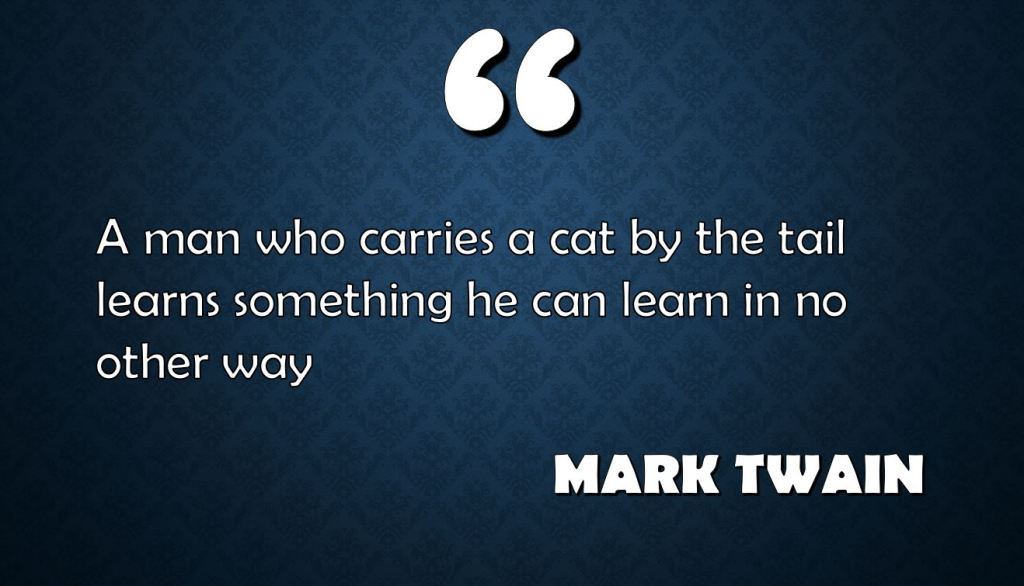
A man who carries a cat by the tail learns something he can learn in no other way.
I couldn’t help but draw parallels with our lives and the challenges that they entail.
Challenges, problems, opportunities- whatever you might want to call them.
Should we or should we not carry a cat by its tail?
There is no one-size-fits-all answer here.
What does this quote mean?
Learning cannot be complete without making mistakes.
Agreed, it is much wiser to learn from mistakes that others make and avoid making them. But that is not always going to be the case.
Individuals are unique, and so are their environments and their learning mechanisms.
Your mom tells you to stay away from the kitchen. You, thinking that you know better, march right in and have boiling water fall on your feet.
You were warned about the cat, weren’t you?
But, you still wanted to hold it upside down by its tail – you wanted to make your own mistake.
When I was a kid, I used to come home with all sorts of cuts and scrapes from all the running and playing around. I would come home crying. My mother would tend to the wounds and tell me that wounds make children grow faster and stronger.
I would believe it and feel proud of the imaginary centimeter that I would add to my height after every scrape.
We all have to carry the cat by its tail at some point to understand that persistence in the face of adversity is what eventually makes us stronger.
Braving difficult circumstances prepares us for ups and downs that life subjects us to. We know we can do it in the future, because we have done it in the past.