Latest Comics

  • Cathedral by Raymond Carver: Summary, Analysis and Review

    Cathedral is a short story written by Raymond Carver. This story was included in the ‘Best American Short Stories’ (1982). It’s the story of how a man’s perspective about blind people changes dramatically when he meets an extraordinary blind man who introduces him to a new realm of experience.

    “Cathedral”

    What’s the first thing that comes to your mind when you read this word?

    My guess is that you made a mental image of a cathedral, right?

    Now here’s a question: how long do you think it’s going to take you to explain your mental image of a cathedral to me so that I see it exactly the same way you do?

    5 minutes? 15 minutes? An hour?

    And how satisfied are you once you’re done explaining it?

    Cathedral, a short story by Raymond Carver, is an immense realization of this. to say the least.

    Cathedral Short Story: Summary and Plot Analysis

    The story opens with the narrator mentioning a visit from a friend of his wife, one whom he does not seem to particularly like, considering that he is blind.

    This friend’s wife has recently died and after returning from one of his relatives’ place, he considers meeting the narrator’s wife, as they live close-by.

    The narrator knows quite a lot about this friend – he was a reader. The narrator’s wife met and was employed by this man years ago. On the last day of her job, this blind friend had touched his wife’s face and wrote a poem about it.

    Knowing all this, the narrator finds this man’s blindness ‘unsettling’, more than anything else.

    The narrator also goes on to give the us (i.e. the readers) a peek into his wife’s past-marriage to a childhood sweetheart, loneliness that had led to a suicide attempt (which she survived) followed by a failed marriage.

    Through all these experiences, she continued to keep in touch with her friend. Poems and tapes were the primary means of communication between them. They talked about everything and everyone, including the narrator.

    The narrator and his wife have a discussion about the impending visit from her friend, wherein his wife continues urging him to be nice to her friend, while the narrator continues to bring up reservations about the guest being blind.

    She tells him about that man’s wife, their married life and her struggle with a terminal disease. All this while, the narrator, seemingly immune to the grief of the blind man, continues to wonder about the unhappiness his wife would have felt thinking he could never see her.

    The narrator’s wife goes to pick her friend from the train station, while the husband waits for them at home.
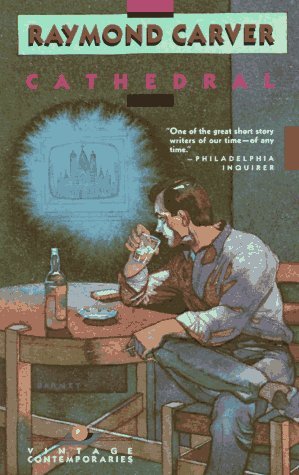
    cathedral by raymond carver book cover
    Cover of Cathedral by Raymond Carver. The links to buy this book are provided at the end of this article.

    He is shocked to see that Robert (the blind man) sports a beard. This does not seem natural to the narrator. His wife introduces him to Robert and all of them engage in conversation.

    The narrator inadvertently asks Robert which side of train did he sit on his way here. He quickly realizes his mistake, but seeing that Robert is unnerved by the question, he’s a bit surprised.

    Three of them sit for dinner and stuff their faces. Many things about Robert continue to surprise the narrator, including, Robert not wearing dark glasses, his ability to smoke ‘normally’ and eat and drink effortlessly.

    All this starts to challenge the blindness stereotype that he had held in his mind for so long.

    While his wife excuses herself for a change of clothes and is gone for quite a while, both men engage in small talk and narrator switches his attention to the television which aired a program about Middle Ages, showing cathedrals from different parts of the world.

    This prompts the narrator to ask Robert if he had any idea what a cathedral looked like. Robert requests the narrator to describe one to him but finds him struggling while doing so.

    Robert then asks the narrator to bring a pen and paper and draw a cathedral. He puts his hand over the narrator’s hand, following the movement of the narrator’s hand. The narrator continues to draw and finds himself immersed in the experience, in a way that he had never felt before.

    At one point, upon Robert’s insistence, he starts drawing with his eyes closed. When he’s  done, Robert asks him to open his eyes.

    The narrator chooses not to, soaking in his newfound bliss. When he’s asked how it felt, he simply responds with “it really is something”.

    Cathedral: Review and My thoughts

    The story seems simple, doesn’t it?

    But it has a little Thich Nhat Hanh lesson (he’s a famous monk and peace activist who has published over 100 books) for us there – a lesson of mindfulness.

    Not only that, it takes a jab at how easy it is for humans to fall prey to stereotypes.

    The story sure is short, but has much to offer. The narrator’s reservations about blind people, his completely warped view of the world of disabled is, on some occasions, comical, while at others bordering on apathy.

    Some quotes from Cathedral

    One of the narrator’s blanket statements about blind people is downright comical.

    “I remembered having read somewhere that the blind didn’t smoke, because, as speculation had it, they couldn’t see the smoke they exhaled.”

    I couldn’t help but laugh when, on seeing his wife’s thigh exposed, the narrator rushed to cover it, only to put it back when he realized that the only other person in the room was blind.

    Here, read for yourself to see if it has the same effect (holding breath in anticipation of your validatory smile):

    “(While sleeping) she had turned so that her robe had slipped away from her legs, exposing a juicy thigh. I reached to draw her robe back over her, and it was then that I glanced at a blind man. What the hell! I flipped the robe open again.”

    His reminiscence about his wife’s tragic past is sad, but with a slight undertone of jealousy. That man who seemed like a stone, did expose his soft side. I couldn’t help but gush a little when I read this.

    “Her officer – why should he have a name? He was her childhood sweetheart, what more does he want?”

    And yes, why should a spouse’s ex have a name?

    Robert’s positivity and an upbeat temperament is in stark contrast with the narrator’s expectations.

    Robert seems to have it all – loving and meaningful relationships, complete immersion in what he does and an undying penchant for learning.

    “I am always learning something. Learning never ends. It won’t hurt me to learn something tonight. I got ears.”

    Couldn’t get any more cliche than that, eh? Yet valuable just the same.

    Learning. Never. Ends.

    We have great people from history and the present worldwide vouching for Robert on this one, and for good reason.

    It’s ironical that a seemingly indifferent narrator has a profound experience at the hands of someone that he was completely apathetic to, until they share an immersive experience.

    Very cleverly, Carver exposed the error of the narrator’s way by showing him that the world he thought he was lacking was actually the one capable of making him feel fulfilled.

    A world that showed him better things. A world that makes him see.

    I hope I see more from this day on.

    Want to read Cathedral?

    Cathedral is available on Amazon if you want to get yourself a copy. You are welcome to use the links given below to order a copy:

    Check Price on Amazon US
    Check Price on Amazon Canada
    Check Price on Amazon India

  • Cupid and the Paintbrush by PG Wodehouse: Summary, Plot Analysis, Review

    Cupid and the Paintbrush is a short story written by PG Wodehouse – an English author and one of the most popular humorists of the 20th century. The story revolves around a man who proposes marriage to his love interest through a unique contest. 

    Let’s take a look at the plot summary of the short story:

    Cupid and the Paintbrush: Summary and Plot Analysis

    The story starts with the narrator (who is not named anywhere in the story except for his initials “R.A”) talking to Marjorie – his love interest.

    The narrator tries to persuade Marjorie to get married to him. Marjorie, however, is reluctant about the idea of marrying him. She insists that she would “make him wretched”, and that he would “hate the sight of her in a few years” and that he has no idea what she’s really like.

    RA doesn’t back down and continues trying to convince Marjorie to marry him. She remarks that she has nothing against marrying him per se, and that she actually likes him too, but it’s the idea of marriage that she is unsure about.

    R.A is puzzled by this. “What is your objection to marriage in the abstract? Tell me the worst. Are you a woman with a mission?” he asks.

    “Well, I suppose, I am, in a way. I want to paint.” she replies.

    He then asks why would that stand in the way of her marrying him. She explains that she wouldn’t paint so much once she is married to him as she would get lazy.

    RA assures her that that wouldn’t happen, as he is something of an artist himself. He then proposes a bargain to Marjorie.

    “We will each paint a picture for the Academy this year, and whoever paints the better one has his or her way in the matter. Do you agree?”

    Marjorie, after a little hesitation, accepts the offer.

    The couple meets again after 15 days and discuss the progress they’ve made with their respective pictures.

    RA, very cheerfully, informs Marjorie that he has chosen an allegorical subject for his picture. He intends to “represent a beautiful young lady dressed in a neat creation of white, standing on a rustic bridge with her back to a rather sweet thing in Turneresque sunsets.” He has titled the painting “Waiting”.

    Marjorie then tells him that she is painting a landscape which has a cow in a corner.

    RA is now convinced that his painting will easily win this contest, because the President (presumably the judge of the contest) will remember the beautiful young lady from his painting, and will hand him the win.

    After the result of the contest is declared. RA pays a visit to Marjorie’s house, where he finds her crying.

    He inquires if her picture was rejected.

    “Yes” Marjorie sobs. “I see how silly I was ever to think that I could paint.”

    RA consoles her and mocks his stupid contest. Once again, he implores her to marry him.

    An emotional Marjorie says yes.

    They embrace each other and make love.

    Afterwards, RA tells Marjorie that he came in to ask her to accept his marriage proposal despite that stupid wager.

    “But you won it.” says Marjorie.

    RA then informs her that his painting also failed to impress “the Committee”.

    Marjorie is surprised. “What! You were refused?”

    “My picture was. I was accepted. By you. Don’t move.”

    Following a long silence, RA proposes that they take to photography, share the same camera and “develop off the same plate”.

    Marjorie comments that she realized that she never did think very highly of “the Academy”.

    RA replies “Exactly what I have always thought about it. Don’t move.”

    And the story ends with a rather cryptic line “She did not move”.

    You can read the full version of this short story here

    Cupid and the Paintbrush Review

    This short story by Wodehouse is, in many ways, very much like his other stories. There is an underlying theme of humor which keeps you hooked to the characters and the plot.

    However, this story is a little unusual in the way it concludes.

    In the last few lines of the story, RA asks Marjorie to “not move” and she obliges by not moving. In the very last line of the story, Wodehouse emphasizes that Marjorie didn’t move.

    This makes you wonder – is there a hidden meaning to this “do not move” reference? Has Wodehouse tried to convey something here?

    I can assure you that when you read the story for the first time (which I highly recommend, by the way), you are highly likely to be puzzled by its conclusion.

    Wodehouse has left it to readers’ imagination to make their own interpretations of the story.

    What happens at the end of Cupid and the Paintbrush?

    The end of Cupid and the Paintbrush is really cryptic as the story ends with “she did not move” in reference to Marjorie – the love interest of the narrator.

    Let me share with you two interpretations that I made of the story’s ending:

    The narrator was proposing to paint her, not marry her?

    One way to look at the ending of the story is that right from the start, he sought Marjorie’s permission to paint her. This is conveyed in the story by means of R.A proposing marriage to Marjorie, when, in fact, he was proposing painting a picture of her, and wanted her to say yes.

    Marjorie is not a real person?

    One interpretation that I drew about the story’s ending is that Marjorie is not a real person. Rather, it’s an imaginary individual who R.A (who’s a painter) has fallen in love with, wants to draw her. Maybe that’s why he keeps asking Marjorie to not move (so that he could paint her)?

    To be honest, I am really not sure what Wodehouse wanted to convey through the conclusion of this story. These are the two interpretations that I made.

    However, I would love to hear your thoughts on it.

    Here’s a challenge for you: What’s your interpretation of the ending of Cupid and the Paintbrush?

    Share your thoughts and get featured on this website!

    What do you think happens at the end of Cupid and the Paintbrush? What does it mean when R.A says the mysterious line “she did not move” in the end?

    If you want to read the original copy of this short story by PG Wodehouse, you can read it here – it’s not more than 4 pages.

    Please take a look at the story and share your interpretation of its conclusion in the Comments section. We would love to hear your thoughts.

    If your interpretation of the ending fills all gaps and connects all dots of the story convincingly, then we would feature your interpretation in this article and credit you for it.

    What our fellow FriendsofWords (FOWs) are saying

    Sanebishop, a reader of FriendsofWords, agrees with my first interpretation of the ending, i.e. RA proposed to paint Marjorie, not marry her.

    Sanebishop also presented an interesting perspective: could we be missing something that was more obvious 100 years ago, when Wodehouse originally wrote this short story?

    I must admit that I had overlooked this aspect of the story – it is a century old tale!

    Many things make sense only in a specific time period. There are many examples of stories, novels and movies that were huge successes when they first released decades ago, but if you read or watch them today, it’s possible that you may feel “That book/movie isn’t that great. I don’t understand why it got so popular.”

    Is it possible that we, reading the story today, are missing something that made sense 100 years ago?

    If that’s the case, then what is it that we’re missing?

    In the end, let me just say this – this is a really underrated and relatively unknown short story from Wodehouse.

    Believe me, I talked to a lot of people about the ending of this short story, but surprisingly, most people were unable to crack the mystery of the “did not move” line at the end.

    I was first challenged to interpret the ending of the story by a friend. In response, I came up with two interpretations, which, in my opinion, are not as watertight as I’d like them to be.

    Now, my dear reader of FriendsofWords, I present the challenge to you!

  • Whenever You Are About To Find Fault With Someone, Ask Yourself The Following Question – What Fault Of Mine Most Nearly Resembles The One I Am About To Criticize: Marcus Aurelius

    I read this the other day and felt an itch, I would grand it up a little bit by calling it a philosophical version of Hell’s itch. Suffice to say that the itch is painful.

    Fun fact #1

    In my life so far, I am yet to meet a person that likes to be criticized. And I know people that hate the word ‘criticism’  more than COVID.

    Fun Fact #2

    I am yet to meet a person that has not criticized at least one person in their life.

    If you are an ordinary Earthling like me, there is a good chance that both fun facts may apply to you too.

    We don’t like people finding faults in our behavior and pointing them out to us. And there is a good possibility that we disregard the opinion as well as the person that enlightens us with this critical feedback.

    Sometimes things get worse when someone points a fault that we know we have. Ironically the way we use to respond to this criticism is holding resentment or criticizing the person that pointed out our flaw.

    So what is it about this whole criticism game? Why do we so readily dish it out when we can not take it? Why does abstaining from criticism feel like such a Herculean task?

    The reason is simple.

    We love ourselves, sometimes to a fault, plus we all have ego that gets the better of us from time to time.

    After all, the world revolves around us. Doesn’t it?

    Enter Marcus Aurelius.

    “Whenever you are about to find fault with someone, ask yourself the following question: What fault of mine most nearly resembles the one I am about to criticize?” 

    Now this is a very twisted game. Instead of a quick-fix to the criticism problem, when I can simply attack a person when they attack me, feeling a fleeting yet instant second of win, I have to think before I retort now.

    Man, that’s a tough thing to do.

    A conversation that could earlier go like this:

    Dave: What an idiot! How many times do I have to tell you how to do this before you can do it yourself?

    Paul: If you are such an Einstein, why dont u do it yourself?

    Is now going to look like this:

    Dave: What an idiot! How many times do I have to tell you how to do this before you can do it yourself?

    Paul: Yes, you are right. I should have done it myself. I was being as lazy as you.

    OR

    Paul: Yeah, you are right, I guess I am as lazy as you. Let me help you out (same as the last one , minus the sass)

    You and I both know that this entails  a lot of work.

    And a hell lot more deep breathing.

    But I see two very obvious advantages of going through with this exercise:

    1 – I am not going to retort by saying something nasty and then simmer in guilt for days on end.

    2 – My friend whom I did the favor of not criticizing, would probably take the cue and not be an ass next time.

    Basically. it all boils down to patience.

    Next time I am ready to spit venom, I might take a deep breath and selfishly count the days I am going to simmer in guilt of the aftermath of a criticism bout.

    That, I hope, will stop me in my tracks.

    There is more to ‘look before you leap’ than I thought.

  • If Anyone Tells You That A Certain Person Speaks ill Of You, Do Not Make Excuses About What Is Said Of You But Answer, “He Was Ignorant Of My Other Faults, Else He Would Not Have Mentioned These Alone.”: Epictetus

    On one of my random internet surfing days, I came across this meme:

    I am not saying I hate you, but I would unplug your life support to charge my phone meme

    Now if you are like me, you did smile looking at it, didn’t you?

    What you might not have done is put up a mental roster of people that you hate enough to say this.

    I am no angel but I couldn’t think of any person I would actually do that to.

    Although, there are a few that come quite close.

    Jokes aside, I am sure we all have someone that we do not particularly like or find disagreeable, but some people take it to the next level. They’ll say nasty things about others behind their backs.

    And sometimes, these people may not necessarily be on your “I-don’t-like-these-people” list. They may be people whom you considered friends.

    Some of us confront people whom we don’t like and even clear the air. This is a relatively rare occurrence as both parties have to be patient and have an open mind.

    A more common manifestation is hurt and a gnawing feeling to seek revenge. Instead of clearing the air, people try to get back at them by saying things behind their backs too.

    Unless you have complete control over your emotions – you are NEVER going to be indifferent to people saying bad things about you behind your back.

    Like any other human response to an unpleasant situation – you are either going to fight, after all, you love yourself and have to defend yourself to save your honor.

    Or, you may choose to flee (ah, f**k this shit!)

    Sometimes, choosing one of these responses can make things better. But more often than not, they don’t.

    Here is when Epictetus comes to rescue.

    “If anyone tells you that a certain person speaks ill of you, do not make excuses about what is said of you but answer, “He was ignorant of my other faults, else he would not have mentioned these alone.”

    Your first reaction to reading this could be:

    “Wow, this guy is smart”

    OR

    “What a load of c**p, I would rather show them their place.”

    Regardless of the category you belong to, I strongly recommend trying this when someone badmouths you. It works like a charm.

    Epictetus never ever fails to deliver when it comes to practical advice.

    Get ready for your next mic drop moment, thanks to him.

  • Flee Sloth; For the Indolence of the Soul is the Decay of the Body: Cato the Younger

    You know what a sloth is, right?

    It is a lethargic, unbelievably slow and might I say adorable animal that lives on treetops and travels 41 yards per day – less than half the length of a football field – on average.

    Cato the Younger, in his famous quote, urges you to “flee sloth.”

    Does he mean flee from a sloth?

    Well, Cato definitely didn’t mean that (I hope).

    But what he means is scarier than that for me.

    Ever seen or been a person that sets an alarm and never EVER wakes up to it?

    Not very proud to say, but I am exactly that person. Every Sunday evening I re-resolve to turn my life around by waking up at 6 in the morning, go for a short run and have breakfast before I start work.

    I have managed to actually do that on precisely ZERO days.

    I am so proficiently a sloth slave that I shut the alarm off in my sleep. And then wonder why didn’t it ring. If ‘sleep shutting an alarm’ was a disease, I suspect that I am in a fairly advanced state.

    So when I was reading a book the other day, this quote felt like a tight slap on the face:

    “Flee sloth; for the indolence of the soul is the decay of the body.”

    Sleeping in till late does make me feel happy that I got good sleep, but that transforms into guilt instantly as soon as I open my eyes in the morning.

    Oh Darn! Not again.

    It’s not that I haven’t tried doing it. I have.

    I have read books on avoiding laziness. I have read numerous books on the benefits of waking up early. I have watched TED talks by people who have had their lives transformed by waking up early.

    What I have failed to do, is act on all that knowledge.

    Maybe reading this was a sign. I have sloth’ed around too much. Today, being a Sunday evening, I am ready for the transformation in my life.

    Time to set the alarm. And hang this advice from Cato right beside the clock.

    Flee sloth; for the indolence of the soul is the decay of the body.