Category: Self-help

  • Can You Handle Living Alone For a Long Time?

    Can You Handle Living Alone For a Long Time?

    A brilliant man seems to be drawing an intricate map of something on a paper that he dutifully conceals in a bible; another one has it drawn all over his body, cleverly disguised. Another one, well, he just seems to be pounding on a decrepit-looking wall with a sledgehammer, and the uniformed people around him are all asleep or maybe heavily sedated. 

    I just gave the last one away, didn’t I? 

    These individuals are all hell-bent on achieving the same goal – breaking out of prison!

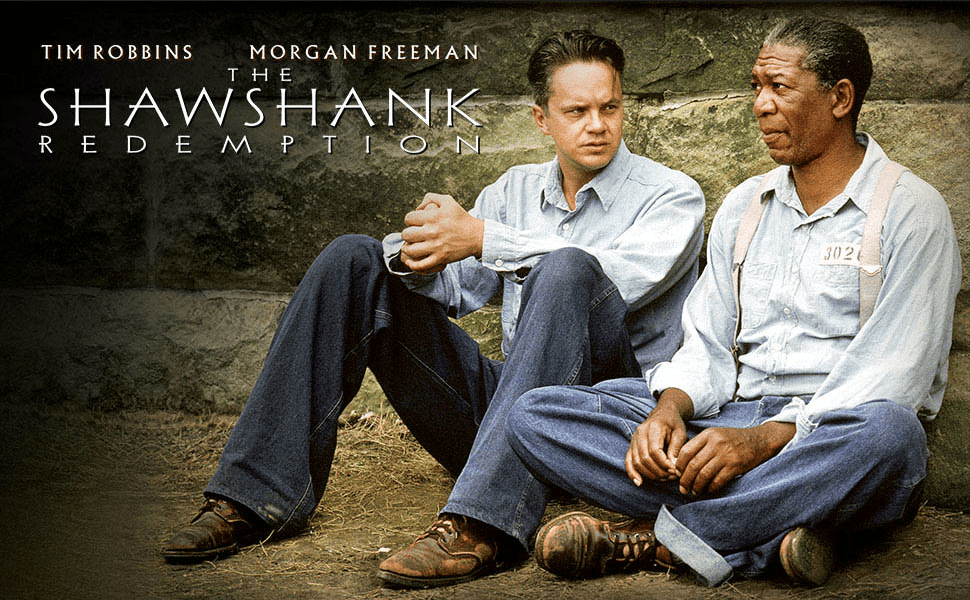
    One of my all-time favorite prison break movies is Shawshank Redemption, and I just love the meticulous Andy Dufresne, the prison break they showed in the movie is one of the best I have ever seen. And it very well might be the best. 
    Tim Robbins (left) plays the character of Andy Dufresnse in the movie.

    Although the prison break scene is important, a few other scenes in the movie have piqued my curiosity more.

    In one scene, he hijacks the radio room and plays classical music, smiling contentedly while ignoring the guards pounding on the glass door and attempting to break in. Also, the one where the warden puts him in solitary confinement more than once.

    Latter is the one that I am going to focus on.

    After his first solitary confinement, he leaves his friends somewhat puzzled when he looks upbeat. He wasn’t supposed to. Who would, in their minds, come back refreshed from a seemingly maddening absolute solitude? 

    It was not normal, was it?

    As far as I can remember, I must have heard the phrase ‘Man is a social animal’ at least a hundred times. It’s only very recently that I learned that it was Aristotle that once said, “Man is by nature a social animal, an individual who is unsocial naturally and not accidentally is either beneath our notice or more than human. Society is something that precedes an individual”.

    After all, a lot of human happiness and sorrow are derived from associating with others.

    In this day and age of overstimulation, and over-engagement, solitude gets a lot of bad rap. People dread going to restaurants alone for fear of being judged.

    What would the hotel staff think?

    What would the people sitting next to me think?

    Why is everyone looking at me in pity?

    Doesn’t matter one bit if all those people I worry about are strangers. The thought of being by ourselves is just too scary. There is even a phobia: autophobia (I’m not kidding!). Like every other phobia, it is irrational.

    Solitude, I have figured over time, isn’t that bad. I have found it quite liberating. 

    Although unplanned, my journey was a super basic two-step exercise, in hindsight.

    Step 1: Going to a restaurant alone.

    The initial few solo trips to my favorite Chinese restaurant were quite awkward for me, ‘A table for one doesn’t have a nice ring to it,’ which was an excuse I gave to myself for not going. I decided to ‘be a woman’ and do something about it. I initially carried a fascinating fiction book as a crutch, so when I was immersed in reading it, I wouldn’t care what people around me thought. 

    But I realized that with each subsequent trip, I didn’t have to depend on the book anymore. I was becoming increasingly confident with my request for a ‘table for one,’ asking for things I wanted to eat and eating like it was no one’s business.

    Step 2: Designate a day of the week as a No-cellphone day.

    I would designate either Saturday or Sunday as a no-cellphone day; I would behave as if my cell didn’t exist. 

    It was a bit difficult initially. For the first few weekends, I locked my cell in a suitcase and gave my amiable neighbor the key. This would make accessing it difficult even if I had the urge to have a peek. 

    Slowly, I started to enjoy these no-disturbance weekends and eventually relieved my neighbor of the key-safekeeping duties.

    Step 3: Meditation retreats

    I rolled my eyes when a friend suggested this to me once, this was not for me, I said. Eventually, I changed my stance and decided to give it a chance. Zeroed in on a weekend retreat. 

    The first thing they did upon admission was to have me deposit my cell. ‘Sucka!!! I had two years of practice. It was a hit from the get-go; the retreat was in nature, the instructor was super calm, and she didn’t have us wake up at 4 am to enjoy the true meditation experience. 

    The initial few hours were tough; in silent meditation, my mind drifted to every possible realm.

    Did I bring my house keys?

    Did I forget to turn the tap and stove off at home?

    Did I turn off the humidifier?

    Did I take the garbage out?

    Did I make the credit card payment? Am I overdue?

    Did I let Dad know I was going? I hope Mom has informed him.

    This place is so beautiful, I love nature; one day, I will be able to afford a house here, maybe? I wonder what the downpayment would be?

    This top itches at the shoulder.

    Call it my basic brain, or my mundane life, the random thoughts first slowed down and then almost stopped. That state of being and not being, at the same time was immensely calming. A few minutes of that floating feeling was a high like nothing I had experienced before. Like all good things, this feeling was interrupted too.

    By an image of Shawshank Redemption’s Andy Dufresne stepping out of this solitary cell, smiling.

    andy dufresne from the movie shawshank redemption in the climax of the movie, escaping the
    That scene from Shawshank Redemption
  • Are you watching closely?

    Are you watching closely?

    I call myself a Nolan fan, mostly of his earlier works (to be clear, I fully comprehend what went down in Interstellar and Tenet. wink, wink). The Prestige happens to be my favorite Christopher Nolan movie of all time. I must have seen it more than five times. And given how obsessed I am with it, that number will not be static.

    So why the sudden rant about The Prestige?

    There are many things I love about the movie, the passionate characters dedicated to their craft and their willingness to go to any levels necessary, the not-so-friendly competition between the magicians, the beautiful women that don’t shy away from holding a mirror to their men, the visionaries, the acolytes – you name it. 

    But something from the movie that trumps them all in my little universe is the question, “Are you watching closely?”

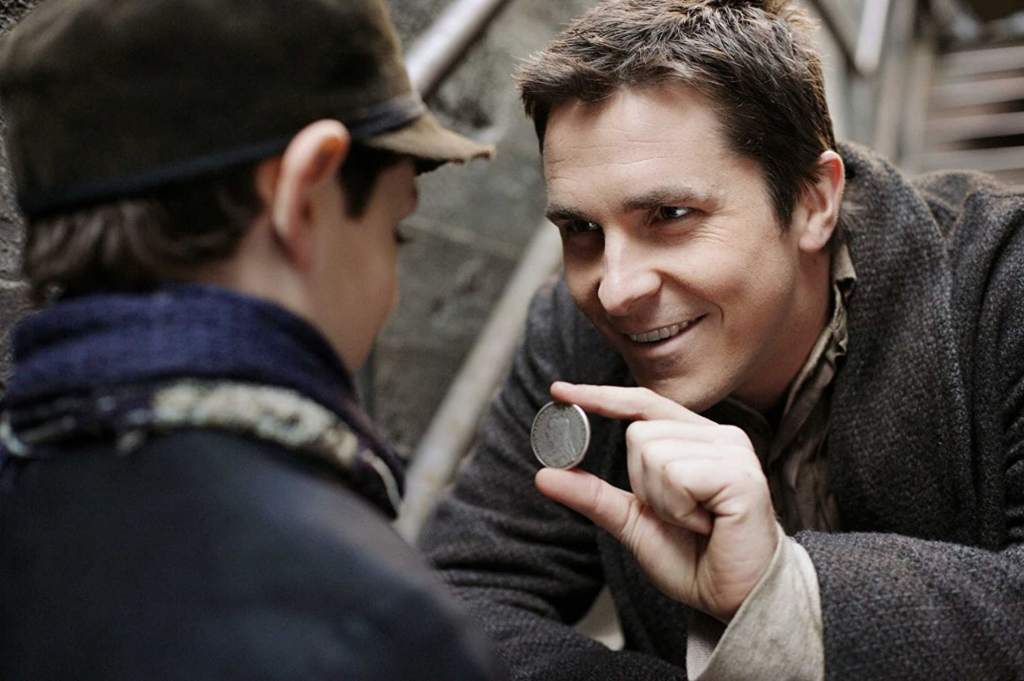
    Alfred Borden (played by Christian Bale) during the famous scene in The Prestige

    Borden would say that multiple times in the movie, enthralling the audience with his majestic magic tricks. The guy is cheeky enough to challenge his crowd into watching him closely, daring them to expose the flaw in his tricks.

    He would not shy away from putting his happiness and even his life on the line for the love of the craft that he held so dear. 

    Why does the fear of being exposed not threaten him? What infuses in him the bravery of the daredevil? Is it mastery of the craft? Is the attraction of the spotlight much too intriguing?

    I have never found an answer that I could find satisfying enough for more than two days. 

    Are you watching closely?

    Like in the movie, this question works on so many levels.

    Say I was watching closely, closely enough to have been able to find a flaw in his tricks? Where would that have got me? 

    Maybe on that path of obsession to be looking for flaws in every magic trick from there on? And why just magic? Maybe that spilled over to every other area of my life? 

    What if I watched every ‘good relationship’ closely enough to see the cracks in it? Maybe I started dissecting every argument I see being made so that I could see where all it had been patched to create the illusion of the truth? Perhaps I would even doubt the perfect relationship between a Mr. Fox and a Ms. Kelly from You’ve Got Mail. 

    Mr. Fox and Ms. Kelly in You’ve Got Mail

    After all, Mr. Fox only went back to see her on their blind date because she was pretty, did he not?

    I wonder if watching everything closely would turn me into a disbeliever,a cynic? And do I want to be that?

    I do want to see things for what they are. I do! But to what extent do I go? Where do I stop? At what point do I become a Hypocrite if I choose to close my eyes to the truth? And would happiness/contentment elude me if I do?

    The real Richard Winters (left) and Damian Lewis, who plays the character of Richard Winters in Band of Brothers

    I love Richard Winters from the Band of Brothers and Sean Connery in The Hunt for Red October (who doesn’t?), but I made it a point never to research them enough to get to a point where I could find a fly in that love ointment. I am not oblivious to the dangers of doing this. 

    This logic (if you could even call it that) has a lot of flaws. I have researched enough about Ostrich burying their heads to make their problems disappear. Surprise, Surprise! That isn’t true either, but it is a Roman myth.

    So if Alfred Borden were ever to ask me, “Are you watching closely?” he would have a question coming right back at him “Do I want to?”

  • Who Moved My Cheese: Summary, Plot Analysis and 3 Reasons To Love It

    Who Moved My Cheese: Summary, Plot Analysis and 3 Reasons To Love It

    Who Moved My Cheese is a short story written by Spencer Johnson. It was first published in 1998. It is a motivational story about 4 characters – two of them are mice and two are humans (of very small size). It highlights the importance of anticipating change, adapting to one’s environment and not taking things for granted.

    “The quicker you let go of old cheese, the sooner you find new cheese.”

    Too simple a truth, eh? For cheese and non-cheese lovers alike ! In his world renowned book ‘Who moved my Cheese’ Dr Spencer Johnson treats us with many simple truths like these, leaving us wondering – how could a business self help book be such that it applies to all areas of our life, and doing that in a language that may seem too simple but one that is still  heavy with abundance of life-changing truths.

    Let’s jump right in.

    Who Moved My Cheese: Summary and Plot Analysis

    The story revolves around four characters- Two are mice named Sniff and Scurry and the other two are humans , about the size of mice themselves, called Hem and Haw. They live in a maze and depend on cheese for their survival.

    In their cheese hunt, they chance upon a spot with supply of cheese enough to last their lifetime, they end up spending a lot of time there.

    While the mice are agile and ready to move when the cheese disappears, the humans are stuck in their old ways, All they do is simply take the cheese for granted, sit back and brag about it.

    Eventually cheese runs out.

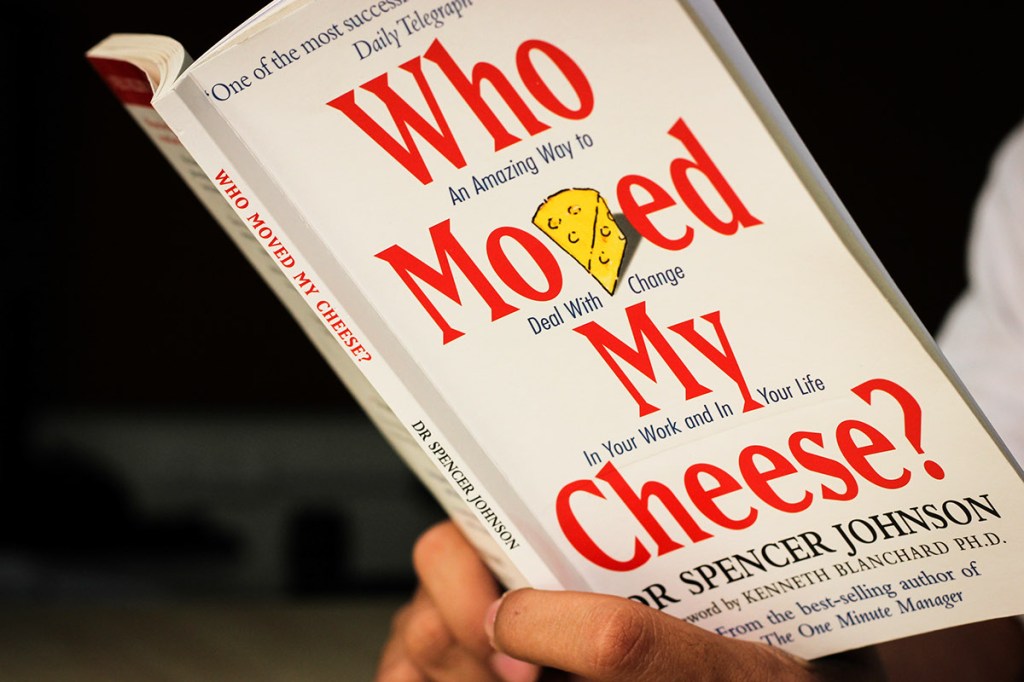
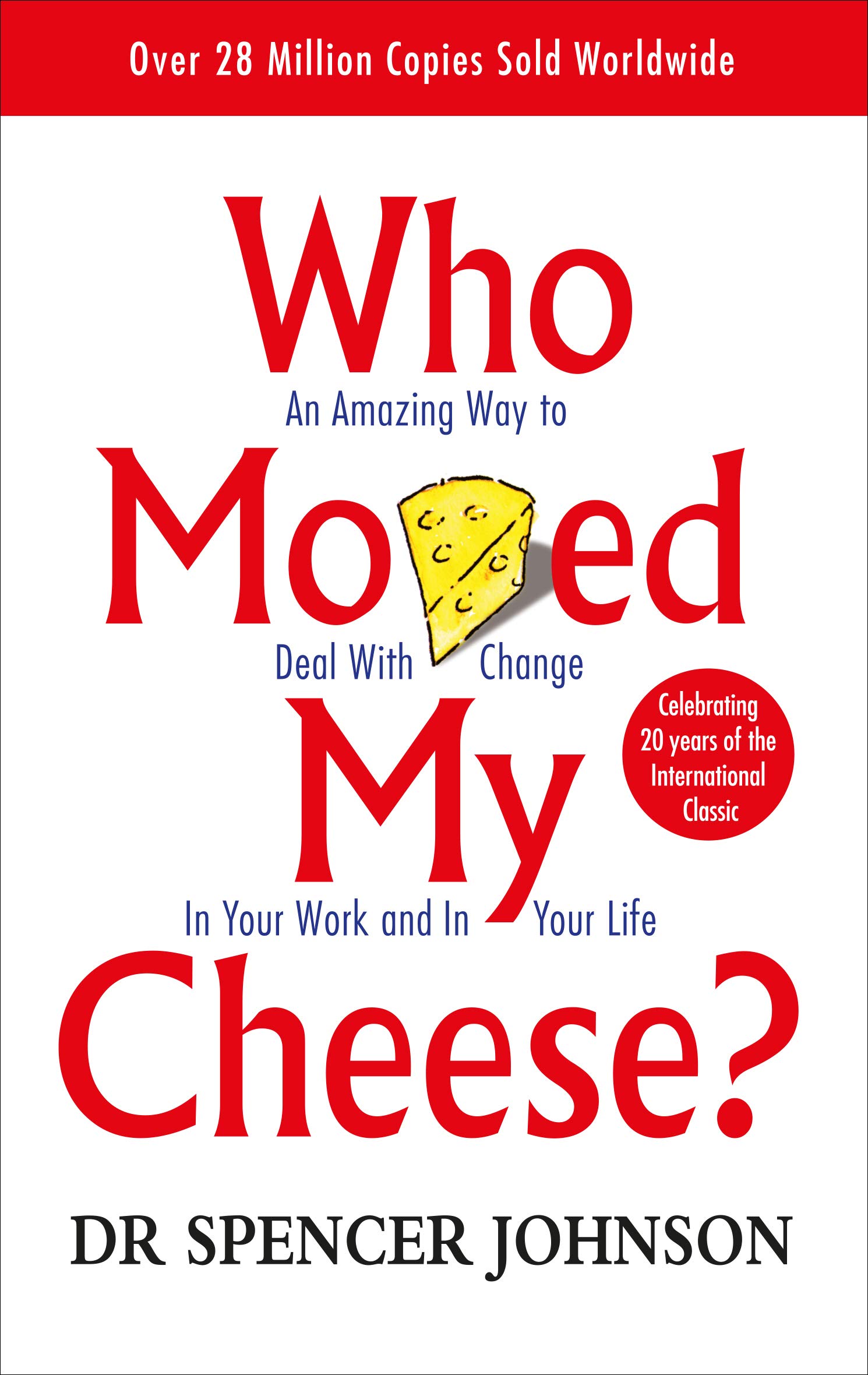
    book cover of who moved my cheese
    Cover of Who Moved My Cheese?

    While the mice moved on to find new cheese, Hem and Haw, too set in their old habits, are afraid of what lies out there in the maze and simply complain about them deserving more after all of their hard work.

    Too scared to set out, Hem and Haw start blaming each other for their troubles. Over a period of time, Haw gets smarter and decides to explore the maze for more cheese.

    Finding that Hem is hesitant to come along, Haw continues to explore further, leaving a trail of messages for Hem, if he ever decides to follow him.

    Eventually, he does find a ton of cheese , deep in the maze only to find Sniff and Scurry there already. Learning from his past, Haw is now a vigilant explorer, he monitors the current cheese supply to avoid the same fiasco from happening again. He decides it best for Hem to explore by himself to find his way to him.

    3 Reasons to love Who Moved My Cheese?

    1 – Where you are and where you will be is your own doing

    Times got tough for all four of them. They were all faced with the same challenge. Was the result same for all four? No!

    Why?

    Because each of them chose to respond to the situation in a different way. While Hem and Haw were busy in their blame games and petty squabbles, Sniff and Scurry were already resting with their newfound cheese chest. Haw finally did see the error of his ways and changed eventually to find himself rewarded, who’s to say what happened to our poor old Hem?

    2 – Complacency is your worst enemy

    Times do get easy and that’s when our worst enemy, complacency, strikes! We are blinded by comfort to an extent that nothing else is visible- even the dangers staring at us right in the face.

    Amy Lowell, American Poet, was right on point when she said –‘ Happiness, to some, elation; Is, to others, mere stagnation.’

    3 – Stay aware, Be Prepared

    Stay away from ‘Bury your head in the sand’ syndrome. The first step in the preparation is to acknowledge that there is a need to change.Like Sniff and Scurry, be aware that the cheese could disappear and you might need to explore and find novel ways to get to the new and better cheese.

    7 Wall Writings from Who Moved My Cheese?

    The simplicity of this book is priceless. Consider, for instance, the lessons that Haw writes on the wall for Hem.

    1 – Change Happens They Keep Moving The Cheese

    Change is everywhere- work, home, our communities, you name it . Heraclites – the Greek philosopher – wasn’t wrong when he said “nothing is permanent but change.”

    2 – Anticipate Change Get Ready For The Cheese To Move

    Regardless of us seeing change everywhere, how often are we caught by surprise? How often do we see ourselves complaining about it?

    3 – Monitor Change Smell The Cheese Often So You Know When It Is Getting Old

    Are we ever proactive enough to see what lies ahead and what the impending change might entail for us?

    4 – Adapt To Change Quickly The Quicker You Let Go Of Old Cheese, The Sooner You Can Enjoy New Cheese

    Are we ready to make a move when the change happens? Are we prepared?

    5 – Change Move With The Cheese

    Are we changing ? Are we ready to reroute our actions around what the change calls for?

    6 – Enjoy Change! Savor The Adventure And Enjoy The Taste Of New Cheese!

    It could be difficult adjusting to change, let alone enjoy it at times, But are we those
    nimble agile kind of people that can actually savour change?

    7 – Be Ready To Change Quickly And Enjoy It Again They Keep Moving The Cheese.

    Are we ready to change again and faster the next time?

    So, we have Sniff and Scurry and Hem and Haw…. which one of those are you?

  • Jonathan Livingston Seagull: Summary and Plot Analysis

    Jonathan Livingston Seagull: Summary and Plot Analysis

    Jonathan Livingston Seagull is a short novel (or novella) written by Richard Bach in the 1960s. It is a story of a seagull whose name is Jonathan Livingston who is trying to perfect the art of flying.

    Over the years, this novel has become a classic and is often considered one of the best inspirational or motivational books ever written.

    Who wrote Jonathan Livingston Seagull?

    Jonathan Livingston Seagull is written by Richard Bach.

    Interestingly, it was not written as one complete novel initially; Bach wrote it as a series of short stories which was published in a magazine called “Flying” in the later half of 1960s.

    Then, the series of short stories was compiled by Richard Bach and was first released as a book in 1970. The book was illustrated by Russell Munson.

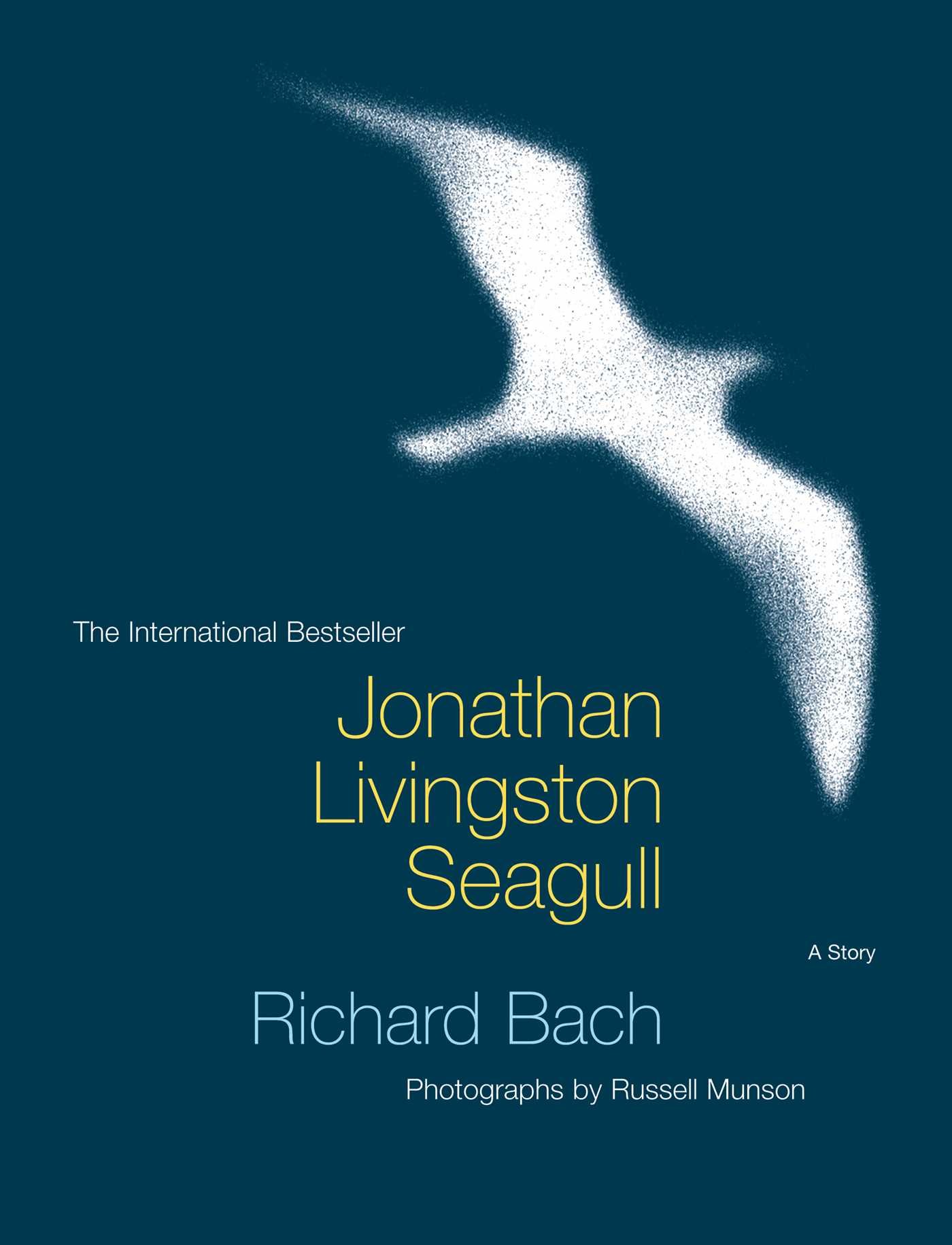
    jonathan livingston seagull book cover
    Cover of Jonathan Livingston Seagull

    Within a few years of publication, Jonathan Livingston Seagull became a best seller and sold millions of copies and became known worldwide.

    Who is Jonathan Livingston Seagull?

    Jonathan Livingston is the name of the protagonist of book Jonathan Livingston Seagull. He is a seagull who tries to perfect the art of flying.

    The name of the novel is also the name of the protagonist of the novel’s story.

    Book Summary: What is Jonathan Livingston Seagull about?

    Jonathan Livingston Seagull, a book by Richard Bach is a story about a seagull’s unbounded passion for flight despite rebuke from his clan, his friends and his most loved ones. His perseverance, and his unquenchable thirst for achieving perfection. Touted as One of the 50 timeless spiritual classics , you will be amazed how he has put this profound truth in such simple words.

    Our seagull is bored with the mundane struggle for food every day and disheartened by the lack lustre passion-less lives the seagulls around him love and expect him to conform to. The lack of encouragement from his fellow folk does not deter him from following his passion and he continually keeps pushing himself to learn all he can about flying.

    This lack of conforming to the norms does not go down well with his folks and he is subsequently expelled from the flock, bringing shame to his family. A new outcast but free nonetheless, he continues to learn, coming closer and closer to his goal of achieving perfection.

    This skill acquired with practice brings him immense joy and resulting contentment in his life.Although alone now, he is a happy seagull.

    One fine day, two seagulls meet him and tell him of a better world found through perfection of knowledge, he meets a fellow seagull that has the same passion for flight as himself. His dedication and love for the craft makes him a very distinguished bird and Jonathan prides himself in the fact.

    white seagull flying over blue water
    Jon’s dedication and love for the craft makes him a very distinguished bird. (Image by Bruno Glätsch from Pixabay)

    Here Jonathan makes friends with a wise gull that reveals to him the secret of
    instantaneous movement anywhere in the world, Jonathan marvels at this skill, eventually acquires it and is humbled by his knowledge. He has acquired what he wants , but still feels empty.

    Jonathan now feels the urge to return to earth to find others like himself to tell them what he’d learned and to spread his love for flight. He is successful in this endeavor and soon finds himself around other outcast but passionate seagulls.

    The first of his students, Fletcher Lynd Seagull, is quick to grasp learnings from Jonathan and ultimately becomes a teacher in his own right. Jonathan leaves to teach other flock thus spreading his love for the flight and the timeless truth of
    limitless human potential.

    Life lessons from Jonathan Livingston Seagull

    “He spoke of very simple things- that it is right for a gull to fly, that freedom is the very nature of his being, that whatever stands against that freedom must be set aside, be it ritual or superstition or limitation in any form.

    “Set aside,” came a voice from the multitude, “even if it be the Law of the Flock?”

    “The only true law is that which leads to freedom,” Jonathan said. “There is no other.”

    Of all the great things Jonathan Livingston seagull has said in Richard Bach’s book of the same name, this speaks the most to me.

    To me Jonathan Livingston seagull brings 3 life lessons:

    1- Our potential is limited only to the extent we let it to be

    And I do not mean in ‘we as humans use only 10% of our potential’ way, but more often than not, we are limited by our perception of what we are capable of achieving. Changing that mindset is solely under our control. Why should we let someone else tell us what we can and can’t do?

    Remember Chris from the movie ‘Pursuit of Happyness’? The scene where he tells his son, “Hey. Don’t ever let somebody tell you… You can’t do something. Not even me. …’.

    That about sums it up.

    2- Find your passion and be relentless in your pursuit of it

    Our seagull Jonathan was exemplary in illustrating that sometimes following our passions can take us away from places and people that we hold dear, but in no way did that deter him from following his passion, or giving it his all. It’s because at the end of the day, he was answerable to himself. And so are we.

    To quote Steve Jobs, “Stay hungry, stay foolish”. Being loyal to our passion brings us
    profound happiness and contentment and that’s the state that we all ultimately strive for. Don’t we?

    3- Pay it Forward

    Jonathan didn’t just stop at achieving perfection, he took it a step further. He thought it best that learnings be shared with others, to let them know that we can think beyond our present circumstances for a blissful future.

    It may not be entirely selfless given that there is a significant upliftment we feel when we help others , but Hey! its feeding two birds with one scone.

    I cannot help but quote Film critic Roger Ebert who praised the book by saying ” the book was so banal that it had to be sold to adults; kids would have seen through it.”

    Food for thought.

    Want to read Jonathan Livingston Seagull?

    Jonathan Livingston Seagull is available on Amazon if you want to get yourself this book. You can use the links given below to check the price of this book:

    Check Price on Amazon US
    Check Price on Amazon Canada
    Check Price on Amazon India