I came across this quote during a re-read of the famous comic classic and my personal favorite Three Men in A Boat by Jerome k. Jerome.
In addition to making me smile, it took me on a trip down the memory lane. I don’t know about you but I cannot bear the thought of having to wake up when everyone around me is still asleep.
I dread my high school exam days to this date, when this was a fairly common occurrence to me.
‘Three Men in a Boat’ is my Agony Aunt – not the one that would listen to my woes
and suggest alleviation mechanisms, but the one that would make me laugh so hard that I forget about everything else.
But right after that bout would come a phase of reflection, but more on that later..
Straight back to school days, living with my siblings. I was (and will be, for the foreseeable future) a late riser.
I would sleep in until noon on weekends. I used to have just two meals – the one you have after lunch (they call it ‘brunch’, right) and dinner – this way, I would load up on all movies and TV shows I could pack in my weekend waking hours.
I was the most amiable person you could find on the planet if I could sleep a minimum of 10 hours a day.
That would, however, not be the case if my siblings slept for 10 hours and 5 minutes. No!
No one could sleep more than me. No one!
And over the years, I have realized I am as unique in having this trait as 2 billion others on the planet. There is something very disturbing about someone having more privileges – for me it was sleep back then.
I value my sleep as much as I did back then, but there are quite a few other items that have been added to the list over the last few years.
I might be happily getting by with my 1-bed apartment until someone my own age, someone I know, has recently paid off the mortgage on a 3-bed. The same apartment that was a haven for me before, suddenly, feels too cramped.
It’s not even like we are the only ones that resort to comparison; perhaps all of our parents did that too.
For instance, imagine a boy who’s jubilant that he got an A in his exams, when his parents were expecting him to get just a B+. Obviously, he ‘exceeded expectations’ of his parents.
But when he breaks the news to his parents, they hardly seem excited about it. Why?
Because their neighbor’s kid got an A+.
The scene changes from enthusiastic congratulations to his parents complaining about he ‘failed’ compared to his classmate. ‘After all’ the parents say, ‘don’t you get the same privileges as that boy who lives next door?’
The Comparison Monster can creep in all spheres of our life and wreak havoc if we are not watchful. We need to guard our happiness and sanity as fiercely as Joey from Friends guards his food.
So, how do we ensure that we are not a permanent resident of Compareville aka Miserytown?
The answer is pretty simple. Read the following quote once, twice, thrice. Hell, put it up in your living room for good measure:
“Someone else’s beauty is not the absence of your own.”
As simple as these words sound, the impact that they have when you let them sink in is
profound.
Have you seen one of those people that are constantly in their future, either imagining it in all its glory or dreading it?
I have.
I am one of those people.
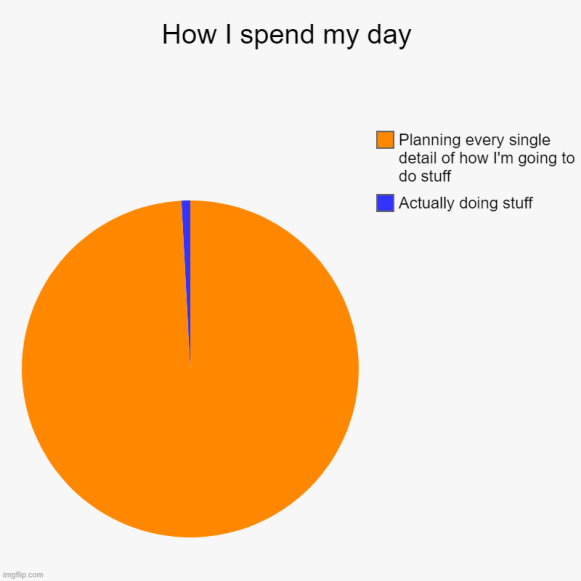
This is what my day would look like usually –
It’s amazing to think how little I accomplished considering how much I planned.
Come 1st Jan, and I would stock up on all sorts of planners, agendas, diaries – to plan my days- the professional-looking grey leather-bound, the colorful pink dreamer planners and the ultra chic weekly tear-off To-do list.
My study would probably look like the stationery aisle of a Staples store. I would be super-pumped and ready to take on the world with all sorts of planners in my arsenal.
My yearly planner would be more ambitious than a conventional 10-year plan:
● Learn French
● Learn Spanish
● Learn Python
● Sleep less
● Exercise more
● Volunteer more
● Get another degree
● Enrol in certification programs
● Save more
…. and on and on.
You might have seen a list like that. There is a good chance you probably tried creating one for yourself. We have all been there at that spot at some point in their lives.
What would help ensure that we do not end up at the same spot in the future?
The answer to that puzzle lies in Roosevelt`s quote:
“Do what you can, with what you have, where you are.”
We can wait forever for the opportune time to come. That time may never come.
I totally second Sidney Sheldon when he says “Tomorrow never comes” through the title of one of his most popular novels.
But one thing we all have and will always is the time NOW.
Your situation now, however limited it may feel to you, is still something that can get you started.
Yes, I want to finish that 300-page book in a week, but simply planning and never reading it is not going to help me get there.
I need to pick it up and start reading even if for just 5 minutes a day.
Agreed, that I may not be able to finish it in one week; it might take me 3 months instead. But that is still a huge improvement, considering the fact that I wasn’t even going to start at all.
The skill could be anything – playing music, learning a new language, polishing your photography skills, working on your social skills, practising public speaking… the same rule applies, regardless of your goal: having byte-sized goals for everyday and having a portion of your day dedicated to achieving them.
Never forget that slow and steady wins the race.
Alright, alright, alright! Don’t listen to me.
But you’ll listen to Shia Labeouf – the star of Transformers, right?
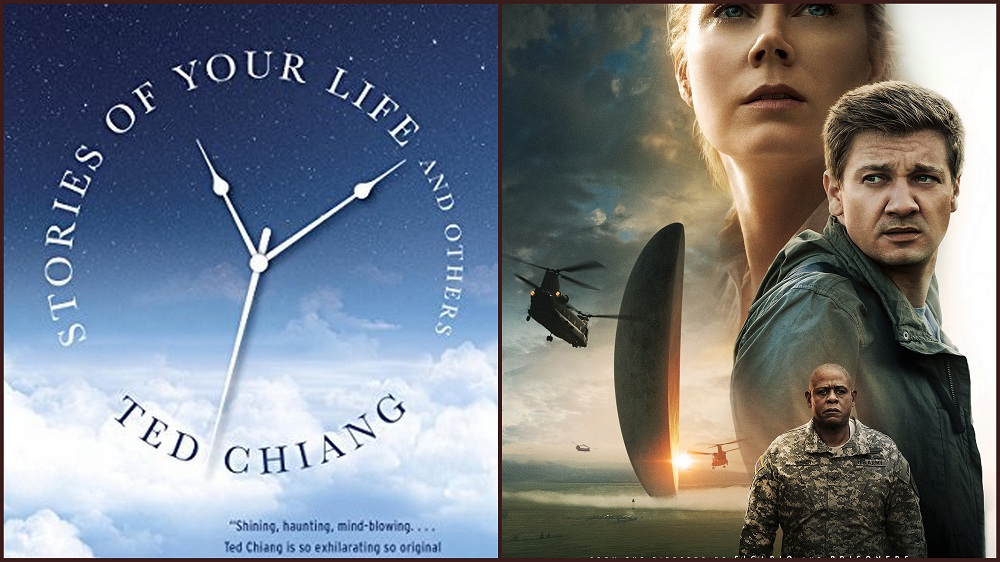
Story of Your Life is a science fiction short story written by Ted Chiang. It was first published 1998. The story revolves around a renowned linguist and how she makes a breakthrough in communicating with the aliens that have landed all over the world in massive spaceships. This story received many accolades and shot to immense popularity following the success of a Hollywood movie ‘Arrival’, which is based on this story.
“Despite knowing the journey and where it leads, I embrace it and welcome every moment.”
What would you do if you somehow chance upon the ability to be able to see your future?
Will that scare you, or will you be hopeful? Or both?
Ted Chiang, in his short story “The Story of Your Life”, brings you some answers in a very humane sci-fi manner, traversing through the themes of language and determinism.
First published in Starlight 2 way back in 1998, this story has received multiple accolades. Its most recent adaptation into a Hollywood movie – Arrival, starring Amy Adams and Jeremy Renner – is a testimony to its ever-growing popularity.
Story of Your Life: Summary and Plot Analysis
The story revolves around Louise Banks, a respected linguist, who is also the narrator of the story. Louise is recounting the events of her life to her daughter and story alternates between glimpses into her past and future.
The story opens with a couple enjoying a romantic dance on a day which happens to be the one where their daughter was conceived.
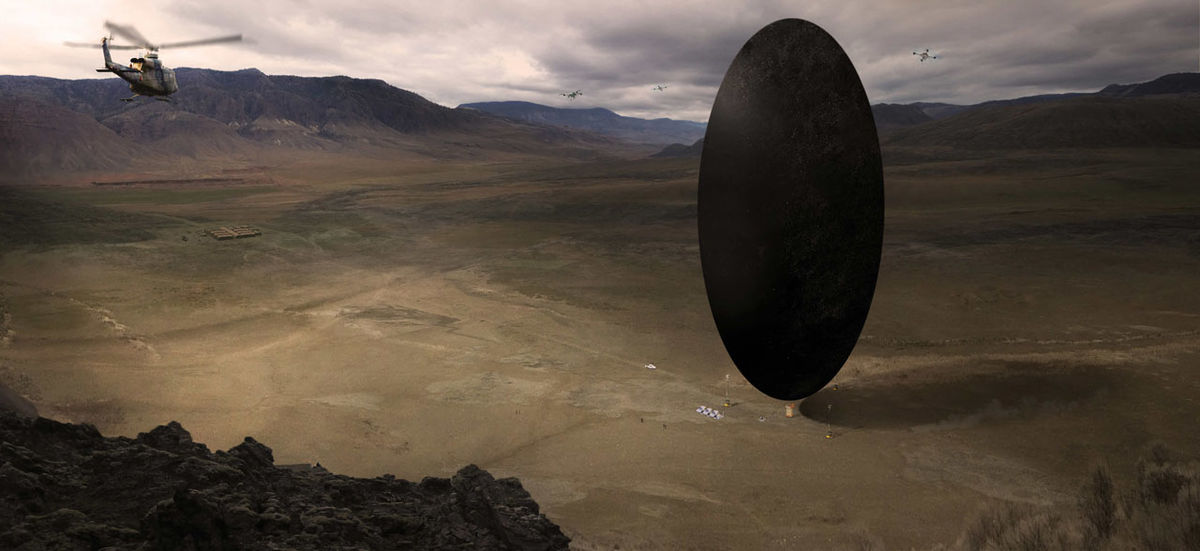
The pivotal point in the story is the arrival of aliens in spaceships that land in different parts of the world, including the US, Russia, China etc. And not just one or two, a total of 112 gigantic semi-circular spaceships land all over the planet.
These ‘devices’ serve as an audio visual link to the aliens.
This is the alien spaceship which land in different parts of the world. This image is a screenshot of the movie Arrival, which is based on this short story. (Photo Credit: Arrival Movie)
Aliens initiate communication with humans and Dr. Banks and Gary Donnelly (who is a physicist) have been brought in to assist with the process.
Aliens, whom people call ‘Heptapods’, because of their seven limbs and radially symmetrical appearance, communicate in a language that is nothing like any form of language (both written or verbal) that humans have ever known.
Louise and Gary are assigned to 9 “looking glass” sites (that’s what humans call the sites where these spaceships have landed) and start to work with them to understand their language in order to be able to communicate with them.
They work with two aliens, whom they nickname Flapper and Raspberry.
Through a series of conversations with them, Louise realizes that their written and spoken words are not related to each other at all! She and her group refer to speech as “Heptapod A” and the written form of the language as “Heptapod B”.
Through a series of experiments that Louise and her team run to understand the aliens’ language, both in linguistics and physics, they infer that the alien language has a ‘free word order’. In addition to that, their language does not seem to have any linear sequence making it even more complicated to understand.
Not much progress is made until one day Gary explains Fermat’s ‘principle of least time’ to Louise. From this fresh understanding, it dawns upon Louise that similar to the light in Fermat principle (where light knows exactly where it will end up before it chooses its path of travel), aliens know their full sentences beforehand.
Instead of experiencing events sequentially, they experience all of them at once, hence confirming why the Fermat principle resonated with them so much.
Armed with this knowledge, Louise becomes proficient in Heptapod B quickly, but it also alters her understanding of reality. She observes that her train of thought is now absurdly directionless.
She experiences complete immersion in Heptapod B and starts to think in it and perceives time the same way as Heptapods do. She now sees glimpses of a future, a daughter she does not yet have, her daughter’s death and a life she doesn’t have yet.
One day, the aliens announce that they are leaving. They shut down the looking glasses and disappear. It is never established why they came and why they left, although there were rumors flying around that implied that they found human race to be too primitive to be of interest to them.
This knowledge of the heptapod language changes Louise’s life. She knows the future now, but does nothing to alter it.
She knows that she is going to end up together with a man, have a daughter and will lose her when she is still young. Despite this knowledge of her future, she goes on ahead with her life, changing nothing.
Flash back to the present, when Gary asks her if she wants to make a baby, she says yes.
Want to read Story of Your Life by Ted Chiang?
Story of Your Life is a short story which is published in a collection of short stories written by Ted Chiang. You can use the links given below to buy this short story collection on Amazon:
Story of Your Life has won numerous awards for Ted Chiang, including the prestigious Hugo award. Mr.Chiang has this innate ability to convert extremely dense topics to something that you can not only comprehend, but think and marvel at the new perspectives that it brings.
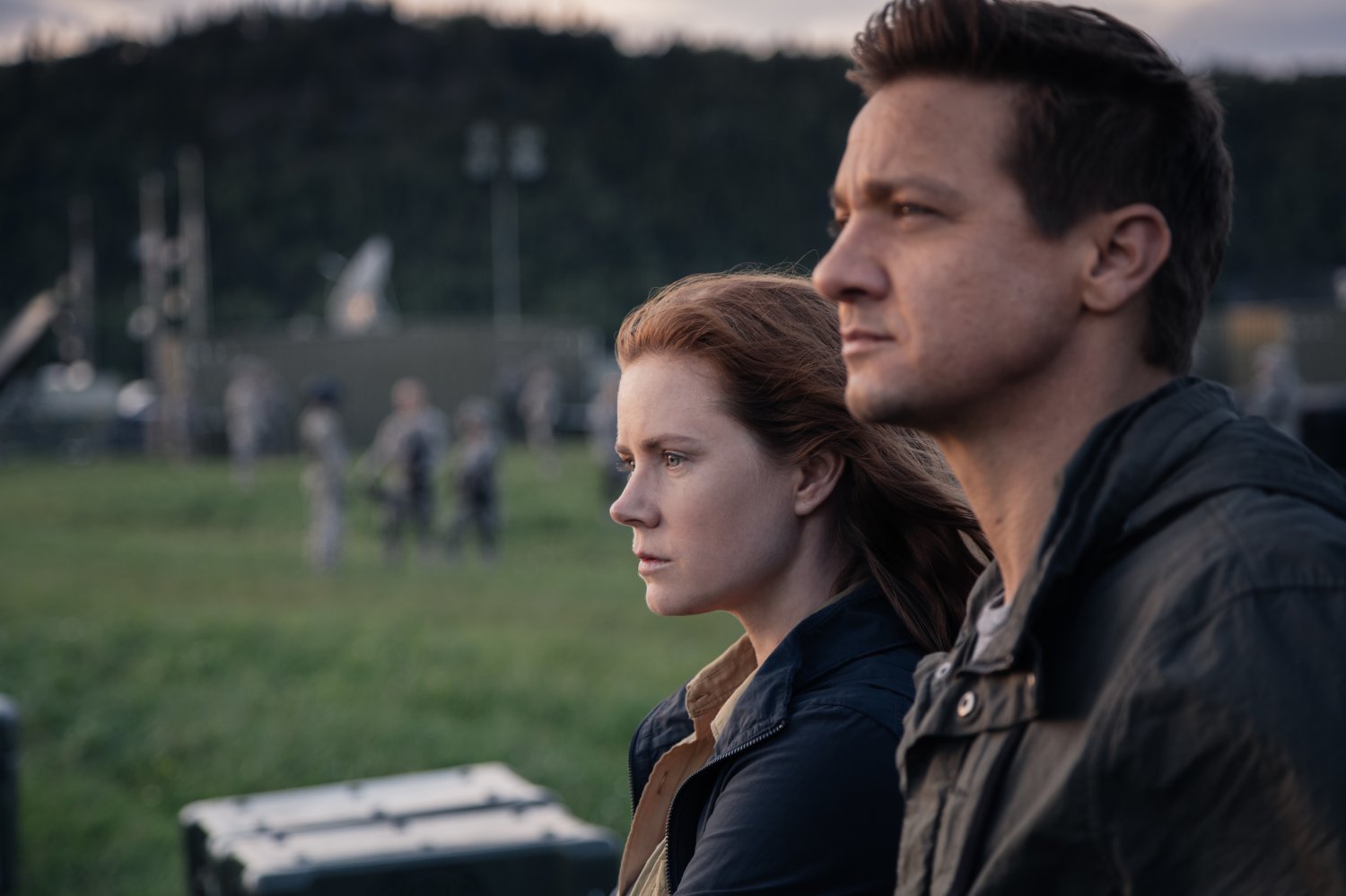
A still from the movie ‘Arrival’ – it is based on A Story of Your Life
This story brings the debate of free will and determinism to the fore. The portrayal could not have been any more gripping and profound than it is. The story shines in its intellect and humaneness.
It has got rich material that will keep both the dreamer and scientist hooked.
Consider for example, how Chiang has broken down the concept of Fermat’s principle:
“Any hypothetical path would require more time to traverse than the one actually taken. In other words, the route that the light ray takes is always the fastest possible one.”
The way that he has married science with philosophy in his story is remarkable. He is known to have remarked once: “Science fiction is very well-suited to asking philosophical questions; questions about the nature of reality, what it means to be human, how do we know the things that we think we know.”
The clarity with which he has presented the linguistic challenges, realizations and the character epiphanies are spellbinding. It speaks to the amount of research that must have gone towards this immaculate description of a linguists approach towards a new language.
And the biggest sentences had an effect similar to psychedelic posters : sometimes eye-watering, sometimes hypnotic.
7 Quotes from Story of Your Life
Here are some quotes from A Story of Your Life that I absolutely loved:
1 – Whether scientists or tourists they were an awfully incurious bunch.
(Referring to the aliens who had landed in different parts of the world but didn’t seem to do anything after they had landed)
It might be the woman in me talking but I found the depiction of mother-daughter relationship extremely heart-warming. At those specific instances in the story I forgot that I was reading science fiction.
Here are some quotes through which the author depicts the beautiful mother-daughter relationship:
2 – Even if I had never laid eyes on you before, I would be able to pick you out from a sea of babies: Not that one. No, not her either. Wait, that one over there. Yes, that’s her. She is mine.
3 – It will be like growing an errant limb, an extension of myself whose sensory nerves report pain just fine, but whose motor nerves do not convey my commands at all. It’s so unfair. I am going to give birth to an animated voodoo doll of myself. I didn’t see it in the contract when I signed up. Was this part of the deal?
A still from the movie ‘Arrival’ – it is based on A Story of Your Life
4 – My own mother could never understand why I couldn’t just be a high school English teacher. You’ll do what makes you happy and that’s all I ask for.
5 – Living with you will be like aiming for a moving target, you will always be further along than I expect. All those vows that I will give reasonable answers when I became a parent, that I would treat my own child as an intelligent, thinking individual,all for naught, I am going to turn into my mother.
6 – I can fight it as much as I want, but there will be no stopping my slide down that long dreadful slope. Not to forget a little lesson in mindfulness that Ted threw in there as a bonus read-
7 – And the lesson in mindfulness – NOW is the only moment you will perceive; you will live in the present sense. In many ways, it’s an enviable state.
And there is always this overarching message in this book, which he very nicely intrigues us with using the Book of Ages ages and the fallacy of the argument that it exists, leaving us with this gem on his favorite topic of free will vs determinism.
8 – From the beginning I knew my destination and I chose my route accordingly. But am I working toward an extreme of joy, or of pain. Will I achieve a minimum, or a maximum?
James Gleick, an American author, speaking about The Story of Your Life once said, “For us ordinary mortals, the day-to-day experience of a preordained future is almost unimaginable.
But Chiang does just that in this story, and with this brings the hope and faith that our present is all the more enriched with authors like him around.”
When I first came across this quote, a short film started playing in my head:
Someone (not me, I promise!) is carrying a cat by its tail; the cat, seeing that its upside down, is understandably confused and angry, violently lunging to attain a normal posture. After several attempts, it finally manages to strike the person with its paw. Tables have turned and now the man is angry and confused.
And the cat, well, it’s beaming with pride. It has had vengeance.
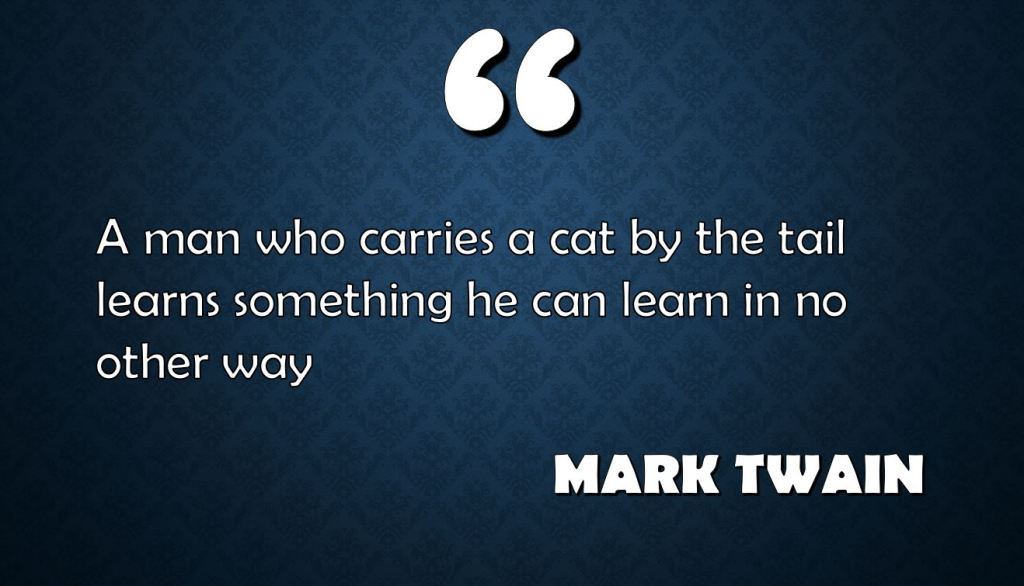
A man who carries a cat by the tail learns something he can learn in no other way.
I couldn’t help but draw parallels with our lives and the challenges that they entail.
Challenges, problems, opportunities- whatever you might want to call them.
Should we or should we not carry a cat by its tail?
There is no one-size-fits-all answer here.
What does this quote mean?
Learning cannot be complete without making mistakes.
Agreed, it is much wiser to learn from mistakes that others make and avoid making them. But that is not always going to be the case.
Individuals are unique, and so are their environments and their learning mechanisms.
Your mom tells you to stay away from the kitchen. You, thinking that you know better, march right in and have boiling water fall on your feet.
You were warned about the cat, weren’t you?
But, you still wanted to hold it upside down by its tail – you wanted to make your own mistake.
When I was a kid, I used to come home with all sorts of cuts and scrapes from all the running and playing around. I would come home crying. My mother would tend to the wounds and tell me that wounds make children grow faster and stronger.
I would believe it and feel proud of the imaginary centimeter that I would add to my height after every scrape.
We all have to carry the cat by its tail at some point to understand that persistence in the face of adversity is what eventually makes us stronger.
Braving difficult circumstances prepares us for ups and downs that life subjects us to. We know we can do it in the future, because we have done it in the past.
Did you understand the meaning of this quote when you first read it in the title?
To be honest, I didn’t.
In fact, when I first read this famous quote by Benjamin Franklin (an American scientist, inventor, politician and the man whose face is printed on the US dollar), I thought I read it wrong.
So, as a reflex, my eyes quickly glanced over the sentence again to understand what exactly did it mean:
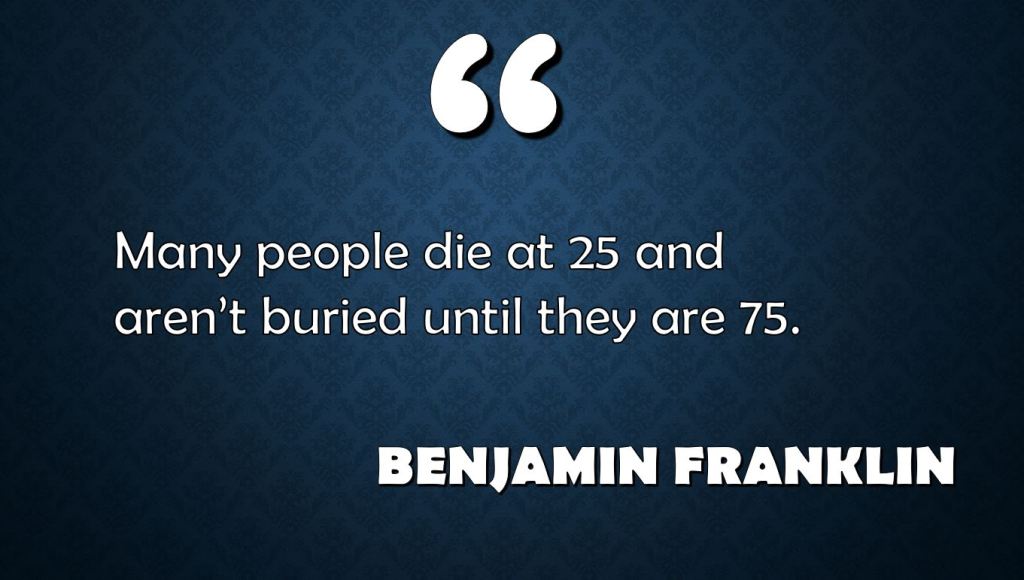
“Many people die at twenty five and aren’t buried until they are seventy five.”
My immediate response to understanding its meaning was wondering if I died at 25 or if I am dead now. I thought about it as long as my impatient soul would permit and I quickly rang my best friend to ask her opinion on the matter.
After failing to get a convincing answer from them, I turned to a few other friends, but strangely enough, no one seemed to understand this at the first glance.
Why would people die at twenty-five and be buried at seventy-five?
Does it mean that people die at 25, but live on like zombies and then finally die when they’re 75?
Living like a zombie for such a significant period of life does not seem very intuitive. Or anyone’s preferred method to live, for that matter. Plus, you and I both know that Mr Franklin was most assuredly not referring to zombies in this quote.
The more I thought, the clearer it became to me: death is the absence of life. And this ‘life’ could mean different things for different people.
It could be professional success, loving relationships, being able to give back to society or a sense of purpose in life. The society is made up of people that aim for some or all of those things.
We all have some ‘drivers’ that motivate us – and the time when we lose them is when the decay begins.
It’s not just the bodily decay that defines death; it is losing the drive to live.
Of all the reading that I have done over the years, wisdom all around the world prescribes life with a purpose as the best antidote to stagnation.
A life lived savoring every moment- happy or sad.
A life full of meaning and love.
A life full of childlike excitement for life.
Kane Tanaka, the oldest living person on the planet recently celebrated her 117th birthday in January this year (2020). After having a piece of her birthday cake, she is said to have remarked – ‘Tasty! I want some more.’