Author: Swati

  • Ladies by Anton Chekhov: Summary and Review

    Ladies by Anton Chekhov: Summary and Review

    Let’s consider the following two statements:

    I’m surprised I didn’t think of it sooner! Listen, here’s what I can offer you.. Next week the clerk at our orphanage is going to retire.If you like, you can take his post! There you are!

    I have no post for you! None, none! Leave me alone! Don’t torment me! Let me be, finally, do me a favor!

    If I tell you that the same person said both of these things to the same person, what would your impression be of that person? 

    Would you consider them bipolar, or would you give them the benefit of the doubt? 

    I hope you chose the latter because the events that transpired between Scenario 1 and Scenario 2 are a fun ride!

    These scenarios are from Chekhov’s short story Ladies is a comical take on the issues of nepotism and corruption in the Russian society. One of his earlier works, published way back in 1886, is also available as part of a short story collection called Fifty Two Stories published by Alfred A Knopf, translated by Richard Pevear and Larissa Volokhonsky.

    Ladies: Summary and Plot Analysis

    Fyodor Petrovich is a director of public education in a Russian province. He considers himself a fair and generous man. The story opens in his office, where he meets a teacher, Mr. Vremensky. 

    Vremensky, having recently lost his normal voice after a comic mishap, is considered unfit to discharge his educational duties and is being dismissed.

    With such a voice, you can not go on working as a teacher. How did you lose it?

    I was sweaty and drank a cold beer.

    The teacher, who has a family to support, is distraught at the dismissal, and the director seems restless about leaving a man such as him to fend for himself after 14 years of service. The director suddenly has an epiphany and, realizing that a clerk in the orphanage was retiring, offers Vremensky his job. 

    I’m surprised I didn’t think of it sooner! Listen, here’s what I can offer you.. Next week the clerk at our orphanage is going to retire. If you like, you can take his post! There you are!

    The director feels good about himself, having done such a noble deed. 

    His happiness, however, doesn’t last long when later at the dinner table, his wife asks for a favor for one of her acquaintances- happens to be for the same job that he previously offered Vremensky to a chap named Polzhukin. He tries to resist, but his wife is adamant that Polzhukin be given that job.

    And you know my rule: I never make appointments through connections.

    That fop? Not for anything!

    Why not?

    You see, my dear, if a young man doesn’t act directly, but through women, it means he’s trash! Why doesn’t he come to me himself?

    It’s not for the salary, but just… After all, it’s government service.

    Later the same evening, he realizes that he had received a letter from the mayor’s wife recommending the same guy, K.N.Polzhukin. After that, not a day passes when he doesn’t receive one recommending him. 

    On one occasion, Polzhukin presented himself directly to the director. The director, visibly disinterested, is quick to express his dissatisfaction with how the solicitation has gone so far.

    Listen, why is it you didn’t turn directly to me but found it necessary to trouble the ladies first?

    Fyodor doesn’t understand why Polzhukin, a man hailing from a well-to-do family, would be interested in a clerical job. Polzhukin clarifies that it is not the money he was after but the government position. He finally produces a document that the director has no power to veto; he has no option now, but to give him the job.

    He took a paper from his pocket and handed it to the director. Beneath the attestation, written in bureaucratic style and script, was the signature of the Governor. Everything suggested that the Governor had signed it without reading it, just to get rid of some importunate lady.

    Unhappy about having to do that, Fyodor also has to rescind the offer for the same job that he had extended earlier to Vremensky. Unable to find the right words and tone to deliver the news, completely overwhelmed, he explodes on the very man his sympathies were supposed to be directed towards.

    I have no post for you! None, none! Leave me alone! Don’t torment me! Let me be, finally, do me a favor!

    Ladies: Review and My Thoughts

    Fyodor started off as a strong, principled man who took pride in doing the right thing. He was obviously pained by Vremesnky’s calamitous situation, revealing that he has his heart at the right place. 

    As soon as he had the conversation with his wife about the position, things started to change, followed by numerous other referrals for the same person, putting him on edge. These people were providing unsolicited referrals for someone that was already well-to-do. 

    He does not like Polzhukin one bit, mainly because he has women doing his bidding. He also feels that with the comfortable financial standing that he is in, he doesn’t need the job as much as a relatively poorer Vremensky. 

    All through this reader still has the impression that the guy is not going to break. But as soon as he sees the letter signed by the Governor, he gives up. 

    The same man had remarked that he would never make appointments through connections. Now in Fyodor’s mind, it could have been a woman that could have prompted the Governor’s signature prompted by a woman’s persistent pestering, but how does that justify Fyodor or the Governor making the wrong call?

    John Amaechi once said -’ You can not be a part-time man of principle’. 

    Fyodor better sit up and take notice.
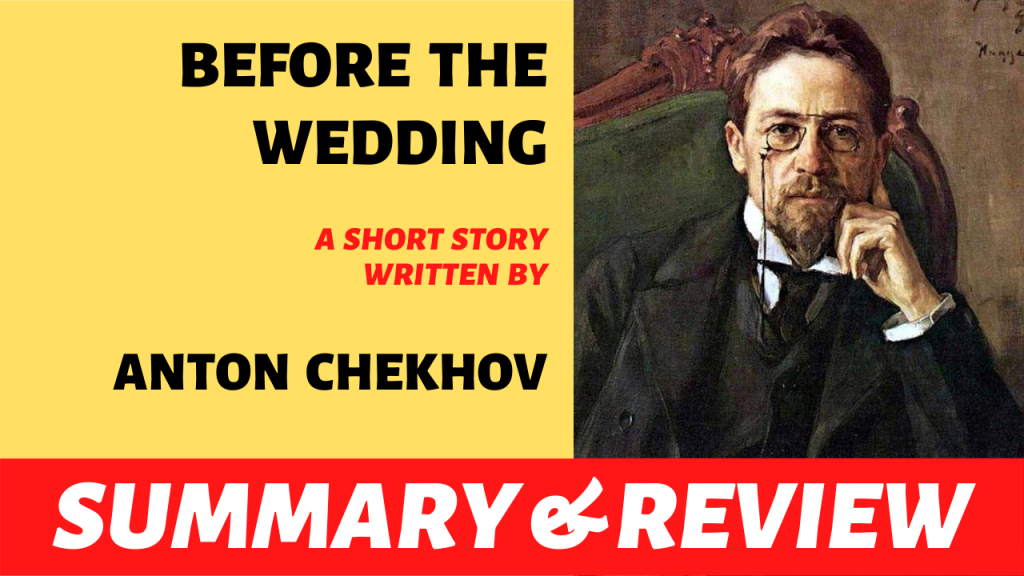
  • Before the Wedding by Anton Chekhov: Summary and Review

    Before the Wedding by Anton Chekhov: Summary and Review

    Unmarried girls are crazy to get married, but they are the only ones, because it is no good at all. I’m married, I should know. Give it time; you’ll see for yourself.

    If you are interested in reading plenty of (good) advice like the one above, you should pick up Anton Chekhov’s short story called Before the Wedding. The story was first published in October 1880 in Dragonfly magazine. It is now available as part of a short story collection called Prank published by The New York Review books translated by Maria Bloshteyn.

    Before the Wedding: Summary and Plot Analysis

    The story opens with the marriage of Podzarylkins’s daughter to a collegiate assessor named Nazariev. Contrary to expectations around such a ceremony, the betrothal went without a hitch. The Podzarylkins’s daughter is entirely unremarkable, considers good spelling as the best intelligence one could have, and loves tall men and the name “Roland.” 

    The Podzatylkins’daughter is remarkable by the virtue of being completely unremarkable. Since no one has ever seen any evidence of her intellect, let’s not talk about it.

    Nazariev, on the other hand, fancies himself as a real ladies’ man, talks loudly, and doesn’t shy from recommending literature reading to almost every woman he meets. He does not make much money, barely enough to cover his tobacco expenses.

    The match looks doomed from the get go.

    After the wedding, the daughter was called on to visit her mother. Her mother has some advice to give to her daughter. She starts with calling her husband names and ends with the same, sprinkling random words of caution about her son-in-law in between. 

    The mother doesn’t seem enthusiastic about her own marriage and advises the daughter to advise caution against her husband and father. In the mother’s mind, nothing good seems to ever come out of a marriage. She also feels offended by her daughter’s complete lack of moroseness on the occasion of the betrothal. 

    How bad would it look to the community- a child not crying! As if the daughter never loved her parents in the first place and is happy to leave them

    Yesterday that ugly balding nitwit – your father, I mean -decided to play the joker. He handed me a shot glass. I thought it was wine, but it was vinegar and herring oil instead.

    You didn’t weep once; what’s there to be so happy about? Everyone must have thought that you are happy to be leaving your parents. That’s how it looks.

    A husband is never going to give you sound or sensible advice. He’s just going to do whatever suits him best. Don’t listen to your father either.

    I hope he swells up till he can’t move!

    The daughter left to see her father soon after. There was plenty of advice to be had there as well. A little more laid back than the mother, the father began with a lot of praise for Nazariev. 

    He then mentioned the vast amount of dowry he had to give him for the marriage, then warned about husbands never having their best interests in mind and finally closing with how untrustworthy his wife and any mother-in-law in the world was.

    Hear your mother out, sweetie, but be careful. She’s nice enough but no less of a double-dealing, flighty, namby-pambyish unbeliever for all that. Her advice can’t compare to that of your father, the very author of your being.

    What does your husband love? Your personality? Your kindness? Your tender feelings? None of that! He loves your dowry.

    Husbands don’t take to their mothers-in-law. I detested mine so much I put burnt cork in her coffee.

    A father comes first – always! Don’t listen to anyone else.

    Nazariev comes to meet his betrothed soon after. He begins with how much he had missed her and then goes on with a lengthy rant about her parents having duped him by not offering the amount of dowry as promised initially. 

    Also, that her father had not disclosed his correct rank before the betrothal, he is adamant to bring her parents to heel.

    That was before the wedding. You don’t need to be a prophet to figure out what happens after.

    Before the Wedding: Review and My Thoughts

    What’s fun about this story is its relevance to our times. It doesn’t seem like much has changed about the perception of mothers-in-law over the last century and a half. 

    The mother hates the father, and the father doesn’t seem to respect the mother. The husband seems to care only about the money and the wife is almost clueless. 

    What was consistent in the message was that her parents, who were at loggerheads with each other, lacked trust in the institution of marriage. Both the parents caution her about trusting her husband too much. No one would love her the way they would. After all, parents love their kid for who they were, unlike the husband, who was in it for his own personal gain – dowry in their case. 

    Of course, the main thing he had on for the discussion when the husband came was how he had been duped on the dowry.

    Chekhov’s message for you here – married or not – Proceed with caution.

  • A Little Joke by Anton Chekhov: Summary and Analysis

    A Little Joke by Anton Chekhov: Summary and Analysis

    This is the time of the year when love is everywhere, absolutely everywhere! 

    You just can’t miss the red roses, the greeting cards lining up the aisles everywhere you go. You might also be getting those subtle hints from your partner, your love interest, in anticipation of the gifts they are expecting, come the 14th of February! 

    What if they say that you will be given a joke instead – a joke that will stay with you the rest of your life.

    A Little Joke by Anton Chekhov is not your typical love story. The story is one of his earlier works, published back in 1886. It is also available as part of a short story collection called Fifty Two Stories published by Alfred A Knopf, translated by Richard Pevear and Larissa Volokhonsky.

    A Little Joke: Summary and Plot Analysis

    The story opens with an unnamed young man and a young woman named Nadezhda Petrovna on a bright winter noon. The unnamed man, who is also the narrator of the story, tries to persuade the woman to slide down the mountain with him. The woman is petrified at the prospect and disagrees, but after multiple requests from the man, agrees to do so.

    As they sled and are mid-air, the man whispers, ‘I love you Nadya’. They finally sled to the bottom and come to a halt. Nadya is completely harrowed from such a scary experience and vows never to do it again.

    I wouldn’t do that again for anything. Not for anything in the world! I nearly died!

    It’s not long after she starts wondering if he had said anything of the sort. She looked at the man’s face for clues that might reveal more, but there was nothing to be found. She wondered if nothing was said, and she imagined it all. 

    The riddle obviously troubles her. Were those words spoken or not? Yes or no? Yes or no? It’s a question of pride, honor, life and happiness.

    She is visibly disturbed by her cluelessness on the matter. The man offers to take her home. She declines. Determined to find out the truth for herself, against her better judgment, she asks the narrator if they could sled again.

    I… I like sledding. Can we do it one more time?

    They sled again, and the same thing is repeated. She is in agony and wants to know the truth. It still evades her. They retire for the day. Nadya leaves a note for the narrator that if he goes sledding, she would like to tag along.

    If you go sliding down the hill for me, will you take me along?

    They go sledding again, and the same incident is repeated. Nadya doesn’t have a clue if those words are actually being said or she has been imagining it all. But that doesn’t matter to her anymore.

    She soon gets used to the phrase, as to wine or morphine. She can’t live without it. True, to go flying down the hill is as frightening as before, but now fear and danger lend a special allure to the words of love, words that constitute as much of a riddle as before and torment her soul.

    Winter fades away, and Nadya is visibly sad now since neither the wind nor the narrator will be around to say those magical words to her, the latter on account of his long-term move to Petersburg. 

    Years pass by, and the narrator reveals that Nadya is now married with children, and he is still not sure why he chose to joke with her.

    As for me, now that I am older, I no longer understand why I said those words, why I was joking…

    The readers are left wondering if it was actually a joke.

    A Little Joke: Review and My Thoughts

    If you ask me, I would call it a load of bollocks. No way! It could not have been a joke. But that is the die-hard romantic in me having a knee-jerk reaction.

    Note to self: Calm down, tiger! Let’s try to be as logical as we can be.

    The guy observes Nadya closely and is able to see the whole spectrum of emotions on her face. 

    Strike one.

    He knows what to say to make her feel happy when seeing her in pain. 

    Strike two.

    After years apart, he still thinks about her and their time together when they were young, eons ago. There you have it.

    Strike three.

    But the funny thing is being right about this (in my head) doesn’t make me happy. There is a lot of pain and regret about leaving things unsaid. The dark clouds of what – if is not something I would want hovering over my head for the rest of my life.

    Would you?

    Moral of the story: use your words. Enunciate. Life is loads of fun that way.

  • Grisha by Anton Chekhov: Summary and Review

    Grisha by Anton Chekhov: Summary and Review

    Chekhov’s short story Grisha explores the innocent and colorful world of a toddler. The heartwarming story is one of his earlier works, published in 1886.

    It is also available as part of a short story collection called Fifty Two stories published by Alfred A Knopf, translated by Richard Pevear and Larissa Volokhonsky.

    Grisha: Summary and Plot Analysis

    The story is a day in the life of a two-years-eight-month old boy named Grisha, living in a family with mama, papa, and nanny. Nanny has taken Grisha into a park on a sunny day. 

    His whole clumsy figure, stepping timidly and uncertainly, expresses the utmost perplexity.

    The park is very different from anything he is used to, living in a small room, every corner of which he is aware. His perception of everything is so primitive and adorable.

    In this new world( the park), where the sun dazzles his eyes, there are so many papas, mammas and aunts that you do not know who to run to.

    The toddler notices all sorts of people in the park and is increasingly perplexed. When not doing that, he is copying what he can. When he sees two dogs running in the park, it is only natural that he does that too. A tall man wearing a coat with shiny buttons soon comes up to greet his nanny. There is so much stimulation in this new surrounding that Grisha starts laughing.

    Soon after, the man with the shiny buttons and the nanny visits someone who has food and drinks ready. Grisha also gets to eat a little pie and drink a tiny sip. They return home, and Grisha tells his mama everything in the indecipherable babble language. 

    He had trouble sleeping as all the experiences of the day were too much for him to bear. He begins crying.

    Grisha: Review and My Thoughts

    The story is fantastic! One of the best portrayals of a toddler’s world I have read in a long, long time. It’s just not possible to go through this story without your heart being warmed, your soul being hugged. The innocent take of a toddler is such a breath of fresh air.

    Grisha’s family only has a pet cat, so look how he describes a dog-

    Two big cats with long muzzles, tongues hanging out and tails sticking up, run across the boulevard.

    Now tell me that it doesn’t melt your heart!

    Look how observant the kid is:

    Mama looks like a doll, and cat-like Papa’s fur coat, only the fur coat has no eyes or tail.

    Not to say, wise beyond his years (wink, wink)

    The nanny and mama are understandable: they dress Grisha, they feed him, and put him to bed, but what Papa exists for – nobody knows.

    In the evening, he simply can not fall asleep. Soldiers with besoms, big cats, horses, a piece of glass, a basin or oranges, the shiny buttons – it all gathers in a heap and presses down on his brain. It tosses from side to side, babbles, and finally, unable to bear his agitation, he starts to cry.

    So, that is the reason, people! You have heard it straight from the horse’s mouth. Less stimulation equates to a peaceful night’s sleep.

    On so many occasions when I have spent time reading in a park, my attention inadvertently goes to the toddlers, some of them visibly confused upon seeing so many adults. Many of them run towards their neighbors, calling them Papa and Mama while their actual parents are standing right next to them; poor things have no clue. 

    Inevitably everyone around the kid breaks into laughter – the kid, his parents, and the neighbors. It’s just an incredible feeling to witness that. Kids’ laughter is infectious and, more often than not, is entirely involuntary. 

    I know that I was that Grisha too, what seems like ages ago now, and sometimes I wish I never stopped being one. He is the happiest teacher in the world.

    But you know that already! Because you were one too 😛

  • Reading by Anton Chekhov: Summary and Review

    Reading by Anton Chekhov: Summary and Review

    Reading means a lot! A whole lot! Read, and you’ll see at once how sharply your horizons change. And you can get hold of books anywhere.

    This excerpt from Chekhov’s short story Reading is a hilarious take on reading and people’s perception about this habit. The story is one of his earlier works, published in 1884. It is also available as part of a short story collection called Fifty Two stories published by Alfred A. Knopf, translated by Richard Pevear and Larissa Volokhonsky.

    Reading: Summary and Plot Analysis

    The story opens in a government office where Impresario Galamidov and bureau chief Semipalatov are discussing the art and beauty of Russian actresses. 

    Semipalatov seems to be smitten by one particular young actress and is virtually speechless when he is interrupted by the office clerk, Merdyaev, to sign some official documents. Put off by the sudden interruption, he instead starts ridiculing the ignorance of this man.

    You said we no longer have any Gogolian types… But here you see! Isn’t he one? Scruffy, out at the elbows, and look how he writes! Illiterate, like a cobbler! Just look!

    Galamidov, taking a quick look at those papers, concludes that Merdyaev does not read much and suggests he picks up the habit to do so. After all, books are easy to get and open horizons. 

    He even offered to bring some to the office, which he did the next day. Merdyaev was handed a book to read; he was anxious from the very beginning.

    His crossed eyes shifted anxiously and seemed to be looking for help from the objects around him.

    The old office accountant Budylda tried to console him and offered some friendly advice regarding this Semipalatov mandated reading business. He advised that the clerk read just about enough to keep the chief off his back but warned against the repercussions of much involvement in the clever stuff.

    Read a little, and then, God grant, he will forget, and you can drop it. Don’t be afraid. And above all, Don’t get involved in it… Read but don’t get involved in this clever stuff.

    Merdyavev tried and tried but couldn’t make anything of it. On an encounter with the chief one day, he froze upon being asked to give a synopsis of what he had read. 

    The chief was not impressed and implored him to re-read other office folks to pick up books and begin reading. Almost everyone went along with the request except for the accountant, Buldylda. He was having none of it.

    No, excuse me, Your Excellency, I’d sooner take my retirement. I know what comes of some of these critiques and writings. On account of them, my older grandson calls his own mother a fool right to her face and gulps milk all through Lent. Excuse me sir!

    After repeated tries of making sense of the book given to Merdyaev, feeling helpless, the accountant asked to put in a request to the chief on his behalf to excuse him from reading.

    I’ll pray to God eternally for you! Ask his excellency to excuse me… I can’t read. I read day and night, don’t sleep, don’t eat… My wife’s worn out from reading aloud to me, but , God, strike me dead, I understand nothing! Do me this great service!

    Budylda tried doing that multiple times, but it just didn’t work. Semipalatov continued reproaching the staff for their ignorance until one fine day, Merdyaev showed up in the office, completely distraught, sobbing and asking for an apology for making counterfeit money and throwing a baby down a well.

    Semipalatov, confused, asked Budylda about such behavior and was told that the reading drove him insane.

    Merdyaev recovered but not completely. And to this day, he trembles and turns away from the sight of books.

    Reading: Review and My Thoughts

    The story is an absolute delight. A story on reading itself, how fascinating!

    I loved every character in the story, Semipalatov for his relentless pursuit of making his staff more art-friendly, and Budylda for his wisdom in doing and advising others to do just the opposite of that. 

    Merdyaev, for being the scared rabbit who went through hell and high water to avoid reading and finally freeing the whole office of the curse of reading. If not for him, their office would still be eventful. It would still have life.

    If I were to pick up my favorite quote from the story, it would have to be Galamidov saying:

    Reading means a lot! A whole lot! Read, and you’ll see at once how sharply your horizons change. And you can get hold of books anywhere.

    I am sure you have read this or heard this in some form or the other from someone in your life. Books are a whole new world and a perfect fit for a creature you seldom see at parties. When you do, in a corner glued to the only person they know from the lot or their cellphones, pretending to monitor social media feeds while actually scrolling through stories. 

    More often than not, this creature, when awake, is found cuddling books when not reading them.

    You might be that creature, and his story seems to be dedicated to you.

    To me, it felt like Chekhov speaking to his readers, donning Galamidov’s form in the story. Still, unlike Semapalatov’s staff, we are not complaining.