This is the time of the year when love is everywhere, absolutely everywhere!
You just can’t miss the red roses, the greeting cards lining up the aisles everywhere you go. You might also be getting those subtle hints from your partner, your love interest, in anticipation of the gifts they are expecting, come the 14th of February!
What if they say that you will be given a joke instead – a joke that will stay with you the rest of your life.
A Little Joke by Anton Chekhov is not your typical love story. The story is one of his earlier works, published back in 1886. It is also available as part of a short story collection called Fifty Two Stories published by Alfred A Knopf, translated by Richard Pevear and Larissa Volokhonsky.
A Little Joke: Summary and Plot Analysis
The story opens with an unnamed young man and a young woman named Nadezhda Petrovna on a bright winter noon. The unnamed man, who is also the narrator of the story, tries to persuade the woman to slide down the mountain with him. The woman is petrified at the prospect and disagrees, but after multiple requests from the man, agrees to do so.
As they sled and are mid-air, the man whispers, ‘I love you Nadya’. They finally sled to the bottom and come to a halt. Nadya is completely harrowed from such a scary experience and vows never to do it again.
I wouldn’t do that again for anything. Not for anything in the world! I nearly died!
It’s not long after she starts wondering if he had said anything of the sort. She looked at the man’s face for clues that might reveal more, but there was nothing to be found. She wondered if nothing was said, and she imagined it all.
The riddle obviously troubles her. Were those words spoken or not? Yes or no? Yes or no? It’s a question of pride, honor, life and happiness.
She is visibly disturbed by her cluelessness on the matter. The man offers to take her home. She declines. Determined to find out the truth for herself, against her better judgment, she asks the narrator if they could sled again.
I… I like sledding. Can we do it one more time?
They sled again, and the same thing is repeated. She is in agony and wants to know the truth. It still evades her. They retire for the day. Nadya leaves a note for the narrator that if he goes sledding, she would like to tag along.
If you go sliding down the hill for me, will you take me along?
They go sledding again, and the same incident is repeated. Nadya doesn’t have a clue if those words are actually being said or she has been imagining it all. But that doesn’t matter to her anymore.
She soon gets used to the phrase, as to wine or morphine. She can’t live without it. True, to go flying down the hill is as frightening as before, but now fear and danger lend a special allure to the words of love, words that constitute as much of a riddle as before and torment her soul.
Winter fades away, and Nadya is visibly sad now since neither the wind nor the narrator will be around to say those magical words to her, the latter on account of his long-term move to Petersburg.
Years pass by, and the narrator reveals that Nadya is now married with children, and he is still not sure why he chose to joke with her.
As for me, now that I am older, I no longer understand why I said those words, why I was joking…
The readers are left wondering if it was actually a joke.
A Little Joke: Review and My Thoughts
If you ask me, I would call it a load of bollocks. No way! It could not have been a joke. But that is the die-hard romantic in me having a knee-jerk reaction.
Note to self: Calm down, tiger! Let’s try to be as logical as we can be.
The guy observes Nadya closely and is able to see the whole spectrum of emotions on her face.
Strike one.
He knows what to say to make her feel happy when seeing her in pain.
Strike two.
After years apart, he still thinks about her and their time together when they were young, eons ago. There you have it.
Strike three.
But the funny thing is being right about this (in my head) doesn’t make me happy. There is a lot of pain and regret about leaving things unsaid. The dark clouds of what – if is not something I would want hovering over my head for the rest of my life.
Would you?
Moral of the story: use your words. Enunciate. Life is loads of fun that way.
What’s the first thing that comes to mind when you read these two words:
Crazy glue
I bet you can recall at least an incident or two about crazy glue – maybe you were the victim to whom the ‘crazy glue’ happened, or you were the one that gave someone their ‘crazy glue’ moment.
There are so many stories available on ‘crazy glue incidents’ of people’s lives – some tragic and some outright comical. I will let Google be your friend on that search.
So why are we talking about it?
Enter Etgar Keret and his remarkable short story Crazy Glue.
Etgar Keret takes crazy glue beyond the physical realms into something much more. Crazy glue is a story about a couple who seem to be struggling in their marriage – nothing will stand out for you initially till our beloved ‘crazy glue’ is introduced.
Here’s how:
Crazy Glue: Summary and Plot Analysis
The wife asks the husband not to touch ‘it’ as it is super glue. The husband asks what the glue was for, to which, upon not finding a satisfactory answer, expresses his irritation – unable to understand why she is fixated on ‘buying all this crap.’
The wife retorts with ‘of course!’, mentioning that she buys these things for the same reason that she married him: ‘to kill time.’
The husband is in no mood to get into a fight, and so is the wife; the fight that never happened, ended there.
The husband asks if the glue is any good, and the wife shows him a picture of a guy that seems to be hanging from the ceiling with his shoes glued there. The husband mentions that to be impossible and points her to look at – what he believes are flaws in this presentation. She does not look. He then rushes off to work.
At work, the husband calls someone named Mindy, with whom he seems to be having an affair. He mentions to her that he will not be able to make it that day as his wife might suspect something. Mindy expresses her confusion about the husband still being in a relationship with his wife when they were hardly doing anything together.
They were so apart that they were not even fighting anymore. The relationship was completely dead.
Mindy begins crying; the husband consoles her by saying that he will come the next day and lies to end that conversation early.
The husband returns home. He calls her name but gets no answer. The odd thing he notices is that the super glue tube is completely empty, and his wife has glued the chairs and tables to the floor and has glued the fridge shut.
He is puzzled by his wife’s behavior. She had been reasonably sane so far. It just wasn’t like her.
He tried to call her to see if she was at her mother’s but was furious to see that she had glued the receiver as well.
It is then he hears her laughing – a laugh that seemed to be coming from up above him. She was hanging upside down from the living room ceiling. It looked like she had glued her feet to the ceiling.
Completely flabbergasted at this point, he assures her that he will get her down safely, seeking help from outside if needed. He stacks a pile of books and climbs on top to pull her down from the ceiling, but nothing happens.
He reassures her, to which the wife responds, amazingly calm and still laughing, “I’m not going anywhere.”
At this point, the husband starts laughing too. She finds her very pretty, natural, and incongruous and reaches out to kiss her on the lips; they kiss passionately.
The books slipped out from under the husband’s feet, who is now hanging by her lips.
Crazy Glue: Analysis and My Thoughts
I loved how poignant the story is, and how power-packed it is with emotions. To top it all, he used so few words to convey so many messages. I am fangirling over it right now, but I will rein in my excitement and point out a few excerpts that stood out for me.
“There’s nothing that needs gluing together,” I snapped. “I can’t understand why you buy all this crap.”
“The same reason I married you,” she shot back, “to kill time.”
The usual couple banter. Isn’t it? (Unless you are one of those couples that get along on everything, because in that case, R-E-S-P-E-C-T!).
The conversation is so relatable. I have heard a variation of this dialogue by every couple I know. Keret’s understanding of the couple banter is on point.
I didn’t feel like getting into a fight, so I kept quiet, and so did she.
‘I don’t see why you stay with her,” she whispered in the end. “The two of you never do anything. You don’t even bother fighting anymore. I can’t figure out why you go on like this. I just don’t get what’s holding you together. I don’t get it,” she said again.
Again, to its core, this is such an astute observation. Lack of communication kills a relationship, and it’s the same thing that was happening there. The couple didn’t fight. This indicates that they are not putting in efforts into their relationship, as if they are convinced that it is beyond repair.
And then..
She was so pretty and so incongruous, hanging upside down from the ceiling that way. With her long hair dangling downward and her breasts molded like two perfect teardrops under her white T-shirt. So pretty. I climbed back up onto the pile of books and kissed her.
Yes, they seemed to have fallen out of love, the husband cheating on her and wife apparently knowing this treachery, choosing not to talk as she is too indifferent to care.
The husband engaging in an affair simply to keep out the boredom and avoid confrontation. Just like the crazy glue, they have shut each other out of their lives with a striking passive force.
But here, he brings the silver lining: the spark is still there. It’s just that the things that brought that couple together had faded into the background.
But now, when they laughed together, the memories had all come rushing back and so had the passion. But does it end there?
My fiercely romantic side would say Yes! They live happily ever after. But my pragmatic side (I do have one, and I am amazed at that myself!) does not agree. It says it is another roller coaster ride.
Highs and lows – guess that’s common between your friendly neighborhood stock market and and your neighbor’s (and may be your own) marriage(s).
Kyle Smith once remarked, ‘Keret can do more with six paragraphs than most writers can with 600 pages’
I couldn’t agree more. AND there is nothing crazy about that.
So, what’s your crazy glue story? We would love to hear from you!
Where would your mind take you if someone said the words ‘the love of a good woman’ to you?
If your mind quickly takes you to classic romantic movies of yore, a wife tirelessly sacrificing her life for her husband, you are the same as the rest of us.
What’s more is that this titular story from this short story collection by Alice Munro is going to take you and that notion of yours for a ride.
The Love of a Good Woman: Summary and Plot Analysis
The story is a four part plot that starts in Walley. The first part – Jutland – begins with a museum.
A very strange exhibit is being displayed in the museum, a red box containing medical instruments which were once owned by an optometrist D.M. Willens.
Mr. Willens tragically drowned in the Peregrine river, in what seemed like an accident. The submerged body and car were discovered by three young boys – Cece, Bud and Jimmy.
Bud and Jimmy fail to inform their parents of their discovery, feel guilty about not doing so the first day. They try to go and meet Mrs. Willens, who seems to be completely unaware of her husband’s absence, hands the boys flowers to take home and retires back home.
The news does finally reach the police and Mr. Willens death is now known, and three of those boys have new nickname now: Deadman.
Part two makes an abrupt change to what seems like a completely different setting. (This reminded me of the time when I first read the Study in Scarlet by Arthur Conan Doyle and the abrupt plot change somewhere in the middle).
We are now tracing the life of Enid, a saintly soul as her mother calls her, is a middle aged nurse. She is currently employed by the Quinns, taking care of an ailing Mrs. Quinn, who is dying of a kidney failure.
Mr. Quinn is a farmer and an old classmate of Enid’s. They have two daughters.
Mr Quinn is shown to be a silent man, while Mrs Quinn is a cranky woman, who constantly whines about everything including her husband’s absence, albeit a lack of it doesn’t seem to comfort her much.
Enid, who is regarded by her mother as a saint for her selflessness, is constantly tormented by erotic dreams and is ashamed by them.
Part three connects the earlier two parts of the story by establishing a link between Mr Willens and this family, when one fine day, Mrs Quinn starts talking to Enid about Mr Willen’s death.
In her version of the events that led up to Mr WIllen’s death, Mr Willens, a lecherous old man, was touching her inappropriately while examining her.
Rupert, having witnessed this, in a rage of passion, grabs Mr Willens and bangs his head on the floor till he dies.
Suddenly realizing that Mr Willens is dead, Mrs Quinn proposes to dispose of the body in the nearby river in his car so as to make it look like an accident. She helps Mr. Quinn carry out this plan.
In a flashback, it is also shown how Enid having once seen his father with another woman, is silenced by her mother saying that it might have been a figment of her imagination
Fourth part of the story deals with the events that follow Mrs. Quinn’s death.
Enid, who seems to have developed feelings for Mr Quinn, is torn between her desire for companionship and her moral obligation to do what is right, which is to expose Rupert for the crime he committed.
There is no way for her to be sure that Mrs Quinn’s version of events was real or a figment of her imagination spouted by her disturbed mind in a diseased body. She devises a scheme to test Rupert, by asking him to row her out in the middle of the river and then letting him know what Mrs. Quinn told her.
Rupert will then have the choice to kill her and remove all the evidence of his crime.
The story closes with Rupert getting the oars while Enid waits for him and her fate at the riverbank. What happens next, is totally left to reader’s imagination.
Want to read The Love of a Good Woman?
The Love of a Good Womanis a short story which is published in a collection of short stories called The Love of a Good Woman. This collection won the Giller Prize and National Book Critics circle prize.You can use the links given below to check the price of this book:
This short story collection by Munro went on to win many accolades – including the prestigious Giller Prize and National Book Critics Circle prize.
There is a reason why this story is celebrated the way it is. Such an astute description of a world built on lies! How change of perspective completely changes the story and that perception, more often than not is usually based off only a cursory understanding of events. The deeper you go, the more you discover.
It’s endearing to see that how remarkably real her characters are. As always she does magic with her kid characters, the way only she can. Consider for example the time that she has spent with the three kids – Cece, Bud and Jimmy.
The way she captures their innocence and their dark worlds is haunting.
Some endearing quotes from The Love of a Good Woman
And yet they hardly thought of each other as friends. They would never have designated someone as a best friend or a next best friend, or joggled people around in this position as girls did.
This brought back a flurry of childhood memories, where nothing in the world mattered more than your friend reciprocating the esteemed honor of best friendship bestowed upon them.
Those walking home for dinner were mostly men. The women were already there- they were there all the time. But some women of middle age worked in store or offices for the reasons that were not their fault.
A little depiction of what the old world looked like, where women had very specific responsibilities in the family, it’s hard to believe that this was our world not very long ago. Working women a fault. Hmm.. Oh how the times have changed and thanks for that!
A little sibling jocularity coming from Munro is the sweetest kind. This does not fail to put a nostalgic smile to my face every time I read it.
In a family of mostly females, a boy remarks about his sisters
“They stationed themselves in front of every mirror in the house with the shelf underneath always loaded with bobby pins, pennies, buttons, bits of pencils”. Ah, the young vanity!
And then the sibling playfulness, the elder and the mighty playing with a younger one’s limited understanding of things around.
“Look, She’s putting lumps in the mashed potatoes again. He had his brother convinced that lumps were something that you added , like raisins to a rice pudding from a supply in the cupboard”
This is a perfect description of a mother with too many quarelling young kids to manage. This is in fact too real for me.
“Leave that pie alone. Stop swearing. Stop tattle-telling. Grow up”
You would feel that this can not be topped. Yet Munro seamlessly transitions from the children’s world to the adult world staying as true to the characters, as it possibly can be done. I marvelled at her deft maneuvering of both the worlds.
“Enid thought she knew what this meant, this spite and venom, the energy saved for ranting. Mrs.Quinn was flailing about for an enemy. Sick people grew to resent well people, and sometimes that was true of husbands and wives, or even of mothers and their children.”
By the time I was done reading the novel, I wondered and wondered, went on a lot of journeys. To the past and to the future. To memories with my siblings, to my classmates growing up, my girlfriends, my workplace, my mother, and that’s hell of an after effect of any story one could read.
Alice Munro is often touted as Master of Contemporary short stories. And this book is a window to the reason behind that.
Goodbye and Goodluck is a short story written by Grace Paley that was published in her collection called TheLittle Disturbances of Man by Doubleday in 1959. One of the more known stories from her collection, this story is a heartwarming tale of a woman in pursuit of love and her struggles with tradition in her journey to attaining it.
Goodbye and Good Luck: Summary and Plot Analysis
The story opens with Rosie Lieber telling Lillie, her niece, a story about her youth. Rosie used to be an overweight, clear thinking and kind woman in her youth.
She used to work in a novelty wear shop and had lost her job once speaking her mind.
The next job that she applied for, was one where they needed a refined young lady in a cultural organization. She responded and got the job shortly.
The job gave her, in addition to a weekly salary of nine dollars, a free ticket every week and opportunity to watch rehearsals as many times as she wanted.
She settles in her job quickly. The theatre manager, Mr Krimberg introduces her to one of the actors, shortly after.
Volodya Vlashkin, also known as the Valentino of Second avenue, soon got into a blossoming friendship with Rosie.
Rosie watched and praised Vlashkin for his theater performances and Vlashkin, finding a comfortable companionship with Rosie, continues to show interest in her. The attention that she continued to receive from him baffled her at times.
She receives a raise as a result of him putting in a good word for her. In addition, she also got to be part of a crowd scene at fifty cents a night.
Vlaskhin finds an apartment for her close to the theater and that is when Rosie informs her mother of this, and kisses her Mama goodbye.
She professes her love for him in front of her mother, who is disgusted by Rosie’s blatant disregard for tradition. She calls Rosie a rotten hole in a piece of cheese and cries relentlessly.
In the years that followed, Rosie got to know many people, most of them admiring her for her youth and terrific listening skills. She gets to know that Vlashkin is a married man with a family-wife and kids, the whole package.
She confronts him about it and Vlashkin comes clean. She accepts it to be true and convinces Rosie that it is with her that he is really happy. Rosie is convinced, until one day where she gets to see Mrs. Vlashkin.
Feeling guilty to be a home breaker, she confronts Vlashkin again and removes herself from his life. She continues on with her life – meeting different men, but finding none of them interesting enough.
Meanwhile, Vlashkin toured abroad for a few years and even wrote a book about his experiences. In a chance meeting with Vlashkin on the street, she congratulates him for his success. They continue to be friendly and supportive of each other.
Many years pass by, the theater closes and she gets a buzz on the phone. Vlashkin has called to inform her about his divorce and that now he was a free man. Feeling insulted by the idea of accompanying Vlashkin only as a mistress, she proposes that they marry. Vlashkin agrees.
The story ends with Rosie telling Lillie that she needs to leave soon as she will be late for her wedding and asks her to tell her mama – Goodbye and Good luck.
Goodbye and Good Luck: Review and My Thoughts
The story revolves around Rosie’s love for Vlashkin and her struggle balancing her love with tradition and her desire for independence.
She follows tradition, no questions asked, until she meets Vlashkin.
She finds it difficult to follow tradition when doing that comes at the cost of proximity to him. Throughout the story, Paley has demonstrated this.
Consider this example from one of Rosie’s dates.
Why do you hide your young throat. These are not old times, my child, to live in shame.
Who’s ashamed? I said taking off the kerchief, but my hand right away went to take the kerchief’s place, because the truth is, it really was old times, and I was still of the nature to melt with shame.
And one where she sadly kisses her mom Goodbye to live a ‘life of love’.
This is a different way of living Mama. Besides, I am driven by love.
Her love for Vlashkin is not the only thing that is exceptional about Rosie. I love how she faces her problems head on and has such a positive disposition and a very healthy sense of self respect.
Upon receiving a comment from the theater manager about her burly figure, instead of questioning her own self worth, she responds in good humor (Everyone likes kindness.)
Rosie Leiber , you got a build on you.
It takes all kinds, Mr Krimberg.
Her human fears make Rosie all the more likeable. Consider, for example, her fear of not being able to live a life of companionship.
This is your lonesome bed. A lady who they call fat and fifty. You made it personally. From this lonesome bed , you will fall to a bed not as lonesome,only crowded with a million bones.
I was personally happy when Rosie tells Lillie that she is going to be wed?
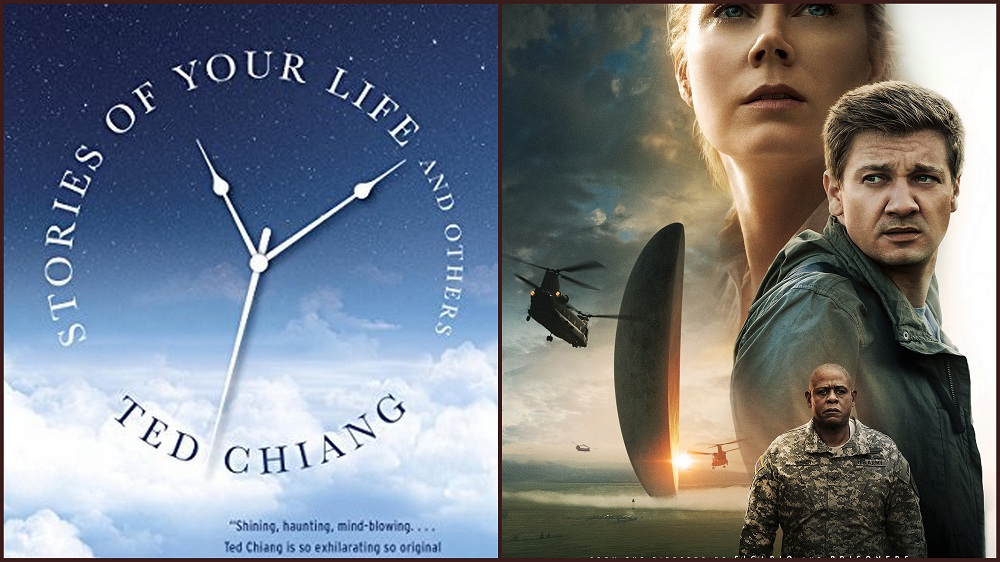
Story of Your Life is a science fiction short story written by Ted Chiang. It was first published 1998. The story revolves around a renowned linguist and how she makes a breakthrough in communicating with the aliens that have landed all over the world in massive spaceships. This story received many accolades and shot to immense popularity following the success of a Hollywood movie ‘Arrival’, which is based on this story.
“Despite knowing the journey and where it leads, I embrace it and welcome every moment.”
What would you do if you somehow chance upon the ability to be able to see your future?
Will that scare you, or will you be hopeful? Or both?
Ted Chiang, in his short story “The Story of Your Life”, brings you some answers in a very humane sci-fi manner, traversing through the themes of language and determinism.
First published in Starlight 2 way back in 1998, this story has received multiple accolades. Its most recent adaptation into a Hollywood movie – Arrival, starring Amy Adams and Jeremy Renner – is a testimony to its ever-growing popularity.
Story of Your Life: Summary and Plot Analysis
The story revolves around Louise Banks, a respected linguist, who is also the narrator of the story. Louise is recounting the events of her life to her daughter and story alternates between glimpses into her past and future.
The story opens with a couple enjoying a romantic dance on a day which happens to be the one where their daughter was conceived.
The pivotal point in the story is the arrival of aliens in spaceships that land in different parts of the world, including the US, Russia, China etc. And not just one or two, a total of 112 gigantic semi-circular spaceships land all over the planet.
These ‘devices’ serve as an audio visual link to the aliens.
This is the alien spaceship which land in different parts of the world. This image is a screenshot of the movie Arrival, which is based on this short story. (Photo Credit: Arrival Movie)
Aliens initiate communication with humans and Dr. Banks and Gary Donnelly (who is a physicist) have been brought in to assist with the process.
Aliens, whom people call ‘Heptapods’, because of their seven limbs and radially symmetrical appearance, communicate in a language that is nothing like any form of language (both written or verbal) that humans have ever known.
Louise and Gary are assigned to 9 “looking glass” sites (that’s what humans call the sites where these spaceships have landed) and start to work with them to understand their language in order to be able to communicate with them.
They work with two aliens, whom they nickname Flapper and Raspberry.
Through a series of conversations with them, Louise realizes that their written and spoken words are not related to each other at all! She and her group refer to speech as “Heptapod A” and the written form of the language as “Heptapod B”.
Through a series of experiments that Louise and her team run to understand the aliens’ language, both in linguistics and physics, they infer that the alien language has a ‘free word order’. In addition to that, their language does not seem to have any linear sequence making it even more complicated to understand.
Not much progress is made until one day Gary explains Fermat’s ‘principle of least time’ to Louise. From this fresh understanding, it dawns upon Louise that similar to the light in Fermat principle (where light knows exactly where it will end up before it chooses its path of travel), aliens know their full sentences beforehand.
Instead of experiencing events sequentially, they experience all of them at once, hence confirming why the Fermat principle resonated with them so much.
Armed with this knowledge, Louise becomes proficient in Heptapod B quickly, but it also alters her understanding of reality. She observes that her train of thought is now absurdly directionless.
She experiences complete immersion in Heptapod B and starts to think in it and perceives time the same way as Heptapods do. She now sees glimpses of a future, a daughter she does not yet have, her daughter’s death and a life she doesn’t have yet.
One day, the aliens announce that they are leaving. They shut down the looking glasses and disappear. It is never established why they came and why they left, although there were rumors flying around that implied that they found human race to be too primitive to be of interest to them.
This knowledge of the heptapod language changes Louise’s life. She knows the future now, but does nothing to alter it.
She knows that she is going to end up together with a man, have a daughter and will lose her when she is still young. Despite this knowledge of her future, she goes on ahead with her life, changing nothing.
Flash back to the present, when Gary asks her if she wants to make a baby, she says yes.
Want to read Story of Your Life by Ted Chiang?
Story of Your Life is a short story which is published in a collection of short stories written by Ted Chiang. You can use the links given below to buy this short story collection on Amazon:
Story of Your Life has won numerous awards for Ted Chiang, including the prestigious Hugo award. Mr.Chiang has this innate ability to convert extremely dense topics to something that you can not only comprehend, but think and marvel at the new perspectives that it brings.
A still from the movie ‘Arrival’ – it is based on A Story of Your Life
This story brings the debate of free will and determinism to the fore. The portrayal could not have been any more gripping and profound than it is. The story shines in its intellect and humaneness.
It has got rich material that will keep both the dreamer and scientist hooked.
Consider for example, how Chiang has broken down the concept of Fermat’s principle:
“Any hypothetical path would require more time to traverse than the one actually taken. In other words, the route that the light ray takes is always the fastest possible one.”
The way that he has married science with philosophy in his story is remarkable. He is known to have remarked once: “Science fiction is very well-suited to asking philosophical questions; questions about the nature of reality, what it means to be human, how do we know the things that we think we know.”
The clarity with which he has presented the linguistic challenges, realizations and the character epiphanies are spellbinding. It speaks to the amount of research that must have gone towards this immaculate description of a linguists approach towards a new language.
And the biggest sentences had an effect similar to psychedelic posters : sometimes eye-watering, sometimes hypnotic.
7 Quotes from Story of Your Life
Here are some quotes from A Story of Your Life that I absolutely loved:
1 – Whether scientists or tourists they were an awfully incurious bunch.
(Referring to the aliens who had landed in different parts of the world but didn’t seem to do anything after they had landed)
It might be the woman in me talking but I found the depiction of mother-daughter relationship extremely heart-warming. At those specific instances in the story I forgot that I was reading science fiction.
Here are some quotes through which the author depicts the beautiful mother-daughter relationship:
2 – Even if I had never laid eyes on you before, I would be able to pick you out from a sea of babies: Not that one. No, not her either. Wait, that one over there. Yes, that’s her. She is mine.
3 – It will be like growing an errant limb, an extension of myself whose sensory nerves report pain just fine, but whose motor nerves do not convey my commands at all. It’s so unfair. I am going to give birth to an animated voodoo doll of myself. I didn’t see it in the contract when I signed up. Was this part of the deal?
A still from the movie ‘Arrival’ – it is based on A Story of Your Life
4 – My own mother could never understand why I couldn’t just be a high school English teacher. You’ll do what makes you happy and that’s all I ask for.
5 – Living with you will be like aiming for a moving target, you will always be further along than I expect. All those vows that I will give reasonable answers when I became a parent, that I would treat my own child as an intelligent, thinking individual,all for naught, I am going to turn into my mother.
6 – I can fight it as much as I want, but there will be no stopping my slide down that long dreadful slope. Not to forget a little lesson in mindfulness that Ted threw in there as a bonus read-
7 – And the lesson in mindfulness – NOW is the only moment you will perceive; you will live in the present sense. In many ways, it’s an enviable state.
And there is always this overarching message in this book, which he very nicely intrigues us with using the Book of Ages ages and the fallacy of the argument that it exists, leaving us with this gem on his favorite topic of free will vs determinism.
8 – From the beginning I knew my destination and I chose my route accordingly. But am I working toward an extreme of joy, or of pain. Will I achieve a minimum, or a maximum?
James Gleick, an American author, speaking about The Story of Your Life once said, “For us ordinary mortals, the day-to-day experience of a preordained future is almost unimaginable.
But Chiang does just that in this story, and with this brings the hope and faith that our present is all the more enriched with authors like him around.”