Latest Comics

  • Taming the Bicycle by Mark Twain: Summary, Analysis and Review

    I wonder what your first thoughts were looking at the title of the story.

    Maybe a memory from childhood or a snapshot of some TV program where the protagonist ended up in a ditch, not able to control their bicycle?

    Well, just when you thought you had seen it all and laughed all you could at your bicycle misfortunes, Mark Twain brings you some of his own with Taming the Bicycle, published as part of his collection What is Man and Other Stories.

    Taming the Bicycle: Summary and Plot Analysis

    In the early eighties, Mark Twain learned to ride one of the old high-wheel bicycles of that period, the form of bicycle that has long been antiquated. Twain’s account of his bicycle adventures are far from it though.

    So Mr Twain saw an ad for a bicycle, thought he could do it and bought one alongwith a barrel of pond’s extract ( Guess what your friendly neighborhood Ponds cream was called back then!). He also hired an instructor from the company, who was to teach him the tricks to tame the wheely monster.

    Mine was not a full-grown bicycle, but only a colt – fifty inch – and skittish, like any other colt.

    The instructor explained a few key points and demonstrated how easy it was to ride one – mentioning that the tricky part was actually to dismount.

    Twain soon realized that it was contrary to his own experience.

    Although I was wholly inexperienced, I dismounted in the best time on record. He was on that side, shoving up the machine; we all came down with a crash, he at the bottom, I next, and the machine on top.

    One crash followed after the other and regardless of how Twain, the bicycle or the instructor were positioned at the start of practice, the end result was always the same – instructor at the bottom, bicycle on top and Twain sandwiched between the two.

    One of those practice runs even landed them in a hospital. Fortunately, the injuries were minor and Twain and his bicycle lived to tell the tale.

    Twain notes: I attribute this to my prudence in always dismounting on something soft. Some recommend a feather bed, but I think an Expert is better.

    The instructor was discharged from the hospital and shortly after, the practice sessions resumed – this time with four new assistants.

    Twain continued to struggle with this new learning experiments; skills required to master this craft always seemed to be at loggerheads with his natural instincts. Seeing the error of his ways, Twain realized that he needed to do the intelligent thing – he needed to evolve.

    The intellect has to come to the front now. It has to teach the limbs to discard their old education and adopt the new.

    He ultimately draws learning from his struggles with the German languages to conquer his new enemy – the bicycle.

    But I also see, by what I have learned of bicycling, that the right and only sure way to learn German is by bicycling method. That is to say, take a grip on one villainy of it at a time, and learn it – not ease up and shirk to the next, leaving that one half learned.

    He continues to work his way around the bicycles – to master balance, art of mounting, art of steering and art of dismounting – all of which result in rather funny endings, but not without great lessons – mostly comic.

    Mark Twain notes on the art of mounting: 

    Then the mounting art is acquired and a little practice will make it simple and easy for you, though the spectators ought to keep a rod off or two to one side, along the first, if you have nothing against them.

    And then the art of dismounting:

    Try as you may, you don’t get down as you would from a horse, you get down as you would from a house afire. You make a spectacle of yourself every time.

    After eight days of daily lessons, he is pronounced fit to paddle a bicycle without outside help. He tries to refute the argument that he could have done it himself without instruction by saying that such a  move could have been risky for him considering his natural clumsiness. 

    Consider his thoughts on a self taught man, for example:

    The self taught man seldom knows anything accurately.., and besides he brags, and is the means of fooling other thoughtless people into going and doing as he himself has done. There are those that imagine that the unlucky accidents of life – life’s experiences – are in some way useful to us. I wish I could find out how. I never knew one of them to happen twice. They always change off and swap around and catch you on your inexperienced side.

    He concludes that receiving proper instruction could have more than one benefit and in case of cycling, that added benefit could be saving up on Pond’s extract.

    So the instructor, after asking a few questions about his strength and receiving unsatisfactory answers, eventually leaves him with the advice to keep practicing.

    Then he left me, and I started out alone to seek adventures. You don’t really have to seek them – that is nothing but a phrase – they come to you.

    Devoid of the encouragement from the instructor and his assistants, Twain takes a rather solo journey of  learning the bicycle. However unbeknownst to him a boy  gives him company in his adventure, though not in the form he expected. He paints a rather funny picture of this boy and the way he supported him through his practice sessions.

    He was full of interest and comment.The first time I failed and went down he said that if he was me he would dress up in pillows, that’s what he would do.The next time I went down he advised me to go and learn a tricycle first. The third time I collapsed he said he didn’t believe I could stay on a horse-car.

    Of course, Twain does not let this teasing get to him, he continues on with his practice sessions marvelling at how the bicycle has exposed unknown areas of the path he had been using for years. Little stones, cats, dogs, anything that came along his way, was bound to make him lose control and bite the dust, his falls usually resulted in injuries to him, while the bicycle stayed indestructible. 

    Dogs eventually presented a bigger challenge than the stones on the path:

    They all liked to see me practice, and they all came, for there was very little going on in our neighborhood to entertain a dog. It took time to learn to miss a dog, but I achieved even that.

    Twain leaves us with a little bicycle wisdom as well:

    Get a bicycle. You will not regret it, if you live.

    I am afraid I can say the same for this essay by Mark Twain. Grab your copy and read it now!

    Reading this essay, in addition to grinning like an idiot when not guffawing like one, I couldn’t help but think of my initial bicycle learning days when I was a kid looking like the Vitruvian man both when sitting on and falling off my bicycle, calling my mom every time I mounted or dismounted it.

    I thought my days were hard, but when I looked at this picture to see the bicycle Twain conquered, my own traumatic ‘bicyclical’ past faded away.

    Mark Twain and his bicycle are my new favorite , and there ain’t gonna be no dismounting that bookshelf soon.
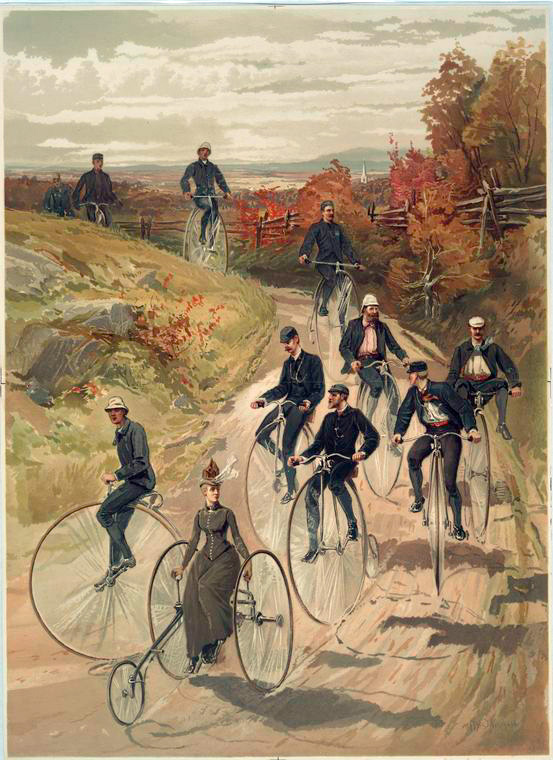
    The bicycle Mark Twain was trying to tame.

    P.S. Assuming that I was able to convince you to read Taming the Bicycle by Mark Twain, and you eventually were able to find time to do so, what section did you like the most?

    Did anything from the story remind you of your own bicycle adventures?

    We would love to hear from you! 

  • The Happy Prince by Oscar Wilde: Summary, Analysis and Review

    The Happy Prince is a short story written by Oscar Wilde. It is the story of a compassionate statue and how it falls in love with a bird which is separated from its flock.

    Every now and then, I feel myself drawn to children’s books – mostly because I am drawn to children; things about them, things for them – they’re all so exciting. Adult novellas feel drab in comparison.

    And it was one of those days, I happened to pick up a copy of the Happy Prince and Other Tales, a short story collection by Oscar Wilde.

    The Happy Prince: Summary and Plot Analysis

    Happy Prince revolves around our Happy Prince, the only catch being that our Happy prince is a statue!

    When alive, our Happy Prince lived in a palace with all material comforts far removed from the reality of poor, suffering people that surrounded it.

    We also have a swallow (a migratory swift-flying songbird with a forked tail and long pointed wings) in the story, who has been left behind, as the rest of the flock flew away to Egypt.

    The swallow, upon finding a sweet spot in the new town on her way, settled down at the feet of the Happy Prince and is almost about to doze off when she feels rain drops over her. Curious at this occurrence, as there are no clouds in the sky, she realizes that it was tears from the Happy Prince statue.

    She learns that the Happy Prince is appalled by the poverty around him and requests the swallow to take the gems from ‘his body’ (the statue) to help those in need – the sick, the lonely, the children.

    The beautiful statue covered in gold leaf, first loses the ruby from the hilt, then the sapphire from its eyes and finally the golden leaves all over its body.

    The swallow initially insisted on leaving to join her flock but eventually decided to stay back out of compassion as the statue was blinded after losing both the sapphires that it had for its eyes.

    As her final day approached she flew over to say one final goodbye to the prince. The prince confesses her love for the swallow, they kiss and the swallow dropped dead at its feet.

    Devoid of all the adornments, the statue was not a pleasant sight anymore. The mayor of the town orders the removal of the statue to erect his own in its place.

    The metal from the statue is melted while the frozen and broken heart of the statue was thrown out in the heap of garbage along with the dead bird. Both of these are taken up to heaven by an Angel that considers them the two most precious things in the city.

    God then decrees that they live forever in His “city of gold” and garden of Paradise.

    Want to read The Happy Prince?

    The Happy Prince is a part of a short collection written by Oscar Wilde, which is available on Amazon if you want to get yourself this book. You can use the links given below to check the price of this book:

    Check Price on Amazon US
    Check Price on Amazon India

    The Happy Prince: Review, Quotes and My Thoughts

    Okay, so confessions first.

    You all know that one person in the group that cries at the drop of a hat.

    I bet you will get a flood of tears out of them when they read this – 

    It is not Egypt that I am going. I am going to the house of death. Death is the brother of sleep. Is he not? Kissed the prince on the lips and fell down dead on his feet.

    After so many selfless deeds, when the swallow saw the Prince for one last time, and the Prince unable to understand that it was her death that she was talking about – assuming she was flying away to her flock – wishes her luck, although his heart broke.

    He still did that out of love. His final confession of love for the bird was simply heartbreaking, not to say that the bird dropped dead shortly after.

    When I was alive and had a human heart. I did not know what tears were, for I lived in the palace of Sans-souci where sorrow is not allowed to enter.

    It was remarkable how compassionate the Prince was, considering the fact that he had never seen poverty or sorrow of any kind. It’s only when he becomes a metal statue does he feel all these emotions. Ironic isn’t it?

    We had a lovable inanimate object before Wall-E, my friends!

    “Bring me the two most precious things in the city” said God to one of his angels; and the angel brought him the leaden heart and the dead bird.

    “You have rightly chosen” said God, “for in my garden of Paradise, this little bird shall sing for evermore, and in my city of Gold the Happy Prince shall praise me”.

    And for this deceptively simple lesson in kindness and compassion –  is as appealing to an adult as it is to a kid.

    You don’t have to trust me on this. So many on-screen adaptations of this story worldwide – going as far back as 1936 to as recent as 2016,are a testimony to timeless beauty of this wonderful tale of love and compassion.

    What does that tell us?

    Oscar Wilde’s stories age better than whiskey.

  • The Five Boons of Life By Mark Twain: Summary, Analysis and Review

    The Five Boons of Life is a short story by Mark Twain published as part of his collection, The 30000 Bequest and Other Stories.

    It’s different from his other stories in that it does not have our humorous Mark Twain saying things that make us grin like idiots in awe of his wit, but something to mull over, something to reflect.

    The Five Boons of Life: Summary and Plot Analysis

    The fable, as the title suggests, is about the five boons of life. It features a fairy and a man over the span of a man’s lifetime. It is divided into five chapters.

    Chapter 1

    Enter Fairy who has arrived with gifts.

    ‘Take one, leave the others ’- she says.

    The five options on offer are – Fame, Love, Riches, Pleasure and Death.

    Without a second thought, the young man chooses pleasure. It does not take him long to realize that it was not a good choice – as each of those pleasures were short-lived, vain and empty.

    He regrets his choice and resolves to choose wisely if the opportunity ever presents itself again.

    Chapter 2

    Man has aged a bit now, Fairy makes an appearance again and grants him another wish. He has the option to choose from the rest of the four.

    The man chooses love this time thinking that it had to be the right decision.

    Years have passed since that visit from the fairy – every loved one the man ever had, either left him or the world. He is pained with grief and curses love from the bottom of his heart.

    He lost way more than he gained, trading with the monstrous Love.

    Chapter 3

    Fairy reappears and now offers the man to pick one from the remaining three.

    Man chooses fame this time. The fairy grants the wish and leaves.

    The man enjoys fame, but that experience of enjoyment does not last long either. Fame is quickly followed by envy, persecution, derision and pity. He sits there alone, marinating in hopeless self-loathing.

    Chapter 4

    The man being given the choice between Wealth and Death this time, chooses Wealth, considering himself utterly foolish for not having done that before.

    Wealth, he thought, was the answer to everything.

    The result of this one was worse if not better than ones from his previous choices. Three years after choosing wealth, the man sat in rags, cursing wealth and coming to realize the most precious wish of them all – Death.

    Chapter 5

    Man is ready to embrace death when Fairy appears and offers him to choose again, but there is a twist.

    The man can only choose from the four options that he had used before. Death was not an option anymore for the man.

    What lay ahead of him was something worse – and in Mark Twain’s words – The Wanton Insult of Old Age.

    Want to read The Five Boons of Life by Mark Twain?

    The Five Boons of Life is a short story which is published in a novel alongwith other short stories written by Mark Twain. You can use the links given below to buy this short story collection on Amazon:

    Check Price on Amazon US
    Check Price on Amazon Canada
    Check Price on Amazon India

    The Five Boons of Life: Review and My Thoughts

    ‘If you were granted one wish, what would you ask for?’

    Growing up, someone must have asked you this question at least once. It is not just something that children marvel at, but is also a good conversation starter for adults.

    Now, I do not know about you, but I have been asked that question many times in my life, so much so that it’d  be a miracle if it does not make a monthly appearance at some conversation or the other.

    What’s more intriguing is how the answer to that question changed for me as I grew older.

    I distinctly remember the first time I was asked this question. And I answered like any ice-cream loving kid would,  ‘An Ice cream truck’.

    Of course, I couldn’t have the satisfaction of having my imaginary ice-cream truck, because I was immediately told what a stupid choice that was.

    If I were you, I would have asked for ‘I wish for every wish of mine coming true’

    That was the Big revelation. How smart! How Intelligent! Why didn’t I think of it?

    Of course I couldn’t, because I was stupid. And my neighbor was smart.

    And then Life happened. (It’s still happening by the way; I am not that old)

    Like the man in Twain’s story, I have craved for some of those things. But with a growing stack of life experiences, I’ve come to realize that there is no end to desire.  Getting one is always followed by an immediate craving for the other and then another and so on and so forth. 

    The fable is not new. You have some version of this in every culture and even if you are not familiar with this particular story, you are not new to the idea.

    Equipped with whatever you took from the story, if I were to ask you, for the n-th time..

    If you were to be granted one wish, what would you ask for?

  • The Canterville Ghost by Oscar Wilde: Summary and Analysis

    The Canterville Ghost is a short story written by Oscar Wilde. It was first published in 1887. Unknown to many, this was his first published prose fiction work.

    Contrary to what the title of the story may suggest, this is a humorous story at the core of which lies the differences in the American and British culture.

    The Canterville Ghost: Plot Summary and Analysis

    Mr. Otis , an American minister, was looking to buy Canterville Chase, a castle that  belonged to Sir Canterville. The castle was not inhabited by the Canterville family for decades now, the reason being that it was believed to be haunted.

    Sir Canterville declared this upfront to Mr Otis, who discarding the haunted castle rumors offered to buy both the castle and ghost – at valuation.

    Mr. Otis moved into the castle with his wife, his son (Washington), his daughter (Virginia) and his two younger twins and were greeted by the castle housekeeper, Mrs. Umney.

    They noticed the blood stain in the hall and Mrs. Umney let them know that it was from when Sir Canterville brutally murdered his wife.

    The family was far from spooked by this – rather proceeding to grab their cleaning supplies to scrub that spot right off the floor.

    The stain came right off.

    The following days, the blood stain re-appeared – although what was noticeable was that blood stain had different hues each time.

    The family finally accepted there might be some truth to the rumors, but still went about their business as usual.

    The ghost finally made an appearance one night and Mr Otis was the one to see him, but instead of being scared – he requested  that he put some oil into the chains so that he didn’t make so much noise while walking around in the night.

    The ghost was surprised, as this was not the normal reaction he was accustomed to. Never in a brilliant and uninterrupted career of three hundred years, had he been so grossly insulted.

    Taking this as an insult to his natural scaring power, he took it upon himself to make even bigger spectacles – what went on in the following days was actually opposite to what he imagined.

    The kids attacked him pea shooters, and played elaborate pranks on him – on one occasion even scaring with a replica skeleton. Insulted and tired, the ghost eventually retired to his own room – feeling even more depressed.

    Viriginia, Mr Otis’ daughter found him one day and was pained to see the ghost, visibly sad and distraught – who told her that he was very tired and had not slept in three hundred years.

    He asked for her help – knowing that she had a compassionate heart – unlike the rest of her treacherous family.

    She agreed to help him, although she was terrified of what lied ahead. They disappeared into a garden of death. 

    Desperate search ensued to find Virginia – who was nowhere to be found. The family was distraught, as was the Duke of Cheshire, who had been courting Virginia for quite some time now.

    Her mother was on the verge of a nervous breakdown, when Virginia finally came back to the house. She let the family know that Sir Simon Canterville, the ghost, was now at rest.

    The ghost, in turn, had left her a box of rare jewels as a gift for her help.

    Although Virginia never told anyone what happened in the garden of death, she always remembered Sir Simon with love and was thankful for sharing the wisdom:

    Love is stronger than life and death.

    Want to read The Canterville Ghost?

    The Canterville Ghost is a short story which is published in a collection of short stories. You are welcome to use the links given below to check the price of this book:

    Check Price on Amazon US
    Check Price on Amazon India

    The Canterville Ghost: Review and My Thoughts

    The story is a delightful read – more so because it did not turn out to be a tale of horror – which if truth be told, I do not have a stomach for.

    Although the story still had a very profound message at the end, it was the characteristic humor that stood out for me.

    So, you are buying a house and the first thing someone told you was that it was haunted.

    What would your reaction be?

    Mr Otis’ reaction on hearing this news was priceless.

    I will take the furniture and the ghost at a valuation, answered the minister.

    I wonder what Sir Canterville would have thought in his head, when he listened to that.

    Not only that, he made it plainly clear that an incident or a commodity of that nature, if known in America, would be a rage.

    I reckoned if there were such a thing as a ghost in Europe, we’d have it home in a very short time in one of our public museums, or on the road as a show.

    Thinking that Mr Otis was not able to fully understand the gravity of situation at his hand, Sir Canterville made another attempt to explain.

    The ghost has been well known for three centuries and always makes an appearance before the death of any member of the family, 

    To which Mr Otis, quickly remarked – So does the family doctor for that matter

    One hell of a lesson in lateral thinking, isn’t it?

    There is no such thing as a ghost and I guess the laws of nature are not going to be suspended for the British Aristocracy.

    Quite a jab at the British aristocracy there! 

    British never seem to have seen eye to eye on their language:

    … We really have everything in common with America nowadays, except of course, the language.

    The story is replete with differences in the British and American culture, a product, I suppose, of Wilde’s experiences in America on his lecture tours there. He pays a little homage to H.W. Longfellow as well, a celebrated American poet.

    Consider this –

    He had hoped that even Modern Americans would be thrilled by the sight of a spectre in armour, if for no more sensible reason , at least out of respect for their national poet Longfellow, over whose graceful and attractive poetry he himself had whiled away many a weary hour when the Canterville were up in town.

    Although this was a ghost story, I was still surprised to know that our ghost had actually killed his wife (I know people can be stupid, right?) for a reason that was even more surprising than the act itself – she was plain looking and didn’t cook well.

    But having been rebuked by Virginia for that, he simply responds with-

    Oh, I hate the cheap severity of abstract ethics. 

    Made me think.

    That is after picked myself up from the floor laughing.

  • Sweet and Low by Nick White: Summary, Analysis and Review

    Sweet and Low is a short story written by Nick White. The story revolves around the life of a young boy Forney, who, having recently lost his father, is coming to terms with a life with his mother – a mother he doesn’t especially feel close to.

    With the feeling of love comes the dread. When you love someone, you give them the power to destroy you with something as little as a look. Or a song.

    This is an excerpt from a short story by Nick White, an American author noted for his debut novel How to Survive a Summer. The story Sweet and Low is one of the stories in his short story collection of the same name.

    Sweet and Low: Summary and Plot Analysis

    The story opens with Felicia (Forney’s mother) cleaning the house meticulously, something that was not very characteristically her, having announced to her son that she was expecting someone for dinner that day.

    Forney, who hasn’t still come to terms with the fact that his mother is seeing other men, feels disgusted but resolves to make sure he knows who that man is.

    The man doesn’t arrive on time and Forney is secretly happy when he tries to console his mother about being stood up.

    The man, whose name is Buck, however, pulls up shortly after, apologizing profusely over his tardiness.

    Dreading to see another man with his mom, he prepares for the worst but looking at the tiny and frail frame of this man, he is secretly relieved. He is convinced that his mother seems to be in this arrangement strictly for his connections.

    Over the course of the evening, Forney comes to know that Buck met his mother at Country Music Palace where her rendition of Sleeping Single in a double bed bewitched him.

    Buck is very appreciative of Felicia’s talents which Forney finds very hard to understand – having never experienced them first hand.

    Buck continues to regale them for most of the night. Forney comes to know that Buck is a DJ, and hosts a show Buck Wild in the Morning – second most-listened program in the  Delta. He confesses to having a soft spot for happy songs.

    Buck, a self confessed sweet tooth, asks them for a dessert. Felicia asks Forney to get some for him from the freezer.

    Dreading the sight of his mother and Buck using it as their moment of privacy, Forney, to his relief, sees them in the driveway where Buck and his mother were sharing a cigarette.

    His mother sees him off and wards off Forney’s question about the nature of the relationship between the two.

    Buck’s visit to the family becomes a regular Friday occurrence – and more and more focused on Felicia’s talents.

    Forney is impressed with Buck’s talent on the piano and even more so, when he listens to his mom singing for the first time. He now realizes what his father and Buck meant when they said they were enchanted by her voice.

    Buck and his mom practice, often till late in the night, but Buck never stays the night. They continue to maintain a strict business-like relationship – at least in Forney’s presence.

    Buck and his mother start going to small open mic gigs and on those occasions Forney is left to live with his uncle and his aunt.

    Although both his uncle and his aunt pretend to not care for information about Felicia, Forney knows that they secretly wish for as much as they can get out of him. He tells them about Buck and how he is teaching her country music.

    Buck drives up into the front yard one afternoon and announces to Forney that the opportunity for his mom had now come. They would be going on a trip to Memphis and this time his mother is going to take him along with them.

    In preparation for the trip, both his mother and Forney shop for something classic that suits the occasion. His mother is in a very jolly mood and kisses Forney on the forehead.

    This, in Forney’s words, is an atomic bomb for his senses.

    Buck drives them to Memphis in his crown vic, entertains a few questions from Forney on his way there before they arrive at the Little Tina. Felicia, nervous about her upcoming performance, touches the statue of W.C Candy for luck.

    The three of them get in a booth at the back, where Forney and Buck order sweet tea and Felicia goes straight for her gin and tonic. They see a performer playing quite well, only to be booed.

    Felicia performs shortly after and the crowd does not even notice her presence. This breaks Forney’s heart who wanted her mother’s performance to be immensely successful. He breaks into sobs.

    Buck’s friend Bishop visits shortly after, missing Felicia’s performance. Felicia and Bishop get drunk and perform again, with her mother slurring through most of the song.

    Forney is disturbed by this drunkenness, and Bishop’s behavior towards his mother.

    In a fit of rage, he splashes his tea on Bishop’s face. He is about to retaliate but he’s stopped by Buck.

    Felicia, in an attempt to repair the damage done by Forney, announces that she will join them later and that they could go on without her.

    Buck and Forney both disagree but Felicia insists that she needed to talk to Bishop to smoothen things as she feels that this will help her career.

    Buck drives Forney back to stay at a motel where both of them share a cinnamon bun brought by a waitress and Buck tells him where his son was, answering a question that Forney had asked him months ago.

    Both of them know that Felicia was not going to return. Forney is sure that she thinks – this is the saddest room in the universe.

    Want to read Sweet and Low?

    Sweet and Low is available on Amazon if you want to get yourself a copy. You can use the links given below to check the price or buy this book:

    Check Price on Amazon US
    Check Price on Amazon India

    Sweet and Low: Review and My Thoughts

    I find the evolution of the relationship between the mother and son endearing. Both of them were grappling with the loss of a dearly loved one; it came as a salvation to see Forney progressing from an emotionally distant son to one that breaks into sobs when his mother did not get the applause he so desperately wanted for her.

    Her response does not alarm or frustrate Forney. That is their way with each other: distant with an air of suspicion.

    He recognizes the feeling inside him and shudders. With the feeling of love comes the dread. When you love someone, you give them the power to destroy you with something as little as a look. Or a Song.

    I loved how Nick White took a loving jab at deep South here and there. And on his road trip to Memphis:

    Forney has this notion that they will see Memphis glittering in the distance, a good mile or two before they reach it. So far, however, there has been nothing but a vast stretch of nothingness in front of and behind them: a hazy wall of humidity,a diminishing wall of trees. Like they are headed away from civilization, not towards it.

    I almost found myself rooting for Buck when he confesses to liking happy love songs:

    The kind where it ends the way it should.

    Although Nick White didn’t end the story that way, he made the journey worth the while.