Category: Fiction

  • The Lottery by Shirley Jackson: Summary, Plot Analysis and Review

    The Lottery by Shirley Jackson: Summary, Plot Analysis and Review

    The Lottery`is a short story written by Shirley Jackson who’s an American author. First published in the New Yorker in 1948, the story is about a strange game of lottery that’s practiced in a village.

    Touted as one of the most famous short stories in American literature and first published in New Yorker in 1948, this story’s journey was rocky in the beginning.

    It opened to a tremendous negative response by the audience. People felt hurt and it received a lot of hate mails. It  was even banned at some places.

    Wondering what so special about it?

    Let’s jump right in!

    The Lottery: Summary and Plot Analysis

    The story opens in a village square on a bright and beautiful summer day. The village is small with about 300 people and has the usual small place charm.

    Everyone knows everyone. Children running around, Wives catching up on the latest gossip and men surveying their children and talking about plantation and taxes before families start standing together in groups.

    The families have assembled for the annual lottery event. This event takes much longer in other towns but the small size of this town works to the villagers’ advantage. The event gets over in no more than two hours.

    Children, who have just gotten off school are running around with stones in their pockets, while some others arrange them in a pile on the ground.

    A man called Mr. Summers runs the lottery because he has a lot of time at his disposal for the village.

    He arrives in the square with the black box, followed by Mr. Graves, the postmaster. The black box is older than the oldest man in the village. Mr Warner attempts to get a new one but is thwarted in the name of tradition.

    Mr. Summers jumbles up the slips of papers in the box. Note that at this point the reader is unaware of the content in those paper slips.

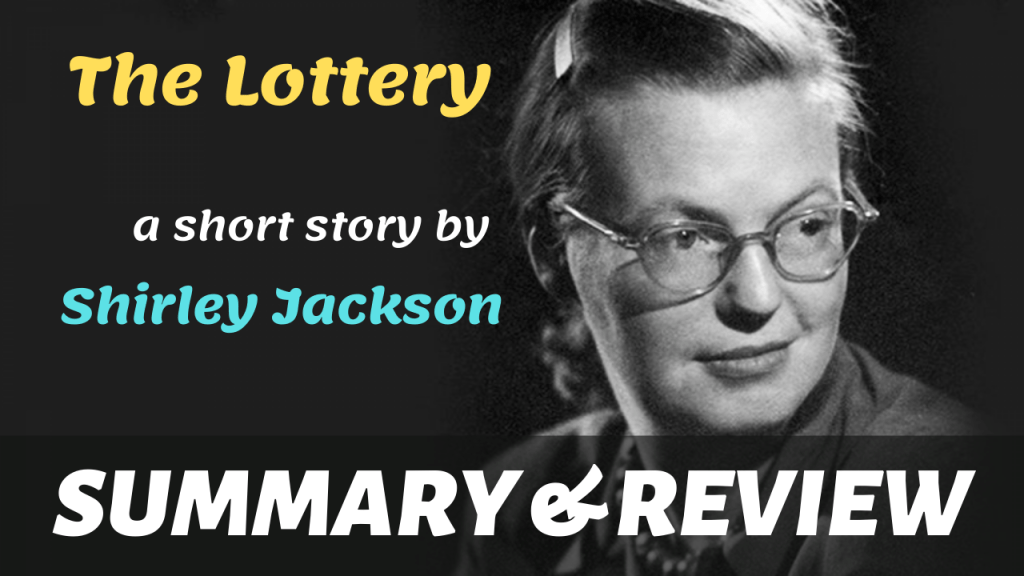
    portrait of shirley jackson
    Shirley Jackson – the author of The Lottery

    Mr Summers and the postmaster made the paper slips the night before and locked it up in his coal company. As a prerequisite to the lottery, a list of families is made and members from each household are identified to be representing the family for the event.

    Mr Summers is sworn in, albeit without the customary salute or song that’s used to characterize such events in the past.

    A village woman Tessie Hutchinson joins the crowd late, visibly flustered having forgotten the day to be the lottery day. People joke about her late arrival in a playful manner.

    Mr Summers confirms with the crowd about everyone’s presence for the event and makes sure that there is someone to draw for every family.

    He then proceeds with a reminder about the lottery rules: he will read family names and the identified family heads will come and draw a slip of paper and no one is to look at their slips until every family has drawn.

    While people continue to draw slips of paper from Mr Summers’ box, Mr Adams and old man Warner strike up a conversation about some other village taking on the lottery tradition, mentioning that some wanted to discontinue it.

    Old man Warner ridicules the idea saying that it is as bad as going back to the caves and that it’s trouble and nothing else.

    Everyone has finished drawing papers and now the family heads open the papers. Word quickly travels that Bill Hutchinson has got it.

    Tessie starts complaining about the unfairness of the draw considering that her husband got very little time to draw a paper. Mr. Summers asks Hutchinsons if there are other members in their family. He confirms.

    There are five papers now to draw from. One for each member of the Hutchinson family. Each member draws their paper, and opens their slips. Tessie receives a paper with a black dot on it. Mr Summers then instructs the villagers to hurry up.

    All villagers grab stones and run towards Tessie, who is now standing in the middle of the crowd. She continues to complain about the unfairness of the lottery until she is hit by a stone on her head, and then everyone begins throwing stones at her.

    The Lottery: Review & My Thoughts

    The first time I read the story, I was shell shocked at the ending.

    Although Jackson dropped quite a few hints about the lottery not being a traditional one that comes to mind when you see or hear this word. I was not prepared for the end.

    I thought I read it wrong; but no, I read it right. She was stoned to death by people she knew, she gossiped with. Hell! Her own family!

    The idea was very bizarre to me, and I was finding it hard to digest. It didn’t sit well with me.

    Up until the absolutely unexpected ending, there were a few references in the story that I marveled at:

    “It was clear and sunny, with fresh warmth of a full summer day”

    I know I might be over-crediting this line, but summers are rare in the place I live and what bad could ever happen on such a nice summer day!

    About how children shall always be children:

    “The children assembled first, of course. School was recently over for the summer, and the feeling of liberty sat uneasily on most of them.”

    How men taking a central role in a family is okay, but women doing the same is not.

    “Wife draws for her husband, Mr Summers said. “Don’t you have a grown boy to do it for you Janey?”

    I did see eerie signs but chose to ignore them, clues spread all throughout the story about lottery not being the traditional one: why was Tessie constantly complaining about getting the lottery? It’s lucky to win one and people want to win it, right?

    We would instinctively trace it back to the dark ages if we ever hear of an incident like this in reality.

    With all of the human rights commissions that we have now, yes, an act like this is not going to get unnoticed, and I sure would like to believe that they would play an instrumental role in curbing a horrible, inhuman practice like this.

    But does that mean that we are not slave to tradition now in these times?

    Mrs Hutchinson’s death is an extreme example of how societies can perpetrate all sorts of injustices for reasons that defy logic.

    The targeted individual could be a different race, a different sex, follower of a different religion, of a different economic class, something that he or she can not control but has to pay the price for.

    Just as villagers blindly follow tradition to stone Tessie to death, real life villains carry out atrocities without questioning the tradition or the widely held belief – however flawed it might be.

    All this is to say that the ending of the story made me think. A LOT.

    And that is the power of a great story. Publishing something like this in 1948! Shirley Jackson was undoubtedly way ahead of her times.

    It pains me to think how much flak she received for this. Bombarded with hate mail in hundreds all through the summer when it was first published.

    The story left me speechless.

    Thank you, Shirley Jackson!
  • Cathedral by Raymond Carver: Summary, Analysis and Review

    Cathedral by Raymond Carver: Summary, Analysis and Review

    Cathedral is a short story written by Raymond Carver. This story was included in the ‘Best American Short Stories’ (1982). It’s the story of how a man’s perspective about blind people changes dramatically when he meets an extraordinary blind man who introduces him to a new realm of experience.

    “Cathedral”

    What’s the first thing that comes to your mind when you read this word?

    My guess is that you made a mental image of a cathedral, right?

    Now here’s a question: how long do you think it’s going to take you to explain your mental image of a cathedral to me so that I see it exactly the same way you do?

    5 minutes? 15 minutes? An hour?

    And how satisfied are you once you’re done explaining it?

    Cathedral, a short story by Raymond Carver, is an immense realization of this. to say the least.

    Cathedral Short Story: Summary and Plot Analysis

    The story opens with the narrator mentioning a visit from a friend of his wife, one whom he does not seem to particularly like, considering that he is blind.

    This friend’s wife has recently died and after returning from one of his relatives’ place, he considers meeting the narrator’s wife, as they live close-by.

    The narrator knows quite a lot about this friend – he was a reader. The narrator’s wife met and was employed by this man years ago. On the last day of her job, this blind friend had touched his wife’s face and wrote a poem about it.

    Knowing all this, the narrator finds this man’s blindness ‘unsettling’, more than anything else.

    The narrator also goes on to give the us (i.e. the readers) a peek into his wife’s past-marriage to a childhood sweetheart, loneliness that had led to a suicide attempt (which she survived) followed by a failed marriage.

    Through all these experiences, she continued to keep in touch with her friend. Poems and tapes were the primary means of communication between them. They talked about everything and everyone, including the narrator.

    The narrator and his wife have a discussion about the impending visit from her friend, wherein his wife continues urging him to be nice to her friend, while the narrator continues to bring up reservations about the guest being blind.

    She tells him about that man’s wife, their married life and her struggle with a terminal disease. All this while, the narrator, seemingly immune to the grief of the blind man, continues to wonder about the unhappiness his wife would have felt thinking he could never see her.

    The narrator’s wife goes to pick her friend from the train station, while the husband waits for them at home.

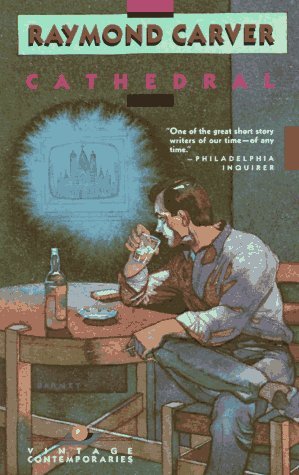
    cathedral by raymond carver book cover
    Cover of Cathedral by Raymond Carver. The links to buy this book are provided at the end of this article.

    He is shocked to see that Robert (the blind man) sports a beard. This does not seem natural to the narrator. His wife introduces him to Robert and all of them engage in conversation.

    The narrator inadvertently asks Robert which side of train did he sit on his way here. He quickly realizes his mistake, but seeing that Robert is unnerved by the question, he’s a bit surprised.

    Three of them sit for dinner and stuff their faces. Many things about Robert continue to surprise the narrator, including, Robert not wearing dark glasses, his ability to smoke ‘normally’ and eat and drink effortlessly.

    All this starts to challenge the blindness stereotype that he had held in his mind for so long.

    While his wife excuses herself for a change of clothes and is gone for quite a while, both men engage in small talk and narrator switches his attention to the television which aired a program about Middle Ages, showing cathedrals from different parts of the world.

    This prompts the narrator to ask Robert if he had any idea what a cathedral looked like. Robert requests the narrator to describe one to him but finds him struggling while doing so.

    Robert then asks the narrator to bring a pen and paper and draw a cathedral. He puts his hand over the narrator’s hand, following the movement of the narrator’s hand. The narrator continues to draw and finds himself immersed in the experience, in a way that he had never felt before.

    At one point, upon Robert’s insistence, he starts drawing with his eyes closed. When he’s  done, Robert asks him to open his eyes.

    The narrator chooses not to, soaking in his newfound bliss. When he’s asked how it felt, he simply responds with “it really is something”.

    Cathedral: Review and My thoughts

    The story seems simple, doesn’t it?

    But it has a little Thich Nhat Hanh lesson (he’s a famous monk and peace activist who has published over 100 books) for us there – a lesson of mindfulness.

    Not only that, it takes a jab at how easy it is for humans to fall prey to stereotypes.

    The story sure is short, but has much to offer. The narrator’s reservations about blind people, his completely warped view of the world of disabled is, on some occasions, comical, while at others bordering on apathy.

    Some quotes from Cathedral

    One of the narrator’s blanket statements about blind people is downright comical.

    “I remembered having read somewhere that the blind didn’t smoke, because, as speculation had it, they couldn’t see the smoke they exhaled.”

    I couldn’t help but laugh when, on seeing his wife’s thigh exposed, the narrator rushed to cover it, only to put it back when he realized that the only other person in the room was blind.

    Here, read for yourself to see if it has the same effect (holding breath in anticipation of your validatory smile):

    “(While sleeping) she had turned so that her robe had slipped away from her legs, exposing a juicy thigh. I reached to draw her robe back over her, and it was then that I glanced at a blind man. What the hell! I flipped the robe open again.”

    His reminiscence about his wife’s tragic past is sad, but with a slight undertone of jealousy. That man who seemed like a stone, did expose his soft side. I couldn’t help but gush a little when I read this.

    “Her officer – why should he have a name? He was her childhood sweetheart, what more does he want?”

    And yes, why should a spouse’s ex have a name?

    Robert’s positivity and an upbeat temperament is in stark contrast with the narrator’s expectations.

    Robert seems to have it all – loving and meaningful relationships, complete immersion in what he does and an undying penchant for learning.

    “I am always learning something. Learning never ends. It won’t hurt me to learn something tonight. I got ears.”

    Couldn’t get any more cliche than that, eh? Yet valuable just the same.

    Learning. Never. Ends.

    We have great people from history and the present worldwide vouching for Robert on this one, and for good reason.

    It’s ironical that a seemingly indifferent narrator has a profound experience at the hands of someone that he was completely apathetic to, until they share an immersive experience.

    Very cleverly, Carver exposed the error of the narrator’s way by showing him that the world he thought he was lacking was actually the one capable of making him feel fulfilled.

    A world that showed him better things. A world that makes him see.

    I hope I see more from this day on.

    Want to read Cathedral?

    Cathedral is available on Amazon if you want to get yourself a copy. You are welcome to use the links given below to order a copy:

    Check Price on Amazon US
    Check Price on Amazon Canada
    Check Price on Amazon India

  • Cupid and the Paintbrush by PG Wodehouse: Summary, Plot Analysis, Review

    Cupid and the Paintbrush by PG Wodehouse: Summary, Plot Analysis, Review

    Cupid and the Paintbrush is a short story written by PG Wodehouse – an English author and one of the most popular humorists of the 20th century. The story revolves around a man who proposes marriage to his love interest through a unique contest. 

    Let’s take a look at the plot summary of the short story:

    Cupid and the Paintbrush: Summary and Plot Analysis

    The story starts with the narrator (who is not named anywhere in the story except for his initials “R.A”) talking to Marjorie – his love interest.

    The narrator tries to persuade Marjorie to get married to him. Marjorie, however, is reluctant about the idea of marrying him. She insists that she would “make him wretched”, and that he would “hate the sight of her in a few years” and that he has no idea what she’s really like.

    RA doesn’t back down and continues trying to convince Marjorie to marry him. She remarks that she has nothing against marrying him per se, and that she actually likes him too, but it’s the idea of marriage that she is unsure about.

    R.A is puzzled by this. “What is your objection to marriage in the abstract? Tell me the worst. Are you a woman with a mission?” he asks.

    “Well, I suppose, I am, in a way. I want to paint.” she replies.

    He then asks why would that stand in the way of her marrying him. She explains that she wouldn’t paint so much once she is married to him as she would get lazy.

    RA assures her that that wouldn’t happen, as he is something of an artist himself. He then proposes a bargain to Marjorie.

    “We will each paint a picture for the Academy this year, and whoever paints the better one has his or her way in the matter. Do you agree?”

    Marjorie, after a little hesitation, accepts the offer.

    The couple meets again after 15 days and discuss the progress they’ve made with their respective pictures.

    RA, very cheerfully, informs Marjorie that he has chosen an allegorical subject for his picture. He intends to “represent a beautiful young lady dressed in a neat creation of white, standing on a rustic bridge with her back to a rather sweet thing in Turneresque sunsets.” He has titled the painting “Waiting”.

    Marjorie then tells him that she is painting a landscape which has a cow in a corner.

    RA is now convinced that his painting will easily win this contest, because the President (presumably the judge of the contest) will remember the beautiful young lady from his painting, and will hand him the win.

    After the result of the contest is declared. RA pays a visit to Marjorie’s house, where he finds her crying.

    He inquires if her picture was rejected.

    “Yes” Marjorie sobs. “I see how silly I was ever to think that I could paint.”

    RA consoles her and mocks his stupid contest. Once again, he implores her to marry him.

    An emotional Marjorie says yes.

    They embrace each other and make love.

    Afterwards, RA tells Marjorie that he came in to ask her to accept his marriage proposal despite that stupid wager.

    “But you won it.” says Marjorie.

    RA then informs her that his painting also failed to impress “the Committee”.

    Marjorie is surprised. “What! You were refused?”

    “My picture was. I was accepted. By you. Don’t move.”

    Following a long silence, RA proposes that they take to photography, share the same camera and “develop off the same plate”.

    Marjorie comments that she realized that she never did think very highly of “the Academy”.

    RA replies “Exactly what I have always thought about it. Don’t move.”

    And the story ends with a rather cryptic line “She did not move”.

    You can read the full version of this short story here

    Cupid and the Paintbrush Review

    This short story by Wodehouse is, in many ways, very much like his other stories. There is an underlying theme of humor which keeps you hooked to the characters and the plot.

    However, this story is a little unusual in the way it concludes.

    In the last few lines of the story, RA asks Marjorie to “not move” and she obliges by not moving. In the very last line of the story, Wodehouse emphasizes that Marjorie didn’t move.

    This makes you wonder – is there a hidden meaning to this “do not move” reference? Has Wodehouse tried to convey something here?

    I can assure you that when you read the story for the first time (which I highly recommend, by the way), you are highly likely to be puzzled by its conclusion.

    Wodehouse has left it to readers’ imagination to make their own interpretations of the story.

    What happens at the end of Cupid and the Paintbrush?

    The end of Cupid and the Paintbrush is really cryptic as the story ends with “she did not move” in reference to Marjorie – the love interest of the narrator.

    Let me share with you two interpretations that I made of the story’s ending:

    The narrator was proposing to paint her, not marry her?

    One way to look at the ending of the story is that right from the start, he sought Marjorie’s permission to paint her. This is conveyed in the story by means of R.A proposing marriage to Marjorie, when, in fact, he was proposing painting a picture of her, and wanted her to say yes.

    Marjorie is not a real person?

    One interpretation that I drew about the story’s ending is that Marjorie is not a real person. Rather, it’s an imaginary individual who R.A (who’s a painter) has fallen in love with, wants to draw her. Maybe that’s why he keeps asking Marjorie to not move (so that he could paint her)?

    To be honest, I am really not sure what Wodehouse wanted to convey through the conclusion of this story. These are the two interpretations that I made.

    However, I would love to hear your thoughts on it.

    Here’s a challenge for you: What’s your interpretation of the ending of Cupid and the Paintbrush?

    Share your thoughts and get featured on this website!

    What do you think happens at the end of Cupid and the Paintbrush? What does it mean when R.A says the mysterious line “she did not move” in the end?

    If you want to read the original copy of this short story by PG Wodehouse, you can read it here – it’s not more than 4 pages.

    Please take a look at the story and share your interpretation of its conclusion in the Comments section. We would love to hear your thoughts.

    If your interpretation of the ending fills all gaps and connects all dots of the story convincingly, then we would feature your interpretation in this article and credit you for it.

    What our fellow FriendsofWords (FOWs) are saying

    Sanebishop, a reader of FriendsofWords, agrees with my first interpretation of the ending, i.e. RA proposed to paint Marjorie, not marry her.

    Sanebishop also presented an interesting perspective: could we be missing something that was more obvious 100 years ago, when Wodehouse originally wrote this short story?

    I must admit that I had overlooked this aspect of the story – it is a century old tale!

    Many things make sense only in a specific time period. There are many examples of stories, novels and movies that were huge successes when they first released decades ago, but if you read or watch them today, it’s possible that you may feel “That book/movie isn’t that great. I don’t understand why it got so popular.”

    Is it possible that we, reading the story today, are missing something that made sense 100 years ago?

    If that’s the case, then what is it that we’re missing?

    In the end, let me just say this – this is a really underrated and relatively unknown short story from Wodehouse.

    Believe me, I talked to a lot of people about the ending of this short story, but surprisingly, most people were unable to crack the mystery of the “did not move” line at the end.

    I was first challenged to interpret the ending of the story by a friend. In response, I came up with two interpretations, which, in my opinion, are not as watertight as I’d like them to be.

    Now, my dear reader of FriendsofWords, I present the challenge to you!

  • Story of Your Life by Ted Chiang: Summary and Review

    Story of Your Life by Ted Chiang: Summary and Review

    Story of Your Life is a science fiction short story written by Ted Chiang. It was first published 1998. The story revolves around a renowned linguist and how she makes a breakthrough in communicating with the aliens that have landed all over the world in massive spaceships. This story received many accolades and shot to immense popularity following the success of a Hollywood movie ‘Arrival’, which is based on this story.

    “Despite knowing the journey and where it leads, I embrace it and welcome every moment.”

    What would you do if you somehow chance upon the ability to be able to see your future?

    Will that scare you, or will you be hopeful? Or both?

    Ted Chiang, in his short story “The Story of Your Life”, brings you some answers in a very humane sci-fi manner, traversing through the themes of language and determinism.

    First published in Starlight 2 way back in 1998, this story has received multiple accolades. Its most recent adaptation into a Hollywood movie – Arrival, starring Amy Adams and Jeremy Renner – is a testimony to its ever-growing popularity.

    Story of Your Life: Summary and Plot Analysis

    The story revolves around Louise Banks, a respected linguist, who is also the narrator of the story. Louise is recounting the events of her life to her daughter and story alternates between glimpses into her past and future.

    The story opens with a couple enjoying a romantic dance on a day which happens to be the one where their daughter was conceived.

    The pivotal point in the story is the arrival of aliens in spaceships that land in different parts of the world, including the US, Russia, China etc. And not just one or two, a total of 112 gigantic semi-circular spaceships land all over the planet.

    These ‘devices’ serve as an audio visual link to the aliens.

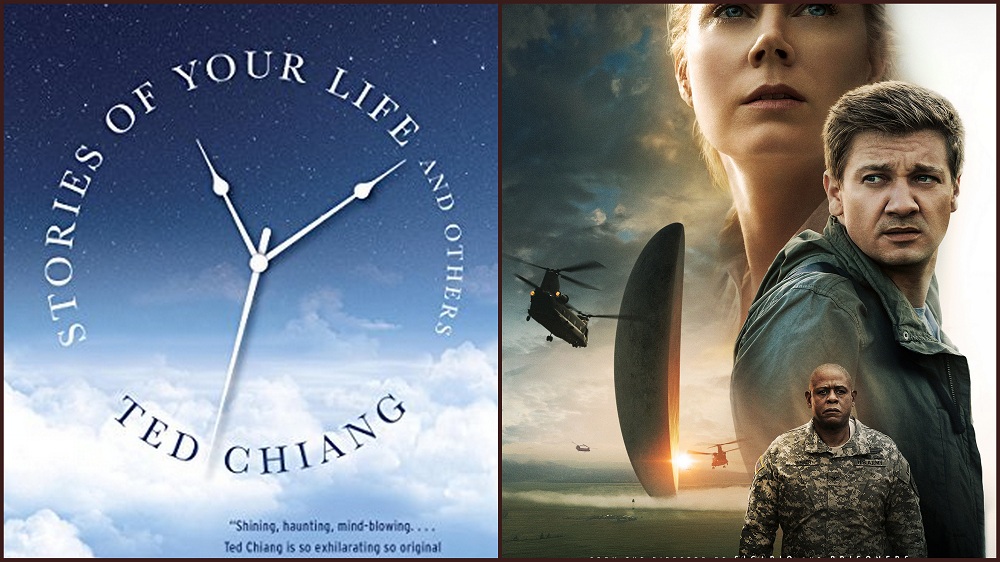
    semicircular alien spaceship from the movie 'arrival'
    This is the alien spaceship which land in different parts of the world. This image is a screenshot of the movie Arrival, which is based on this short story. (Photo Credit: Arrival Movie)

    Aliens initiate communication with humans and Dr. Banks and Gary Donnelly (who is a physicist) have been brought in to assist with the process.

    Aliens, whom people call ‘Heptapods’, because of their seven limbs and radially symmetrical appearance, communicate in a language that is nothing like any form of language (both written or verbal) that humans have ever known.

    Louise and Gary are assigned to 9 “looking glass” sites (that’s what humans call the sites where these spaceships have landed) and start to work with them to understand their language in order to be able to communicate with them.

    They work with two aliens, whom they nickname Flapper and Raspberry.

    Through a series of conversations with them, Louise realizes that their written and spoken words are not related to each other at all! She and her group refer to speech as “Heptapod A” and the written form of the language as “Heptapod B”.

    Through a series of experiments that Louise and her team run to understand the aliens’ language, both in linguistics and physics, they infer that the alien language has a ‘free word order’. In addition to that, their language does not seem to have any linear sequence making it even more complicated to understand.

    Not much progress is made until one day Gary explains Fermat’s ‘principle of least time’ to Louise. From this fresh understanding, it dawns upon Louise that similar to the light in Fermat principle (where light knows exactly where it will end up before it chooses its path of travel), aliens know their full sentences beforehand.

    Instead of experiencing events sequentially, they experience all of them at once, hence confirming why the Fermat principle resonated with them so much.

    Armed with this knowledge, Louise becomes proficient in Heptapod B quickly, but it also alters her understanding of reality. She observes that her train of thought is now absurdly directionless.

    She experiences complete immersion in Heptapod B and starts to think in it and perceives time the same way as Heptapods do. She now sees glimpses of a future, a daughter she does not yet have, her daughter’s death and a life she doesn’t have yet.

    One day, the aliens announce that they are leaving. They shut down the looking glasses and disappear. It is never established why they came and why they left, although there were rumors flying around that implied that they found human race to be too primitive to be of interest to them.

    This knowledge of the heptapod language changes Louise’s life. She knows the future now, but does nothing to alter it.

    She knows that she is going to end up together with a man, have a daughter and will lose her when she is still young. Despite this knowledge of her future, she goes on ahead with her life, changing nothing.

    Flash back to the present, when Gary asks her if she wants to make a baby, she says yes.

    Want to read Story of Your Life by Ted Chiang?

    Story of Your Life is a short story which is published in a collection of short stories written by Ted Chiang. You can use the links given below to buy this short story collection on Amazon:

    Check Price on Amazon US
    Check Price on Amazon Canada
    Check Price on Amazon India

    Story of Your Life: Review and Analysis

    Story of Your Life has won numerous awards for Ted Chiang, including the prestigious Hugo award. Mr.Chiang has this innate ability to convert extremely dense topics to something that you can not only comprehend, but think and marvel at the new perspectives that it brings.

    a scene from the movie 'arrival'
    A still from the movie ‘Arrival’ – it is based on A Story of Your Life

    This story brings the debate of free will and determinism to the fore. The portrayal could not have been any more gripping and profound than it is. The story shines in its intellect and humaneness.

    It has got rich material that will keep both the dreamer and scientist hooked.

    Consider for example, how Chiang has broken down the concept of Fermat’s principle:

    “Any hypothetical path would require more time to traverse than the one actually taken. In other words, the route that the light ray takes is always the fastest possible one.”

    The way that he has married science with philosophy in his story is remarkable. He is known to have remarked once: “Science fiction is very well-suited to asking philosophical questions; questions about the nature of reality, what it means to be human, how do we know the things that we think we know.”

    The clarity with which he has presented the linguistic challenges, realizations and the character epiphanies are spellbinding. It speaks to the amount of research that must have gone towards this immaculate description of a linguists approach towards a new language.

    And the biggest sentences had an effect similar to psychedelic posters : sometimes eye-watering, sometimes hypnotic.

    7 Quotes from Story of Your Life

    Here are some quotes from A Story of Your Life that I absolutely loved:

    1 – Whether scientists or tourists they were an awfully incurious bunch.

    (Referring to the aliens who had landed in different parts of the world but didn’t seem to do anything after they had landed)

    It might be the woman in me talking but I found the depiction of mother-daughter relationship extremely heart-warming. At those specific instances in the story I forgot that I was reading science fiction.

    Here are some quotes through which the author depicts the beautiful mother-daughter relationship:

    2 – Even if I had never laid eyes on you before, I would be able to pick you out from a sea of babies: Not that one. No, not her either. Wait, that one over there. Yes, that’s her. She is mine.

    3 – It will be like growing an errant limb, an extension of myself whose sensory nerves report pain just fine, but whose motor nerves do not convey my commands at all. It’s so unfair. I am going to give birth to an animated voodoo doll of myself. I didn’t see it in the contract when I signed up. Was this part of the deal?

    arrival movie cast amy adams jeremy renner
    A still from the movie ‘Arrival’ – it is based on A Story of Your Life

    4 – My own mother could never understand why I couldn’t just be a high school English teacher. You’ll do what makes you happy and that’s all I ask for.

    5 – Living with you will be like aiming for a moving target, you will always be further along than I expect. All those vows that I will give reasonable answers when I became a parent, that I would treat my own child as an intelligent, thinking individual,all for naught, I am going to turn into my mother.

    6 – I can fight it as much as I want, but there will be no stopping my slide down that long dreadful slope. Not to forget a little lesson in mindfulness that Ted threw in there as a bonus read-

    7 – And the lesson in mindfulness – NOW is the only moment you will perceive; you will live in the present sense. In many ways, it’s an enviable state.

    And there is always this overarching message in this book, which he very nicely intrigues us with using the Book of Ages ages and the fallacy of the argument that it exists, leaving us with this gem on his favorite topic of free will vs determinism.

    8 – From the beginning I knew my destination and I chose my route accordingly. But am I working toward an extreme of joy, or of pain. Will I achieve a minimum, or a maximum?

    James Gleick, an American author, speaking about The Story of Your Life once said, “For us ordinary mortals, the day-to-day experience of a preordained future is almost unimaginable.

    But Chiang does just that in this story, and with this brings the hope and faith that our present is all the more enriched with authors like him around.”

    Mr Gleick couldn’t have been more right.

  • Drunken Fireworks by Stephen King: Summary, Analysis and Review

    Drunken Fireworks by Stephen King: Summary, Analysis and Review

    Drunken Fireworks is a short story written by Stephen King. It was first released as an audio book in 2015 as one of the stories in a short fiction novel titled The Bazaar of Bad Dreams. 

    Stephen King mentions an anecdote with this short story, wherein an old woman, recognizing him at a grocery store, told him that she does not like horror stories.

    He did clarify that horror was not the only genre that he has written in. He mentions that he loves to read and write stories that are funny and it shouldn’t surprise anybody, because humor and horror are Siamese twins “you write some scary stories and you’re like the girl who lives in the trailer park on the edge of town: you get a reputation.”

    Too bad that he didn’t write humor as much; because going by what this story offers, we can do as much with King’s humor as with horror, if not more.

    Drunken Fireworks: Summary and Plot Analysis

    The story is narrated by Alden McCausland, who has been taken into custody by the Castlecounty police.

    Alden lives with his mother, and they are what he calls themselves – idle rich, having recently acquired a lot of wealth from his father’s demise followed by a lottery win.

    Both Alden and his mother have comfortably settled in a life that usually involves them spending a lot of time idling around and drinking. They spend most of their summers at Lake Abenaki.

    Their neighbors, on the other side of the lake, are an Italian-American family – The Massimo. They are very rich and owe their wealth to a very successful construction business.

    The McCauslands, however, do not think much of them.

    Thanks to them being Italian and operating a business out of Rhode Island, they are obviously connected to the Mafia, in the eyes of McCauslands.

    Starting from one fateful day of 4th of July celebrations, both families engage inadvertently in what came to be called the “4th of July Arms race”.

    What ensues is an insane game of McCauslands and Massimos going to great lengths to one-up their neighbors. Being ‘trumped’ by the Massimos on almost all occasions, Alden and his mother become more and more desperate to win the next showdown.

    Their desperation takes Alden to forge new connections himself – going to the extent of sourcing “Close Encounters of the Fourth Kind” or “GE4” – illegally.

    In the ensuing showdown, completely oblivious to the dry summers that Castle county had that year, Alden launches the GE4, only to witness that the fireworks go further than the intended purpose of showing Massimos who’s the boss.

    A shift of wind sets the pine trees around Massimo’s house on fire. Soon after, flames engulf the house and destroy it.

    Alden is then arrested by the police.

    fireworks in night sky
    The story Drunken Fireworks has a lot to do with fireworks… duh!

    The police, upon receiving a full statement from Alden, lets him know that Massimo will not be pressing charges, considering that they were also accountable for taking the arms race to ridiculous proportions, eventually leading to damage.

    Alden is not convicted but soon comes to know that his cabin is burned down too and the cause was attributed to his carelessness, keeping the fireworks too close to the stove. He is advised that getting along with that story, and having insurance pay for the damages is the best course of action for him.

    Drunken Fireworks: Analysis and Review

    The story has humor written all over it. Be it Alden’s complete insensitivity to other

    Cultures or his mom avoiding ‘alcohol abstinence’ like leprosy.

    The story is not devoid of time-tested wisdom either. Consider the following for an example:

    “I guess a lot of Ma’s weight gain had to do with coffee brandy, they don’t call it fat ass in a glass for no reason. But she said she was never Miss America to begin with.”

    We have all seen someone like that – family or friend – haven’t we? Oh forget all that , how much it reminds me of myself!

    Look here:

    “something’s gonna kill everyone, am I not right? Doctors have a way of forgetting that but Ma knew.”

    I noticed two things in that statement- the way I have seen our dear elderly folks try to brush off requests for making some healthy changes to lifestyle and the creative excuses that they come up with to counter them and Alden’s dog-like devotion to her mom.

    “..but they were Italian, and Massimo construction was based in Providence, Rhode Island, and you’re cops, you can connect the dots. And Ma always used to say if you put two and two together, you never get five.”

    A sharp comment on the number of babies of Massimos:

    “Massimos must have had half a dozen babies, and they wore colors so bright, they burn your eyes if you looked at them too long.”

    The next one here makes me laugh every time I read it:

    “Someone ought to dip that trumpet in olive oil and stick it up his ass. He could fart out ‘God Bless America.’”

    Alden’s blatant disregard towards his Italian neighbors is so disgusting yet hilarious.

    Some motivational quotes from Drunken Fireworks

    There were a few motivational gems referenced in the story as well. Consider the ones listed below:

    “It ain’t the size of the dog in the fight but the size of fight in the dog.”

    Then there’s this:

    “I didn’t bother telling her no made up story, because she always sees through them and has since I was knee-high to a collie.”

    This one did elicit an aww from me. The mother-and-son relationship shown in this is the only glimpse of love that you get, hiding behind all the humor and stupidity of the characters.

    Mr King does not write humor much and I don’t see why.